Cosmic Conservative

Rational Conservatism from the heart of America

Rock and a hard place...

By CosmicConservative
So we want to move. We live in the mountains where home prices have been hammered even more than in the metro area. Our home is currently estimated to be worth roughly 10% less than when we bought it over eleven years ago. Yeah, so much for the whole concept of building wealth through home equity. Back when home prices actually were increasing, we foolishly refinanced in part to pay for our daughter's college (before we started just borrowing tons of money for that purpose). So our current equity position on the house is such that even if we could sell it for the general estimated value of the house, we would barely walk away with any cash at all. And of course we'll have to buy a new house with a paltry down payment. So my current outlook on the potential to complete the process of selling this house and moving is not looking very positive.

Newt? Seriously?

By CosmicConservative
Definitely caught me by surprise. However, I think this is an excellent example of my comments about how Romney does not excite people. He can't even beat Newt Gingrich after ABC screams headlines around the world how Newt wanted an "open marriage?" This is not going well.... Obama is probably celebrating with some more of that $800 steak and $3,000 wine tonight...

Co-existent species of man

By CosmicConservative
I think about this more than I should probabaly. In truth I'm fascinated by what we think we know about the history of the human genome. And this once plodding area of scientific study has become one of the more active and interesting areas of paleology, archaeology and the intersection of the two (sometimes called "paleo-archaeology"). Here's the thing... We think of the world today as being populated by a multitude of races of humans, which is true, but the overall differences between any two modern human races is far less, genetically, than the difference that occurs within a race itself. Or to put it another way, it's somewhat scientifically valid to challenge the idea of "races" at all. There are just local variations of one race, one species. That's especially true when you think of what modern science believes was the case just 50 - 100,000 years ago. Or, you could argue, all the way back to perhaps two million years ago. In other words, through the vast majority of the existence of the human race. It is generally known, but rarely thought about, that modern humans (once called "cro-magnon man") co-existed with homo neandertalis, or "neanderthal man". I've posted on this before in one of my most popular posts, "The Truth About Trolls". In that post I argue that human culture has propogated the memory of life among neanderthals as stories and myths about "trolls". I firmly believe this to be true. But the latest discoveries in the field indicate that for most of human existence there have been as many as six different "human" species, and that the neanderthals were perhaps the closest to modern human of them all. (In fact modern human DNA contains roughly 2.5% of Neanderthal DNA.) Since neanderthals were closer to humans than most of the other species, it stands to reason that the other species were even more "alien" looking than neanderthals (which does not seem to have stopped humans from interbreeding with some of them). One co-existant group was the recently discovered "hobbit" species of three foot tall humanoids who lived off the coast of southeast Asia up to 17,000 years ago. That's pretty recent, almost reaching historical times. So consider that at one point in human history, well after humans had established domestication of animals and begun primitive agriculture, and in some cases had even begun to aggregate in large communities and build large structures, humans could have interacted with as many as five different humanoid species. Since at least two, and potentially three, of those contributed to modern DNA, this interaction included sexual activity so it's fair to assume that it probably involved trade of some sort. I am seriously thinking about writing a book set in those times. Of course it would be almost entirely speculative since of those different species we only know the morphology of two of them (neanderthals and hobbits) and we know virtually nothing about their culture (but we know they all made and used tools and wore jewelry), but still, this isn't fantasy, these species truly co-existed and interacted with each other. At one time this planet had multiple "intelligent" species on it.

Entering the 'Atlas Shrugged' era

By CosmicConservative
So... I am pretty well convinced that this country has crossed the border from the fertile heartland of opportunity to the barren wastelands of the Atlas Shrugged zone. So the question is, what sort of career path should the Cosmic Children follow in a Shrugging Atlas world? I mean there's the obvious "take what the state gives you" path, which is what the state actually wants you to do anyway, and for as long as the idiots running the world can steal from the future, there's still some quality of life level in that approach. I wouldn't do it, but lots of people will. Or there's the Henry Reardon approach, which would be to fight against the flood of incompetence and dependence for as long as possible. That's a principled path, and one that would make any parent proud. Or there's the "plod along in the role of prole" approach where you "work" for a government approved wage at a government approved job... I suppose that's better than being a leech. Or there's the "figure out how to become a permanent student and let the government take care of your debt" approach, which has its own appeal, but I think that gravy train will be one of the first ones to dry up. What else is there?

I'm guessing William Macy will play the Captain in the movie...

By CosmicConservative

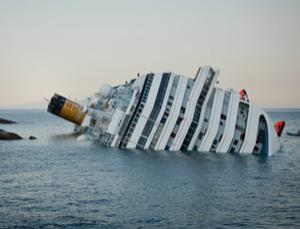
One of Europe's largest cruise ships, the Costa Concordia, carrying 4200 passengers and crew, suffered a fatal and spectacular accident on Saturday. The vessel was holed on rocks off the Italian island of Giglio – and then quickly keeled over, preventing lifeboats on its port side from being lowered and trapping some passengers and crew in the bowels of the ship. At 12:00 GMT today, six people had been confirmed dead and a further 15 were missing. So how stable and safe are these vertiginous floating multistorey hotels?

via How stable are cruise ships like the Costa Concordia? - tech - 16 January 2012 - New Scientist.

This is the sort of story that I get fascinated by. Everything about this story flies in the face of what should happen. That ship should never have been that close to shore. That shore should have impeccably accurate GPS mapping. That ship should have the latest state-of-the-art sonar mapping. The ship should never have listed so badly so quickly. The Captain should never have abandoned his ship, crew and passengers to chaos and panic. How could so many terrible things go so badly wrong in so short a time? Then I look at the pictures and the ship is just meters off the shore, and eleven people died? Maybe more? Maybe Rosie O'Donnell will play the Captain.

The Romney train rolls on...

By CosmicConservative
So, I long ago predicted that Mitt Romney was the likely Republican nominee. My concerns about Mitt being electable have been well noted here. But it is what it is, and we are now going to have to ride the Romney train into November. But that just cements this election as being all about Obama. Romney simply is not an exciting candidate who will energize swing voters to vote for him. A Republican win is going to rely entirely, and I mean ENTIRELY on the voters deciding to fire Barack Obama. I hope they do. But I wonder how many people truly realize what a disaster for this nation Obama has been. I doubt enough do, and those who waffle will be pushed hard by the media to believe that the Republicans are to blame for four of the most disastrous years of my lifetime, in spite of Democrats controlling the entire US Government for two of those years, and controlling 2/3 of the US Government for the other two years. I suppose a Mitt Romney presidency will slow the headlong rush off the cliff of financial ruin from supersonic to subsonic speed. Or at least I hope so. But it sure ain't gonna reverse the direction of that train....

Phantom Menace in 3d

By CosmicConservative
Saw the trailer this weekend... Couldn't help but think "3D graphics? But that's two more D than the plot or acting."

Broncos season wrap-up

By CosmicConservative
I happened to be having a conversation Sunday about the Broncos playoff run. Of course you can't do that without discussing Tim Tebow, and there was significant doubt expressed by one party about Tebow's ability to play in the NFL. My response was: "If I had promised you after the Detroit game (another 45-10 loss) that by the end of the season Tim Tebow would have more than 450 yards passing AND more than 100 yards rushing in the playoffs, would you have been happy?" His reply was "well, of course." "Well then, be happy." I certainly hope that common sense and perspective prevails among the Denver Broncos' front office and coaching staff if nowhere else. I think Tebow is a potential top-tier QB, and one who presents unique challenges for opposing defenses. But for Tebow to be successful he needs receivers who can get open and catch the ball, an offensive line who can protect the QB, and running backs who can present a threat on their own, without relying on Tebow himself as a decoy to break them free. On the defensive side they need to upgrade their secondary and they need to get some pass rushers. The bottom line is that the Broncos seriously over-performed this season. There is no way this team ends up playing a divisional playoff game without some luck and gritting out some games most teams would have lost. As much as I love that grittiness, you can't depend on that formula in the long run. They need talent at several key positions. I just hope the coaching staff understands that. I'm not sure they do.

More planets than stars in Milky Way

By CosmicConservative
This isn't really news to most folks who have paid any attention to astronomy or cosmology. It's more of a confirmation of what most experts have suspected for a couple generations now, ever since the stellar lifecycle models were proposed and passed most reasonable observational tests.
WASHINGTON (AP) — The more astronomers look for other worlds, the more they find that it is a crowded and crazy cosmos. They think planets easily outnumber stars in our galaxy and they are even finding them in the strangest of places. And they have only begun to count. Three studies released Wednesday, in the journal Nature and at the American Astronomical Society's conference in Austin, Texas, demonstrate an extrasolar real estate boom. One study shows that in our Milky Way, most stars have planets. And since there are a lot of stars in our galaxy — about 100 billion — that means a lot of planets.
It is nice to see this public acknowledgement that planets are common in the Milky Way (probably well over a trillion planets just orbiting stars. Who knows how many "rogue planets" are roaming around in interstellar space. By some estimates that number might even be bigger than the number of star orbiting planets.) However, even through the filter of crappy science reporting, there's still something that I've never seen addressed in any story about planets, and that's the vastly increased likelihood of earth-like bodies capable of supporting life. See, the thing is that the stellar lifecycle models don't just predict that most stars probaby have a dozen or so planets (like our own system) but that a large fraction of those planets are gas giants. And that is what we are seeing when we find planets orbiting other stars. What did surprise cosmologists and astronomers when the first observational confirmation of planets orbiting other stars came in was how many of these gas giant planets are in close orbit to their stars. The assumption was that most stellar systems would resemble our own solar system, with rocky small planets close to the star and larger gas giants further out. That doesn't seem to be the case though, at least so far. The majority of systems we see have large gas giant planets in orbits more like Mercury, Venus or Earth. So of course the idiots who call themselves science reporters bemoan that those planets are not "earth-like" and therefore are not candidates for looking for "alien" life. But nothing could be further from the truth. See, the stellar lifecycle models don't just predict that stars have planetary systems. They also predict that gas giants have moon systems, and that those moons can be equal in size to what we think of as planets. So for every gas giant that is in close orbit to its sun, there is a fairly high probability that "hot Jupiter" has a collection of moons that could easily be the size of Mercury, Mars or even Earth. Using our own solar system as a model, we have eight acknowledged "planets". However those eight planets have over a hundred moons, and at least eight of those moons would qualify as planets if they were in orbit around the sun by themselves. So that means we should essentially not only DOUBLE the estimate of the number of possible life-supporting objects, we should actually QUADRUPLE that estimate since virtually all such "moons" are rocky bodies more resembling earth than gaseous bodies resembling Jupiter or Uranus. So if half of the trillion or so "planets" now estimated to be in stellar orbits are gas giants, then there are likely TWO trillion planetary-sized objects with earth-like composition. How many of those would be in the Goldilocks zone? Meaning how many would there be where water could exist in a liquid state on the surface? Well, that's still a guess, but based on what I've seen from the data so far, probably five percent of the planets discovered so far would be in that zone, but the vast majority of them are "hot Jupiter" type objects. By the way, that's not necessarily because most planets in their star's "goldilocks zone" are gas giants, that's basically because our planet-detection process is still far more likely to find massive bodies in close orbit to stars than smaller bodies, or massive bodies in larger orbits. Anyway, just throwing my own personal guess at things, I would guess that most stars have SOMETHING orbiting in their goldilocks zone. Some of those objects will be earth-like planets, some will be asteroid-like bodies and some will be gas giants with their own collection of moons. So my guess is that there's likely to be a near one-to-one relationship between stars and rocky bodies capable of having liquid water on their surface. Which puts the total number of such bodies into the hundreds of billions in our galaxy alone. Now, if we plug that into the Drake Equation, that vastly increases the odds of there being alien life in our galaxy, which would therefore greatly increase the odds that there is intelligent life in the galaxy, which then greatly increases the odds that there are technologically advanced beings in our galaxy.... But then that takes us right to the Fermi paradox. "Where the hell are they then?" By the way, using the standard of a potential life-supporting body being something large enough to have differentiated its composition and that composition being mainly of "rock", our solar system has 27 such bodies currently known. Two of them orbit in the Goldilocks zone today. Mars and Venus are both right on the edge of that zone, and in the past and future both of them have been or will be in the Goldilocks zone. That means our solar system has four bodies that would merit close examination as potential life-bearing bodies if we were to be examined from some other vantage point outside our own solar system. Four. I'm guessing that might be a pretty common number of potentially life-bearing planets for most stars. That means that roughly 15% of bodies of earth-like composition with reasonable surface gravity in our solar system are, have been or will be in the "Goldilocks zone" of our own star. That would mean if there are two trillion such objects in the galaxy, and our solar system can be used as a model, there should be roughly 300 BILLION Goldilocks zone inhabiting earth-like bodies in the galaxy. My personal guess is that life is actually pretty common in the galaxy.