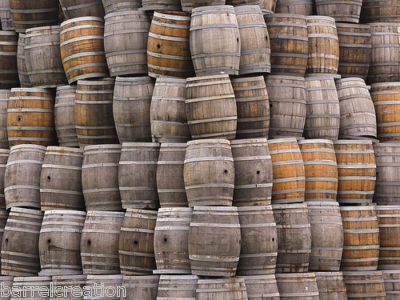
 A barrel maker is known in the trade as a "cooper." (Heh, so if I'm making miniature scale models of barrels, I suppose that makes me a "mini-cooper"....)
Coopers were one of the original trades, alongside trades like "smithing" or "tailoring" etc. Which is why you see "Cooper" as a fairly common surname in English-speaking cultures.
And as with those other trades, the development of barrel making was a major cultural turning point in human society. Seriously. Major turning point.
Why is that? Well, for several reasons. First of all barrels and other cooper-made objects (washtubs, pails, butter churns, etc) were the first reliable mass-produced containers for large amounts of liquids. (Or, conversely, large amounts of things that must be kept dry, like iron nails, or salted meat).
Anthropologists and historians have theorized that coopering is a direct offshoot of ship-building, since both trades require the careful shaping and bending of wooden staves. I wouldn't be too terribly surprised if the trade evolution didn't travel in the other direction, and coopering led to the development of complex board-bending in the ship-building trade. We'll probably never know. But in my experience these sorts of technology things tend to scale UP, not scale DOWN, meaning it is far more likely to me that someone was looking at a barrel maker and thinking "crap! that would make it much easier to build my ships!" than someone was looking at a shipyard and thinking "wow! I could really use that to develop a liquid-proof container!"
Not that it matters... But beyond the simple fact of the ubiqutious utility of the lowly barrel, it turns out that barrel making itself is a significantly difficult task, which is why it was an actual trade for thousands of years. Why is it so difficult? There are two main reasons that barrels are not trivial to construct. The first is that in order to get a watertight seal, the barrel maker has to carve and shave the staves to very high levels of accuracy. Most traditional barrels did not use any sort of adhesive to keep the staves together, instead they relied on the tightness of the joins between the staves and the fact that wood swells when it gets wet, which means that the container is essentially self-sealing if the staves are sufficiently well joined. Secondly, since the liquid being transported soaks into the barrel staves, any sort of adhesive leeches out into the liquid. Since one of the main purposes of barrel making since antiquity to the present day is to store and transport alcoholic beverages, using adhesives taints the flavor (and potentially potability) of the beer, ale, wine or bourbon being transported. So no adhesives, please.
The other thing about barrels that is perhaps not clearly understood is that they are shaped the way they are for a very important reason. Barrels are designed to be transported with the minimum amount of effort possible. That means they are designed to roll. But a simple cylinder would "roll" just fine, so why does the barrel have it's distinctive "barrel" shape, with the convex belly? Well, because that turns out to be the optimal design for a contanier which can be rolled and turned in any direction with a minimum of effort. A cylinder of sufficient size and weight is very difficult to turn around a corner, and will create enough friction that it would eventually wear huge gouges in warehouse floors. Barrels can turn on a dime, allowing them to navigate through warehouses, up ramps, onto ships, etc.
It was the development of barrels which allowed for trade to carry massive amounts of beer, ale, salted goods, etc across the ancient world. Not just because the containers were waterproof (although that is a huge consideration) but also because they could be loaded and unloaded with a minimal number of workers, with the maximum amount of maneuverability.
In short, barrels are an amazing technological development and I suspect if anyone really delved into the anthropology and history of them, you would see civilization following barrels across the world. I don't think that's a coincidence...
Barrelling along...
By CosmicConservativeSo, some of you might follow my gaming blog, and if so you know that I've been working lately on small modular terrain items to spruce up a game board for game play.
Well, one of the things that I've been planning to make, and am now prototyping, are scale models of barrels of various sizes.
So, because I'm insane about these things, I've been researching barrel making.
It's truly a fascinating subject.
A barrel maker is known in the trade as a "cooper." (Heh, so if I'm making miniature scale models of barrels, I suppose that makes me a "mini-cooper"....)
Coopers were one of the original trades, alongside trades like "smithing" or "tailoring" etc. Which is why you see "Cooper" as a fairly common surname in English-speaking cultures.
And as with those other trades, the development of barrel making was a major cultural turning point in human society. Seriously. Major turning point.
Why is that? Well, for several reasons. First of all barrels and other cooper-made objects (washtubs, pails, butter churns, etc) were the first reliable mass-produced containers for large amounts of liquids. (Or, conversely, large amounts of things that must be kept dry, like iron nails, or salted meat).
Anthropologists and historians have theorized that coopering is a direct offshoot of ship-building, since both trades require the careful shaping and bending of wooden staves. I wouldn't be too terribly surprised if the trade evolution didn't travel in the other direction, and coopering led to the development of complex board-bending in the ship-building trade. We'll probably never know. But in my experience these sorts of technology things tend to scale UP, not scale DOWN, meaning it is far more likely to me that someone was looking at a barrel maker and thinking "crap! that would make it much easier to build my ships!" than someone was looking at a shipyard and thinking "wow! I could really use that to develop a liquid-proof container!"
Not that it matters... But beyond the simple fact of the ubiqutious utility of the lowly barrel, it turns out that barrel making itself is a significantly difficult task, which is why it was an actual trade for thousands of years. Why is it so difficult? There are two main reasons that barrels are not trivial to construct. The first is that in order to get a watertight seal, the barrel maker has to carve and shave the staves to very high levels of accuracy. Most traditional barrels did not use any sort of adhesive to keep the staves together, instead they relied on the tightness of the joins between the staves and the fact that wood swells when it gets wet, which means that the container is essentially self-sealing if the staves are sufficiently well joined. Secondly, since the liquid being transported soaks into the barrel staves, any sort of adhesive leeches out into the liquid. Since one of the main purposes of barrel making since antiquity to the present day is to store and transport alcoholic beverages, using adhesives taints the flavor (and potentially potability) of the beer, ale, wine or bourbon being transported. So no adhesives, please.
The other thing about barrels that is perhaps not clearly understood is that they are shaped the way they are for a very important reason. Barrels are designed to be transported with the minimum amount of effort possible. That means they are designed to roll. But a simple cylinder would "roll" just fine, so why does the barrel have it's distinctive "barrel" shape, with the convex belly? Well, because that turns out to be the optimal design for a contanier which can be rolled and turned in any direction with a minimum of effort. A cylinder of sufficient size and weight is very difficult to turn around a corner, and will create enough friction that it would eventually wear huge gouges in warehouse floors. Barrels can turn on a dime, allowing them to navigate through warehouses, up ramps, onto ships, etc.
It was the development of barrels which allowed for trade to carry massive amounts of beer, ale, salted goods, etc across the ancient world. Not just because the containers were waterproof (although that is a huge consideration) but also because they could be loaded and unloaded with a minimal number of workers, with the maximum amount of maneuverability.
In short, barrels are an amazing technological development and I suspect if anyone really delved into the anthropology and history of them, you would see civilization following barrels across the world. I don't think that's a coincidence...
Comments (0)
No comments on this post.