 You are allowed to tour virtually the entire ship, even down to the lowest deck where the hull is full of thousands of rusting iron bars used as ballast to keep the ship stable in heavy seas.
Touring the ship tought me some interesting things about sailing the high seas in the US Navy 150 years ago. It also brought home to me some of the things I have known about such ships for a long time, but actually seeing it in real life brings the message home much more vividly than just reading about it or seeing a documentary on TV.
Walking around on the ship it is very difficult to imagine such a small vessel with such crowded and cramped quarters actually holding over 200 men for months at a time at sea. The officers quarters were roughly the size of a bedroom closet and contained either a bed or a hammock and a small dresser with a fold down desk. The quarters had a door, however, and this provided officers with some degree of privacy. The non-officers had nothing but a hammock which was frequently shared with other seamen who worked a different shift, so the non-officers had nothing but their bundle of belongings which was truly their own.
The Captains quarters were quite frankly obscenely large when compared with the quarters of the rest of the officers. The captain even had his own private restroom, which was alone as large as most of the officer's quarters. The officers area was separated from the rest of the ship by a partition and doors. There was a large table where the officers and captain would eat, and another large table on the other end of the ship where the rest of the crew would eat.
The economy of space in the ship was remarkable. A spare mast was held on the main deck by large wooden clamps, and there were spares for the crossbeams that carried the sail from the mast.
The quality of the woodwork on the ship was also remarkable. The builders of this ship obviously took great pride in their work. The wood was of a very high quality, with most of the structural elements of the ship made with oak and the flooring and facings done in white pine. The masts, however, looked to me to be made of spruce, but the legend describing which woods were used on the ship neglected to list the masts, so I am going by my limited ability to recognize wood here. I'm pretty sure they were spruce though.
The ropes and rigging are things of beauty. The Cosmic Son asked how a crewmember would get up to the crow's nest and seemed unconvinced when I showed him the rigging and said the crew mostly climbed around on the rigging for a variety of on-ship tasks. Visualizing several sailors climbing around on the rigging in heavy seas gave me a moment of vertigo, frankly. But that's what they did.
Contemplating the reality of 200 men living on that ship helps one to understand the absolute authority a captain needed to weild to keep the ship in line. Putting that many young men that close together for that long, it is inevitable that conflict will arise. Authority would need to be near absolute to maintain discipline under the conditions met at sea.
When the USS Constellation was commissioned there were no motors or electricity in use in the Navy. The ship sailed on pure wind power and the muscle and sweat of the crew. The entire ship was nothing but wood, ropes and cannon. That's all it was.
There was a story I once read of an English warship of the 17th century which was caught in a hurricane and all three of its masts were snapped, and the ship was run aground on the shore of New Jersey or somewhere like that. If I recall, the ship was tossed so much that even their spare mast was lost, and the ship was reduced to a broken mass of floating timbers.
It took several months but the crew of that ship rebuilt her and sailed her back to England. Using nothing but hand tools, ropes and pulleys, the crew rebuilt an entire ship, replacing the broken masts with spruce cut down in the forest and using local wood to replace timbers and bracing, as well as to repair the flooring and the hull.
Imagine trying to do that today with a modern cruiser...
There was a lot to admire in the men who sailed those ships. Those men may have been many things, but they were demonstrably brave and resourceful men who were up to almost any challenge.
Thoughts on the USS Constellation
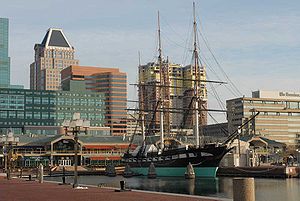
By CosmicConservativeThis is the ship we toured in Baltimore's "Inner Harbor."
You are allowed to tour virtually the entire ship, even down to the lowest deck where the hull is full of thousands of rusting iron bars used as ballast to keep the ship stable in heavy seas.
Touring the ship tought me some interesting things about sailing the high seas in the US Navy 150 years ago. It also brought home to me some of the things I have known about such ships for a long time, but actually seeing it in real life brings the message home much more vividly than just reading about it or seeing a documentary on TV.
Walking around on the ship it is very difficult to imagine such a small vessel with such crowded and cramped quarters actually holding over 200 men for months at a time at sea. The officers quarters were roughly the size of a bedroom closet and contained either a bed or a hammock and a small dresser with a fold down desk. The quarters had a door, however, and this provided officers with some degree of privacy. The non-officers had nothing but a hammock which was frequently shared with other seamen who worked a different shift, so the non-officers had nothing but their bundle of belongings which was truly their own.
The Captains quarters were quite frankly obscenely large when compared with the quarters of the rest of the officers. The captain even had his own private restroom, which was alone as large as most of the officer's quarters. The officers area was separated from the rest of the ship by a partition and doors. There was a large table where the officers and captain would eat, and another large table on the other end of the ship where the rest of the crew would eat.
The economy of space in the ship was remarkable. A spare mast was held on the main deck by large wooden clamps, and there were spares for the crossbeams that carried the sail from the mast.
The quality of the woodwork on the ship was also remarkable. The builders of this ship obviously took great pride in their work. The wood was of a very high quality, with most of the structural elements of the ship made with oak and the flooring and facings done in white pine. The masts, however, looked to me to be made of spruce, but the legend describing which woods were used on the ship neglected to list the masts, so I am going by my limited ability to recognize wood here. I'm pretty sure they were spruce though.
The ropes and rigging are things of beauty. The Cosmic Son asked how a crewmember would get up to the crow's nest and seemed unconvinced when I showed him the rigging and said the crew mostly climbed around on the rigging for a variety of on-ship tasks. Visualizing several sailors climbing around on the rigging in heavy seas gave me a moment of vertigo, frankly. But that's what they did.
Contemplating the reality of 200 men living on that ship helps one to understand the absolute authority a captain needed to weild to keep the ship in line. Putting that many young men that close together for that long, it is inevitable that conflict will arise. Authority would need to be near absolute to maintain discipline under the conditions met at sea.
When the USS Constellation was commissioned there were no motors or electricity in use in the Navy. The ship sailed on pure wind power and the muscle and sweat of the crew. The entire ship was nothing but wood, ropes and cannon. That's all it was.
There was a story I once read of an English warship of the 17th century which was caught in a hurricane and all three of its masts were snapped, and the ship was run aground on the shore of New Jersey or somewhere like that. If I recall, the ship was tossed so much that even their spare mast was lost, and the ship was reduced to a broken mass of floating timbers.
It took several months but the crew of that ship rebuilt her and sailed her back to England. Using nothing but hand tools, ropes and pulleys, the crew rebuilt an entire ship, replacing the broken masts with spruce cut down in the forest and using local wood to replace timbers and bracing, as well as to repair the flooring and the hull.
Imagine trying to do that today with a modern cruiser...
There was a lot to admire in the men who sailed those ships. Those men may have been many things, but they were demonstrably brave and resourceful men who were up to almost any challenge.
Comments (2)