 ... and even though I only got a trade-in of $750, I end up actually putting money in my pocket each month?
Yes, after a measly trade-in of $750 on my completely paid off Pathfinder, I will actually net about $20 in extra spending cash each month, and will likely net even more in the near future.
Here's how the math works:
I live 49 miles from my office. That's 98 miles of commute a day. Averaging five trips a week (I work from home on occasion, but I also go into town on weekends on occasion, so five trips is a pretty good average), that's 490 miles of commuting each week. That's 25,480 miles per year, or 2,123 miles per month (on average).
My Pathfinder got about 17 miles per gallon in summer, and about 15 mpg in winter when they change the blend to antagonize consumers during the cruel winter. We'll stick with 17mpg. Gas is currently about $3.50 a gallon in Denver, and rising. The cheapest I have seen in the past couple of weeks is $3.41, and the most I've seen is $3.95/gallon. I'll stick with $3.50, although all the experts are predicting $4.00/gal by Memorial Day and all through summer. At $3.50/gal that means I was spending $437.16 PER MONTH on gasoline.
Wow. And at $4.00/gal that will rise to $499.60 PER MONTH. And thats just MY commute. That's not counting trips my wife or daughter make into town.
I looked at that and thought "Wow, that's more than any car payment I've ever had, even on a new car." Then I started thinking about new cars with "good" gas mileage compared to my beat up, but paid for, Pathfinder.
So I did some Internet searching for the best highway gas mileage (since the vast majority of that driving is pure highway driving). And I discovered that there are cars that can get 40+ mpg on the highway. So I did a search for gas cars that get 40+ mpg and sorted them by price from lowest to highest.
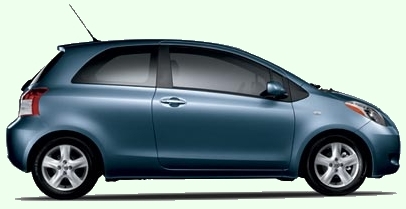
This was the cheapest one, the "Smart Car." I knew from looking last year that the Toyota Corolla was capable of 40+ mpg, so I expected the Corolla to be the cheapest Toyota option. But it wasn't; the cheapest was the car pictured above, the Toyota "Yaris". According to 2008 numbers it gets 36mpg, but that's using the governments new mpg calculations which factor in "average starts and stops" even on highway driving. But most of my driving is pretty much freeway conditions and reviews of the Yaris put it's highway gas mileage between 40mpg and 45mpg.
But let's go with the 36 mpg that the government says it gets. That's actually slightly better than twice the gas mileage of the old Pathfinder. Which means the gas to run it will cost less than half of the $437.16 per month that I was spending. In fact that would be $206.44 per month, a difference of $230.72.
At 40mpg the cost is $185.79 and the difference is $251.37.
The Yaris costs $13,800. With a trade in and a $500 rebate + tax, title and license, and with $1,000 for a 100,000 mile warranty and free service for three years it comes out to about $14,400 to finance at roughly 5.5% for 72 months (yes a six year loan). The monthly payment comes out to about $220/month. (I normally eschew extended warranties and service plans, but 36,000 miles for me is less than 20 months of driving, and I wanted to get more coverage than that. With a discount on the plan, and a lower interest rate as an incentive, it actually only increased the monthly payment by a few dollars.)
So gas + loan payment on the Yaris is roughly $420 (depending on gas mileage) while gas alone on the Pathfinder was roughly $440. Even at the lowest gas mileage expected for the Yaris, I'm making $20/ month.
Considering the warranty and free service for 3 years option, and all of the money I've been spending OUTSIDE of gas on the Pathfinder (things like fixing a broken radiator hose, a broken water pump, a lost boot on the front axle, etc) and the savings are EVEN BETTER. I've been averaging about $1,800 per year on repairs on the Pathfinder. Virtually all of those repairs would have been covered by a new car warranty. (I've only been fixing major things). That's ANOTHER $150/month I've been spending on the Pathfinder that I should not have to pay on the Yaris.
So basically buying a brand-new Yaris is like putting $170 - $200 (depending on actual gas mileage) in the bank every month. Plus I get a new car out of the deal that isn't constantly threatening to fall apart.
So I have one in the garage now, and no longer have the Pathfinder.
The downside? The Yaris is not four wheel drive. And it's not really a truck substitute. It's strictly a commuter car.
But it has been almost a decade since I've gone off-roading in any meaningful way, and all of my favorite fishing holes are easily reachable by our Subaru, or even the Yaris if it's not snowing. And as a front-wheel drive, it will do fairly well in snow, judging by our front-wheel drive van we had when we first moved up here.
I just don't understand why I didn't do this sooner.
What's wrong with my math? How can it be cheaper for me to buy a brand new car instead of continuing to drive an old, but paid for, car? It's bizarro world man.
Insurance is still a bit of an unknown, but 4WD off-road vehicles are not cheap insurance options, so I'm hoping it's not much of a boost to insurance, but even if it is more expensive, there's some room to maneuver before it's even a break-even proposition, and even if it does break-even, HEY, I've got a new car!
My lesson in freakonomics...
By CosmicConservativeWell, maybe it isn't REAL freakonomics, but it freaked me out.
The economy has gotten to the point that it has become insanely counter-intuitive.
Here's the deal. I had a fairly decrepit 1993 Nissan Pathfinder. It's been pretty decrepit for a while. In fact it's remained decrepit because it was paid for. Nothing was owed on it, and had not been owed for years.
So how is it that tonight I traded it in on this car...
... and even though I only got a trade-in of $750, I end up actually putting money in my pocket each month?
Yes, after a measly trade-in of $750 on my completely paid off Pathfinder, I will actually net about $20 in extra spending cash each month, and will likely net even more in the near future.
Here's how the math works:
I live 49 miles from my office. That's 98 miles of commute a day. Averaging five trips a week (I work from home on occasion, but I also go into town on weekends on occasion, so five trips is a pretty good average), that's 490 miles of commuting each week. That's 25,480 miles per year, or 2,123 miles per month (on average).
My Pathfinder got about 17 miles per gallon in summer, and about 15 mpg in winter when they change the blend to antagonize consumers during the cruel winter. We'll stick with 17mpg. Gas is currently about $3.50 a gallon in Denver, and rising. The cheapest I have seen in the past couple of weeks is $3.41, and the most I've seen is $3.95/gallon. I'll stick with $3.50, although all the experts are predicting $4.00/gal by Memorial Day and all through summer. At $3.50/gal that means I was spending $437.16 PER MONTH on gasoline.
Wow. And at $4.00/gal that will rise to $499.60 PER MONTH. And thats just MY commute. That's not counting trips my wife or daughter make into town.
I looked at that and thought "Wow, that's more than any car payment I've ever had, even on a new car." Then I started thinking about new cars with "good" gas mileage compared to my beat up, but paid for, Pathfinder.
So I did some Internet searching for the best highway gas mileage (since the vast majority of that driving is pure highway driving). And I discovered that there are cars that can get 40+ mpg on the highway. So I did a search for gas cars that get 40+ mpg and sorted them by price from lowest to highest.
This was the cheapest one, the "Smart Car." I knew from looking last year that the Toyota Corolla was capable of 40+ mpg, so I expected the Corolla to be the cheapest Toyota option. But it wasn't; the cheapest was the car pictured above, the Toyota "Yaris". According to 2008 numbers it gets 36mpg, but that's using the governments new mpg calculations which factor in "average starts and stops" even on highway driving. But most of my driving is pretty much freeway conditions and reviews of the Yaris put it's highway gas mileage between 40mpg and 45mpg.
But let's go with the 36 mpg that the government says it gets. That's actually slightly better than twice the gas mileage of the old Pathfinder. Which means the gas to run it will cost less than half of the $437.16 per month that I was spending. In fact that would be $206.44 per month, a difference of $230.72.
At 40mpg the cost is $185.79 and the difference is $251.37.
The Yaris costs $13,800. With a trade in and a $500 rebate + tax, title and license, and with $1,000 for a 100,000 mile warranty and free service for three years it comes out to about $14,400 to finance at roughly 5.5% for 72 months (yes a six year loan). The monthly payment comes out to about $220/month. (I normally eschew extended warranties and service plans, but 36,000 miles for me is less than 20 months of driving, and I wanted to get more coverage than that. With a discount on the plan, and a lower interest rate as an incentive, it actually only increased the monthly payment by a few dollars.)
So gas + loan payment on the Yaris is roughly $420 (depending on gas mileage) while gas alone on the Pathfinder was roughly $440. Even at the lowest gas mileage expected for the Yaris, I'm making $20/ month.
Considering the warranty and free service for 3 years option, and all of the money I've been spending OUTSIDE of gas on the Pathfinder (things like fixing a broken radiator hose, a broken water pump, a lost boot on the front axle, etc) and the savings are EVEN BETTER. I've been averaging about $1,800 per year on repairs on the Pathfinder. Virtually all of those repairs would have been covered by a new car warranty. (I've only been fixing major things). That's ANOTHER $150/month I've been spending on the Pathfinder that I should not have to pay on the Yaris.
So basically buying a brand-new Yaris is like putting $170 - $200 (depending on actual gas mileage) in the bank every month. Plus I get a new car out of the deal that isn't constantly threatening to fall apart.
So I have one in the garage now, and no longer have the Pathfinder.
The downside? The Yaris is not four wheel drive. And it's not really a truck substitute. It's strictly a commuter car.
But it has been almost a decade since I've gone off-roading in any meaningful way, and all of my favorite fishing holes are easily reachable by our Subaru, or even the Yaris if it's not snowing. And as a front-wheel drive, it will do fairly well in snow, judging by our front-wheel drive van we had when we first moved up here.
I just don't understand why I didn't do this sooner.
What's wrong with my math? How can it be cheaper for me to buy a brand new car instead of continuing to drive an old, but paid for, car? It's bizarro world man.
Insurance is still a bit of an unknown, but 4WD off-road vehicles are not cheap insurance options, so I'm hoping it's not much of a boost to insurance, but even if it is more expensive, there's some room to maneuver before it's even a break-even proposition, and even if it does break-even, HEY, I've got a new car!
Comments (11)