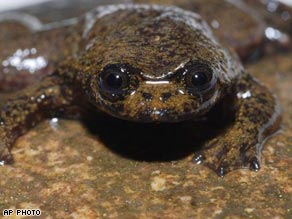
So here's yet another example of how poorly CNN reports science. This is a story about a lungless frog that's been discovered in Indonesia. But the story confuses evolutionary processes and ends up asserting Lamarkian evolultionary principles. Here's the deal, according to the standard evolutionary model, adaptations occur because of random mutations, NOT because of environmental pressure. If a mutation HAPPENS to be benign or (rarely) beneficial, it can get carried on to successive generations. But they don't HAPPEN because of the environment the creature is in. At least not according to the modern understanding of evolution.
And why is that? Because if the mutation of a frog to lose its lungs was "because the frog needed to lose buoyancy in the fast moving streams" then SOMETHING is communicating that need to the frog's DNA and the DNA is listening and responding to the message. So far no such mechanism has been proposed, much less demonstrated.
Lungless 'Jabba' frog offers evolution clue - CNN.com
Graeme Gillespie, director of conservation and science at Zoos Victoria in Australia, called the frog "evolutionary unique." He said the eight specimens examined in the lab showed the lunglessness was consistent with the species and not "a freak of nature." Gillespie was not a member of the expedition or the research team.
Bickford surmised that the frog had evolved to adapt to its difficult surroundings, in which it has to navigate cold, fast-moving streams that are rich in oxygen.
"It's an extreme adaptation that was probably brought about by these fast-moving streams," Bickford said, adding that it probably needed to reduce its buoyancy in order to keep from being swept down the mountainous rivers.
Of course I can't entirely blame CNN, these biologists seem to be suffering under the same delusion. But that's probably a bigger story than the frog story. Biologists who believe in Lamarkian evolution in 2008! That's a story!
Comments (5)