Garrett Lisi, 39, has a doctorate but no university affiliation and spends most of the year surfing in Hawaii, where he has also been a hiking guide and bridge builder (when he slept in a jungle yurt).
In winter, he heads to the mountains near Lake Tahoe, Nevada, where he snowboards. "Being poor sucks," Lisi says. "It's hard to figure out the secrets of the universe when you're trying to figure out where you and your girlfriend are going to sleep next month."
Despite this unusual career path, his proposal is remarkable because, by the arcane standards of particle physics, it does not require highly complex mathematics.
Even better, it does not require more than one dimension of time and three of space, when some rival theories need ten or even more spatial dimensions and other bizarre concepts. And it may even be possible to test his theory, which predicts a host of new particles, perhaps even using the new Large Hadron Collider atom smasher that will go into action near Geneva next year.
Although the work of 39 year old Garrett Lisi still has a way to go to convince the establishment, let alone match the achievements of Albert Einstein, the two do have one thing in common: Einstein also began his great adventure in theoretical physics while outside the mainstream scientific establishment, working as a patent officer, though failed to achieve the Holy Grail, an overarching explanation to unite all the particles and forces of the cosmos.
He bases his theory on a geometrical shape represented in this two-dimensional diagram, but actually existing in a few dozen dimensions.
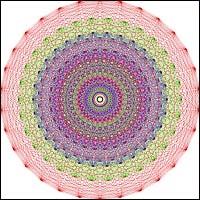
(click on the image to see a large diagram).
Then there's
this story:
A scientist has put forward the bizarre suggestion that there are two dimensions of time, not the one that we are all familiar with, and even proposed a way to test his heretical idea next year.
Time is no longer a simple line from the past to the future, in a four dimensional world consisting of three dimensions of space and one of time. Instead, the physicist envisages the passage of history as curves embedded in a six dimensions, with four of space and two of time.
"There isn't just one dimension of time," Itzhak Bars of the University of Southern California in Los Angeles tells New Scientist. "There are two. One whole dimension of time and another of space have until now gone entirely unnoticed by us."
Now I really like the surfer-dude theory, although I cannot claim to understand it. I do understand enough to know that he has returned to the very core of physics by using pure symmetry arguments as a foundation for his theory. Over the course of physics, symmetry has been one of the most profoundly powerful tools used to explain everything from the laws of motion to general relativity. I tend to stand up and take more notice of theories that have such deep-rooted symmetrical roots.
BUT, the MAIN thing I like about both of these theories is that they are both directly challenging "string theory" dogma and addressing the key issues I have with "string theory" which are:
1. String "theory" is NOT a "theory" in the scientific use of the word "theory." It's more a "hypothesis".
2. String "theory" is not falsifiable, and so far has proven to be untestable, meaning that it remains in the realm of meta-physics as far as I am concerned.
Both of these new theories (although both need work to actually qualify as a "theory" but I think they'll get there) do predict testable outcomes. So in that sense both of these are better "science" than string theory whether they turn out to be on the right track or not.
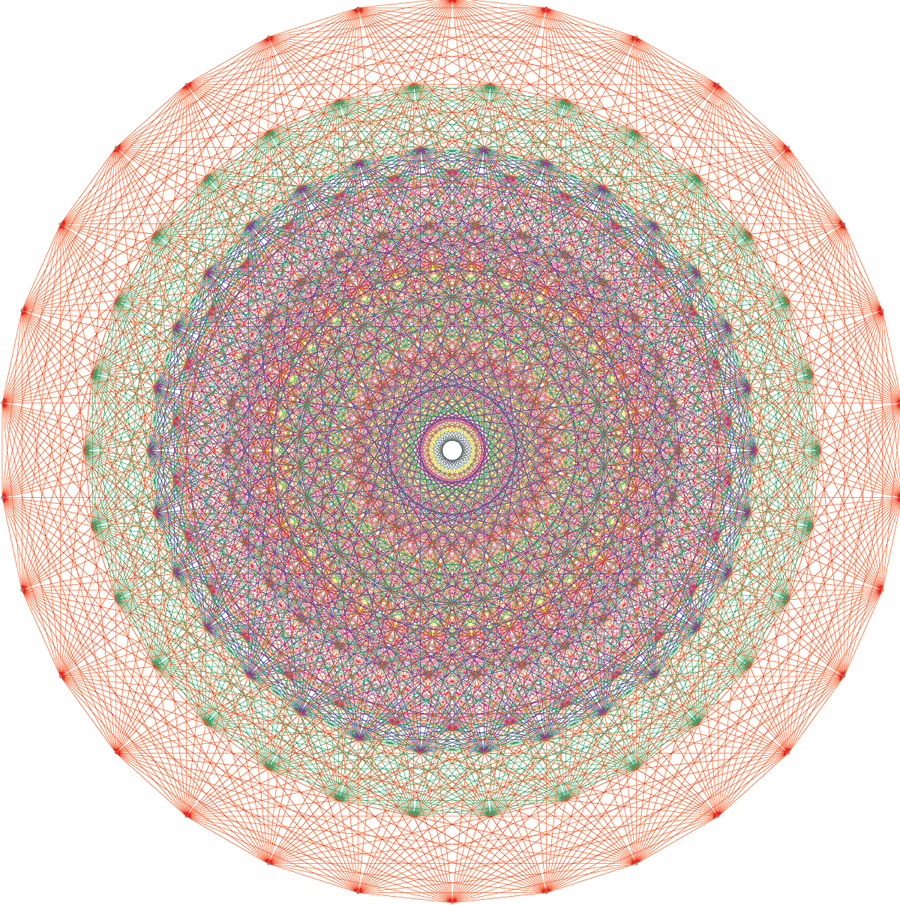 (click on the image to see a large diagram).
Then there's this story:
Comments (10)