So, while we were playing "Grepolis" for the past few months, Drax and I had a number of phone calls to coordinate activities and discuss strategy. As part of that we discussed what we liked and didn't like about the Grepolis game. As that sort of thing goes in our conversations, that led us to what sort of combat/conquest strategy game we'd like to play. And that led us to the idea of a galactic conquest game.
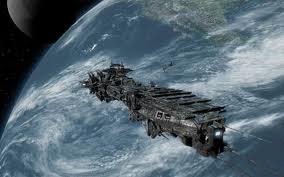
A long time ago, in a previous life, I used to play a game called "Reach For The Stars", which was a game that was published on a variety of PC platforms, including Commodore, PC and Macintosh. It was actually a pretty good game, but it wasn't massively multi-player. It did allow up to six players I think, but it was turn-based and everyone had to take their turns at the computer to make their moves and watch the outcome.
At the highest level what I'd like to see is a massively multiplayer online game similar in concept to "Reach For The Stars."
So Drax said "why don't you write one."
Hmmm... well, I USED to be a programmer. I USED to write games. I USED to build enterprise wide systems capable of running a massively multiplayer game... But that was a long time ago...
Still, it's an intriguing idea.
If I were to pursue this, here are some things I would want to do:
- Most games that are a mix of resource development, military buildup, travel and combat require a huge investment of time in what are, to me, the less interesting aspects of the game like configuring resource management and shuffling resources around. I know that this is a major factor in actual wartime, but I also know that by and large generals leave those details up to subordinates. Generals say "Build me a bunch of tanks and deliver them to this location" and move on to the next agenda item. They don't worry about where to mine the iron, how to smelt it and produce steel, how much steel is needed vs rubber, glass, etc. If someone WANTS to deal with their resources at that level, that's fine, but I'd rather not spend hours per day micro-managing the mines. What I WOULD like is the ability to choose between different subordinates and assign to THEM these details and then monitor status and perhaps tweak the approach of the subordinates by issuing directives to them.
- Games that I've played treat all military units as interchangeable cogs. One ship is exactly the same as another. In fact, from a programming perspective, each military unit is frequently nothing more than a number in a list. There is no actual ship, when a ship is added the number of "ships" is increased by 1. In a game I would create I would have each individual unit be a unique object with a history and several attributes which are tracked separately, some of which might be modified based on the ship's history. (For example two identical ships might have significantly different combat effectiveness due entirely to the number of battles they have survived.) Yes, this means the process of conducting an actual battle will be quite complex, but hey, that's what programmers are supposed to deal with, right?
- The main issue I have with games like Grepolis is that the game requires constant monitoring and this is just not possible for me, or many other people, to do because we have actual LIVES that take precedence over playing a dang game. So the game needs to have some way to allow the player to play when they can play, and to deal with real life when they need to, without constant fear of losing a key military base just because they happened to be asleep at the time. At the same time, the game can't simply go on "pause" mode anytime any single player is unable to play or the game would NEVER move forward. It is my opinion that the game that best resolves this issue is the game that will become the "killer app" of online military strategy games. My initial cut at how to deal with this is to allow the game to create and execute plans. That way the player can set up a series of events and/or triggers with responses and log off secure in the expectation that their plans will be executed and that their pre-planned response will kick in if certain events occur. (For example, if a particularly military asset is under attack, a specific response plan can be triggered and executed.)
- It is a rare game that allows for any re-distribution of forces. I don't know if that is due to a lack of awareness of how wars actually happen, if it is due to lazy programming, or if it is some misguided effort to enforce "game balance." But I personally see no reason that entire armies or fleets could not be delivered to another player, according to whatever exchange the two players agree to. The caveat to this is in the next bullet, which is "support and supply lines"
- It is perhaps the oldest adage in military history, but it is just as true today as it was when Sun Tzu cautioned military leaders about it, and that is that armies "march on their stomachs." In today's terms that means more than just biological stomachs. A military operation is only as successful as the supply lines allow it to be. A command chain that cannot provide support for their armies and fleets is a command chain that will lose wars. While this can be abstracted to some degree, a truly accurate wargame should have military units that use up resources and those resources should need a supply chain to keep the units combat ready. Disrupting these supply chains has always been a major combat strategy. If a command somehow gains units that they cannot support, those units will either disband, mutiny or join another player's fleet/army. Of course that means the game has to have an element that allows for the creation, management and disruption of supply chains.
- Most wargames have completely arbitrary means of providing "game balance", most frequently in the area of defense vs offense. Many games just arbitrarily make defense stronger than offense so that you get the result of needing something like 3x the number of offensive units being needed to overcome defenses. I would like to think that there are ways to make actual tactics more meaningful. In other words, defensive troops should only be "more effective" because they have employed specific tactics that make it harder to overcome them. They shouldn't be harder to kill just because someone clicked the "defend" button instead of the "attack" button.
- In a strategy game, strategy should actually, you know, matter. Right now most wargames I've played are called "strategy" games because they fit some commercially derived genre, not because they actually encourage or even promote strategic gaming. Grepolis is about as "strategic" as checkers. And that might be an insult to checkers. In order to make strategy matter, there have to be actual strategic options and goals for the players to engage. And good strategies should be rewarded while poor strategies should be punished. Again, picking on Grepolis, there is virtually no actual strategic impact in the game. The game boils down to pure brute strength and the ability to build enough cities to out produce your enemies. And that boils down mostly to who is willing to invest more of their personal time into the game, not who is actually BETTER at planning and executing strategies.
Anyway, I could (as usual) go on (and on and on). The bottom line is that I am intrigued by the possibility of re-entering the gaming world by working on a massively multi-player real-time galactic conquest strategy game.
But there's this little novel I've been trying to finish...
Comments (7)