 Here is how that works. In the case of a fore-and-aft sail, the sail acts more like an airfoil than what people think of as a "sail". That means that as the wind flows across the sail, it provides lift just like an airplane wing. That lift can be perpendicular to the direction of the wind itself. However, the sail still has some aerodynamic drag, meaning that it the final vector of force from the sail is still downwind, meaning that from pure sail effects, a ship cannot sail upwind.
What a keel does is provide a deflecting force in the water which adds another thrust vector to the overall ship dynamic. That thrust vector, when added to the sail vector, if managed carefully and properly, provides a combined thrust vector that can be at least partially directed in the direction of the wind. While it is more or less impossible to sail directly upwind a well designed sailing boat/ship can achieve thrust that can be as much as 30 degrees into the wind. To sail in a specific direction is then done by "tacking" which is the process of sailing upwind to the "left" then reconfiguring the sails to sail upwind to the "right" ending up with a zig-zag back and forth across the desired line of travel.
Because of the dual use of the term, and because in some ships the structural integrity and directional stability aspects are completely separate, other terms are used like "centerboard" or "daggerboard" or other terms to describe particular implementations in different ship designs.
Most modern sailboats of the type you see on public lakes and in harbors have retractable keels which pivot up and down to allow the boat to dock in shallow waters, dropping the keel when they reach deeper water.
"Keelhauling" was a disciplinary tactic employed in the age of sail which involved tying a problematic sailor or prisoner to a rope and dragging them underwater from one side of the boat to the other under the hull and across the keel. Many times this resulted in the death of the individual, especially on larger ships.
What is a keel?
By CosmicConservativeSo, commenter jsullins asked in the Sailing post comment area what a keel was. I suspect he's being disingenuous, but I am never one to overlook an opportunity to expound on what I consider to be major developments in technology.
"Keel" is an interesting word. It's etymology is derived from ancient anglo-saxon words for "boat" or "ship". (Back then "boat" and "ship" were not really separate concepts. That came later in the age of big ships.)
There are two simultaneous and in some cases overlapping meanings for the word "keel". The most commonly recognized usage is to describe the "backbone" of a ship. "Laying the keel" is the first step for building wooden sailing ships, and continued to be the first step for building steel-hulled ships for a long time until shipbuilding became a modular enterprise where the "keel" is incorporated into the modular elements of the hull. In that sense the "keel" is the massive timber used to provide the boat's longitudinal stability and the primary structural element of the entire hull. Creating a keel is a complex process involving the joinery of massive wooden beams to create the desired hull shape. The keel is the single most important structural element in large wooden ships and breaking or damaging the keel usually means the loss of the ship since repairing the ship would require virtually rebuilding it from scratch.
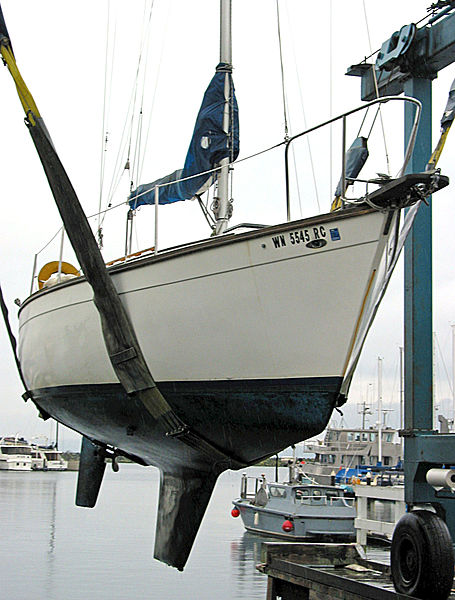
However, that's not the use of "keel" I was invoking in the other post. The other use of "keel" is to describe a long plane which extends vertically below a sailing ship to provide stability for the boat to offset the tendency of the wind to blow a sailing ship over. Or at least nautical historians speculate that was the original purpose of such a keel. It was not long after the introduction of keels of this sort (which sometimes are incorporated into the keel of the first sort) that sailors discovered that by angling the direction of the boat in relation to the configuration of the sails, the end result was that the ship could actually sail partially upwind.
Here is how that works. In the case of a fore-and-aft sail, the sail acts more like an airfoil than what people think of as a "sail". That means that as the wind flows across the sail, it provides lift just like an airplane wing. That lift can be perpendicular to the direction of the wind itself. However, the sail still has some aerodynamic drag, meaning that it the final vector of force from the sail is still downwind, meaning that from pure sail effects, a ship cannot sail upwind.
What a keel does is provide a deflecting force in the water which adds another thrust vector to the overall ship dynamic. That thrust vector, when added to the sail vector, if managed carefully and properly, provides a combined thrust vector that can be at least partially directed in the direction of the wind. While it is more or less impossible to sail directly upwind a well designed sailing boat/ship can achieve thrust that can be as much as 30 degrees into the wind. To sail in a specific direction is then done by "tacking" which is the process of sailing upwind to the "left" then reconfiguring the sails to sail upwind to the "right" ending up with a zig-zag back and forth across the desired line of travel.
Because of the dual use of the term, and because in some ships the structural integrity and directional stability aspects are completely separate, other terms are used like "centerboard" or "daggerboard" or other terms to describe particular implementations in different ship designs.
Most modern sailboats of the type you see on public lakes and in harbors have retractable keels which pivot up and down to allow the boat to dock in shallow waters, dropping the keel when they reach deeper water.
"Keelhauling" was a disciplinary tactic employed in the age of sail which involved tying a problematic sailor or prisoner to a rope and dragging them underwater from one side of the boat to the other under the hull and across the keel. Many times this resulted in the death of the individual, especially on larger ships.
Comments (8)