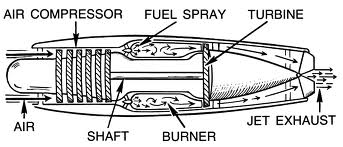
 I mean it's not as if jet engines are that complex. At their root they are incredibly simple. You have a compressor to improve power efficiency, a combustion chamber to burn the fuel-air mix, and a turbine that converts the high-pressure gas outflow into usable work. The concepts and physical properties of a jet engine go back hundreds of years, but the key design breakthrough that allowed them to become ubiquitous power generators was when the compressor was coupled to the turbine allowing the engine to be self-compressing. What seemed to throw the engineer I was talking to was their narrow view of a "jet engine" as being something you find on an airplane. They could not wrap their mind around the idea that "jet engines" can drive propellers or electric generators. They seemed unable to abstract the notion of "jet engine" as a generic power source that can do pretty much anything a piston engine could do, sometimes more, sometimes less efficiently, depending on the purpose and designs of the engines.
I could focus on the lack of technical awareness of the engineer and blame it on their attention or schooling, but the real issue is that they clearly had no understanding of the historical context of jet engine development. If they did, all the other stuff would be automatic.
I see this lack of historical context everywhere. Why do cars have gasoline engines instead of, for example, kerosine? How does a nuclear power plant work? What is a "turbo-charger" in an automobile? Why are they sometimes used, and sometimes not, and where did they come from?
More and more as I talk to people about things I wonder if my entire thought process is so unusual as to be almost unique. I can't help but try to fit pretty much everything I know into some sort of historical context which includes the causes and effects of change. I think that allows me to have a much more holistic view of the world. I can't think about turbines without automatically contemplating the aelopile, which was the first functioning turbine created in ancient Greece. That automatically makes me start contemplating external vs internal combustion engines, and my mind will more or less automatically roam around different types of engines and what makes them unique, and why some are, and some are not, used.
There used to be a show on PBS called "Connections." That show probably was closer to how my mind works than any other thing I can think of. It was a fascinating look at how history was driven not by singular events occurring in a vacuum, but how almost every event was intricately tied to other events in a complex web of cause, effect and inspiration.
I think that's the best way to view the world. But I don't know if other people really even understand it. Or care.
Knowledge vs contextual awareness
By CosmicConservativeI've been in a number of conversations lately where I have realized in the middle of the discussion that the person I was talking to was not merely confused about something, but was totally ignorant of the subject from every possible angle, from historical context to practical application.
The latest example was a discussion I was having about jet engines with an actual engineer. Yes, an engineer. An engineer who apparently had no idea what a turboprop was, what the "turbo" and "prop" roots meant or even seemed to understand the most basic principles of "jet engines" and why they are so widely used for power generation. The jaw-dropping moment came when the subject of "internal combustion" vs "external combustion" came up and they simply could not wrap their mind around the concept that a jet engine was an "internal combustion" engine. In their mind "internal combustion" meant "piston", even though the most common external combustion engines (steam engines in particular) are piston engines.
It was weird. Just weird.
I mean it's not as if jet engines are that complex. At their root they are incredibly simple. You have a compressor to improve power efficiency, a combustion chamber to burn the fuel-air mix, and a turbine that converts the high-pressure gas outflow into usable work. The concepts and physical properties of a jet engine go back hundreds of years, but the key design breakthrough that allowed them to become ubiquitous power generators was when the compressor was coupled to the turbine allowing the engine to be self-compressing. What seemed to throw the engineer I was talking to was their narrow view of a "jet engine" as being something you find on an airplane. They could not wrap their mind around the idea that "jet engines" can drive propellers or electric generators. They seemed unable to abstract the notion of "jet engine" as a generic power source that can do pretty much anything a piston engine could do, sometimes more, sometimes less efficiently, depending on the purpose and designs of the engines.
I could focus on the lack of technical awareness of the engineer and blame it on their attention or schooling, but the real issue is that they clearly had no understanding of the historical context of jet engine development. If they did, all the other stuff would be automatic.
I see this lack of historical context everywhere. Why do cars have gasoline engines instead of, for example, kerosine? How does a nuclear power plant work? What is a "turbo-charger" in an automobile? Why are they sometimes used, and sometimes not, and where did they come from?
More and more as I talk to people about things I wonder if my entire thought process is so unusual as to be almost unique. I can't help but try to fit pretty much everything I know into some sort of historical context which includes the causes and effects of change. I think that allows me to have a much more holistic view of the world. I can't think about turbines without automatically contemplating the aelopile, which was the first functioning turbine created in ancient Greece. That automatically makes me start contemplating external vs internal combustion engines, and my mind will more or less automatically roam around different types of engines and what makes them unique, and why some are, and some are not, used.
There used to be a show on PBS called "Connections." That show probably was closer to how my mind works than any other thing I can think of. It was a fascinating look at how history was driven not by singular events occurring in a vacuum, but how almost every event was intricately tied to other events in a complex web of cause, effect and inspiration.
I think that's the best way to view the world. But I don't know if other people really even understand it. Or care.
Comments (3)