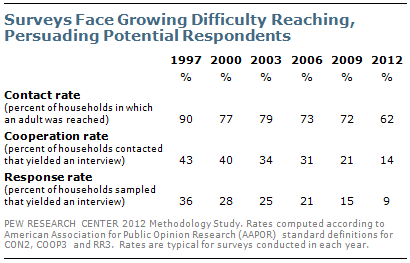
It has become increasingly difficult to contact potential respondents and to persuade them to participate. The percentage of households in a sample that are successfully interviewed – the response rate – has fallen dramatically. At Pew Research, the response rate of a typical telephone survey was 36% in 1997 and is just 9% today.
 I don't participate in polls, but then I never had. My typical poll phone call goes like this:
Me: "Hello?"
Pollster: "Hello, this is XXXX and we are taking a poll ...."
Me: (interrupting) "Who are you?"
Pollster: "... This is XXXX and..."
Me: (interrupting) "I heard that the first time. I don't know what that is. Who are you? What does your company do?"
Pollster: "... if I could just have a minute of your time..."
Me: "You've already taken at least a minute of my time. Now who are you? What does your company do? Who are you affiliated with?"
Pollster: "... we are just trying to take a poll..."
Me: "Then tell me who you are. I know the main polling companies, and I don't recognize your name. That means you are almost certainly a company hired to take a poll, and that means you are almost certainly taking a push poll where you are going to be trying to influence me to answer in a particular way so you can claim your poll supports whatever agenda your client has. Now one more time, who hired you? Who is your client?"
Pollster: "... we can't divulge that information."
Me: "Hmmm. well, then neither can I. But at least I can keep you on the phone long enough that I cost your client some money and at least one more person won't get a call from you. Goodbye."
Of course that's been more or less my standard response for decades, so that's nothing new.
Comments (4)