Cosmic Conservative

Rational Conservatism from the heart of America

Science & Technology

Immortal jellyfish

By CosmicConservative
Did you know that there is an actual immortal organism on this planet? This jellyfish ages until it is stressed, when its cells somehow reverse their differentiation and it returns to an undifferentiated larval state from whence it regrows into an adult jellyfish again.

Sommer was conducting research on hydrozoans, small invertebrates that, depending on their stage in the life cycle, resemble either a jellyfish or a soft coral. Every morning, Sommer went snorkeling in the turquoise water off the cliffs of Portofino. He scanned the ocean floor for hydrozoans, gathering them with plankton nets. Among the hundreds of organisms he collected was a tiny, relatively obscure species known to biologists as Turritopsis dohrnii. Today it is more commonly known as the immortal jellyfish.

Sommer kept his hydrozoans in petri dishes and observed their reproduction habits. After several days he noticed that his Turritopsis dohrnii was behaving in a very peculiar manner, for which he could hypothesize no earthly explanation. Plainly speaking, it refused to die. It appeared to age in reverse, growing younger and younger until it reached its earliest stage of development, at which point it began its life cycle anew.

via Can a Jellyfish Unlock the Secret of Immortality? - NYTimes.com.

Weird, huh?

The "warp drive" debate

By CosmicConservative
So, my previous post on the "Super" and "Micro" moons were a rather tame example of my problem with mainstream media "reporting" about "science". Here is a much more common sort of example, with a reporter from "The Atlantic" hyperventilating about "warp drives" and travel to Alpha Centauri in two weeks. (Note to those who might have some understanding of relativity. She's not talking about two relative weeks which would be over four years in earth-time. She means four weeks in earth time AND ship time.)

So, one-tenth the speed of light and we could be there in 40 years. That's not half bad. As Seager notes, many people would be willing to give up Earth and make that assuredly miserable journey for the privilege of being the first humans to explore another solar system. But still: 40 years, it's no cakewalk.

That's why a new number, care of NASA physicist Harold White, is so stunning: Two weeks. Two weeks to Alpha Centauri, he told io9, if only we can travel by warping space-time.

via What If NASA Could Figure Out the Math of a Workable Warp Drive? - Rebecca J. Rosen - The Atlantic.

How is such a thing even theoretically possible? Well, the concept is based around a highly controversial paper published years ago which has generated wild speculation among the pseudo-scientific about zipping through the universe like the starship Enterprise. Here's how it "works". Heh, notice the Federation starship image there? I wonder if the Atlantic got permission to use that image in their article. Anyway, I'm not going to pretend to understand all the math involved in this, it's highly speculative interpretation of general relativity equations generated essentially by assuming a mathematical symmetry between positive and negative energy. The rationale behind the "theory" (and I put "theory" in quotes because this sort of proposed starship drive is not only not theoretical, it's based on such a highly controversial interpretation of general relativity equations that "wild guess" is a better word than "theory" to describe it) was first inspired by the sudden "realization" that the universe is mostly comprised not of normal "matter" (the stuff that makes up you, me, the earth, the stars, galaxies, and everything else we can see), not even of exotic "dark matter" (the stuff that gravitational mechanics analysis of the universe seems to imply has to exist in huge amounts and makes up the vast majority of the universe's mass, even though we can't see it and have no idea what it is), but that the vast majority of the universe is actually made up of "dark energy" which not only dwarfs normal matter, but dwarfs "dark matter" and is the driving force behind the expansion of the universe which will eventually rip apart the very protons and electrons themselves. "Dark energy" is theorized to be constantly flooding the universe and appears to come from nowhere, as far as our normal physical laws of the universe are concerned. Well, this guy, Miguel Alcubierre, took that idea and made the assumption that "dark energy" is essentially what you get if you flip the mathematical sign on Einstein's general relativity equations. Which is fine, in a way, that's not terribly controversial. Other physicists have speculated that dark energy could arise in that fashion and the result would be a set of symmetrical field equations, which is always highly desirable by physicists. Physicists love symmetry. Symmetry is the fundamental concept that drove Einstein's general relativity theory, and was a driving concept behind Newton's theories as well. But there is not only no experimental evidence to support this idea, there is no plausible means of devising an experimental test. It's closer to metaphysics than it is to real-world physics. It's fun to contemplate, but it's really pure speculation at this time. But even that speculation is generally done in cosmological scales with no real exploration of where all the energy comes from to do this stuff. (One of the truly amazing things to me about modern cosmological high-energy physics is that the entire concept of "Dark Energy" totally violates everything physicists have ever believed about the "Law" of conservation of matter and energy. It totally violates that "Law" and nobody seems to care. But I digress, this sort of thing will eventually lead me to discuss why I can't believe that black holes are what they are supposed to be...). Anyway, what Miguel Alcubierre did that was so breathtakingly revolutionary is that he assumed that the dark energy theories can be applied on a local scale. Since the whole new cosmological model is all about how the space-time continuum is as malleable as cookie dough, he just asked the question "can you warp space and time locally? And if so, can you use that as a means to travel through space?" Then he just started applying the equations to see what it would take to warp space to the degree that a ship could travel "faster than light". That last part is in quotes because even these equations assume that in local frames of reference you can't travel faster than light. Instead you have to stretch or compress space-time outside of the ship, while maintaining a "bubble" of "normal" space-time for the ship to survive the process. That led to the concept of warping space-time in front of the ship (compressing it) and in back of the ship (expanding it). The combination of the two results in the ship "moving" from one location to another, while remaining dead stationary in its local frame of reference. Meaning the ship itself would feel no acceleration from the process. The problem is that the equations suggest that while this might be possible, it requires energy input that is truly astronomical. The first proposed technique would have required the total conversion of Jupiter's mass into pure energy in order to move a ship from our solar system to Alpha Centauri. Which seems a bit excessive since even if it would work, there aren't enough Jupiter-sized masses laying around to convert into energy, so this would be a one-time effort. Not to mention that the total destruction of Jupiter might offend some environmentalists' sensibilities and they might register a lawsuit to stop the endeavor. But since that early paper enthusiasts have refined the process and come up with tricks that reduce the amount of energy required to manageable levels of matter-energy conversion. This is fun to speculate, not just because of the potential for writing stories with some supposed link to theoretical physics, but also because of the remarkable ramifications of such a "warp drive". Basically this sort of drive would potentially operate in a very, very similar manner to the "warp drive" as conceived by Gene Roddenberry in the iconic "Star Trek" TV series and movies. One of the things that always used to amuse me is how the ship would accelerate to faster than light travel on a dime without crushing the ship from the acceleration effects. The drive as proposed would keep the ship in a stationary local frame of reference, so you could, hypothetically, drink your coffee comfortably as your ship zipped along its jaunt through the galaxy. In fact, if plausible, this sort of drive would not only make travel within the galaxy feasible, but would also make travel BETWEEN galaxies possible. That is beyond amazing. Of course all of it is currently nothing more than a crazy idea that exploits several completely untestable hypotheses, including the need for us to finally completely understand dark energy and how it can be manipulated, but at one point that's what all new theories are. Einstein's relativity theories were no less mind-bending when they were first proposed, and yet we now accept them as basic universal laws. Unfortunately there is a major, major problem with this theory. That problem is that if this sort of drive is technically possible, then even if intelligent life is rare, by now some race of space-faring aliens should have created fleets of galaxy-spanning ships zipping around like buzzing bees. Which takes us back to the famous question first proposed by Enrico Fermi: "Where are they?"

The Moon, the Sun and common misperceptions

By CosmicConservative
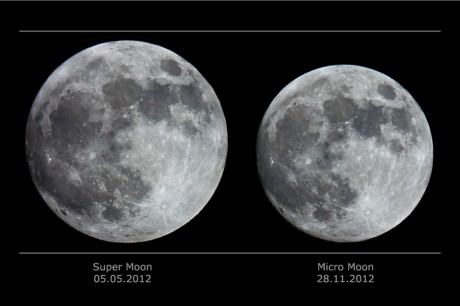
One of the things that is always able to get a chuckle out of me is "science reporting" in the news. The sheer level of stunning ignorance on display always gives me hope for the employability of the mentally disadvantaged. Earlier this year the "big news" splashed across newspaper and web pages around the world was the awesome celestial display of the upcoming "Super Moon". A "Super Moon" is when the full moon occurs close to the moon's perigee (closest point in its orbit). This week the news has been somewhat less breathless, but the basic message has been similar because the last full moon we had was a "Micro Moon", which occurs when the full moon occurs close to the moon's apogee (farthest point in its orbit). So, with all the breathless superlatives being slung around, you'd think that the actual moon in the sky would be dramatically different in size. The fact is that the great majority of people, and by great majority I mean on the order of 99.9% of them, would never have noticed any difference in the moon's size or brightness unless the NY Times ran a story about it. Not because the difference is negligible (it's not, see below) but because there is no real frame of reference in the sky that allows the human eye to really judge its size anyway, much less compare the size of a full moon to another several months later. Here is a photo of the moon comparing its relative size between "Super" and "Micro" moons: So you can see that there is a roughly 10% difference in the apparent size of the moon (the "Super moon" is 12 - 13% larger in apparent size than the "Micro moon" if you want to be more accurate) So, now having said that, this brings me to another bone of contention about people's general understanding of celestial events and their presumed significance. I cannot tell you how many times in my life I have had a conversation with someone who has waxed poetic about the "impossibly improbable coincidence" that the sun and moon are the "exact same apparent size" in the sky, which allows for the most dramatic celestial showcase in our sky, the "total solar eclipse". Usually this is in the context of "proving" that the earth is so unique that it must have been divinely designed. Well, the truth is that just as the moon varies in size by up to 13%, the earth's orbit is also an ellipse, meaning that the sun's apparent size also varies by a few percent over the course of the year (the earth is actually at apogee, meaning the sun is furthest away and therefore appears smallest in the sky in the summer for the Northern Hemisphere, which always seems to surprise people in America and Europe). These two variations in the size of the earth and moon mean that solar eclipses also vary considerably, with some occuring when the sun is at its largest while the moon is at its smallest, and vice versa. When the moon's apparent size is significantly smaller than the sun's apparent size, that is known as an "annular solar eclipse" and during such an eclipse the edge of the sun will be visible all around the smaller moon. The reverse case means the moon will more fully obscure the sun, hiding more of the sun's solar prominences and corona. An eclipse where the sun and moon are almost exactly the same time is actually somewhat rare. As the moon continues to spiral slowly farther and farther away from the earth, the moon's apparent size will continue to get smaller and smaller until eventually all solar eclipses will be annular eclipses.

Are humans getting dumber?

By CosmicConservative
One of the things I have seen suggested by certain "scientists" over the past few decades is the idea that humanity's evolution is no longer moving in a positive direction with regard to intelligence. A common theory is that because the day-to-day fight to survive pressure is no longer common in the industrialized world, humans are not merely no longer advancing, but are actually declining. There was a story floating around the internet earlier this week where a prominent evolutionary scientist was claiming that a human of 10,000 years ago would be smarter, have better memory and be able to react more appropriately to danger than a modern human. Some of this comes from what I have come to call the theory of evolutionary entropy. That theory suggests that evolution progresses in the direction of stress, and in the absence of stress, traits degrade. The most commonly cited evidence of this tendency is the common "rail" family of birds, which includes a huge variety of short rounded-winged birds, most of which prefer to run on the ground unless forced to take to the air. Rails are poor flyers and as such tend to get blown around by storms a lot. This, somewhat paradoxically, seems to have made them one of the most successful island colonizers among non-seafaring birds. The rationale behind this is that rails tend to get blown off course easily and can be carried hundreds or even thousands of miles off course by strong storm systems (typhoons, hurricanes, Michelle Obama). Because rails are so widespread, and tend to be island colonizers, it has not been uncommon over the geologic timescale for them to end up on islands with no natural predators and abundant food. In such cases rails tend to lose the ability to fly. This, and similar lack of evolutionary "pressure" has led some scientists to conclude that successful traits will breed out quickly in the absence of survival pressure. So they conclude that intelligence in humans is suffering the same fate. Now, I have to admit that when I look at human culture I sort of have to wonder about this theory. It could even be argued that many modern societies tend to selectively breed for what were once considered undesirable traits, such as sloth, ignorance and a desire to watch TV shows like "Honey Boo-boo." It would certainly explain the recent rise and potential dominance of the Democrat party. However, I am not convinced that it's true. First of all, evolution tends to work on timescales that dwarf our cultural frame of reference, so even if it is happening, it is hard to believe that it could be happening fast enough to explain the elections of, for example, Barack Obama or Joe Biden. Also I actually tend to believe that the modern environment humans live in is far more difficult and complex than anything our forebears of 10,000 years ago faced. Humans as a species have not been "pushed" to survive since the introduction of agriculture, which can be traced back at least 10,000 years. And in all that time every culture has had its share of indolent, intellectually vapid citizens. But in spite of that, human technology and culture has evolved and "advanced" at an ever accelerating rate, and shows no signs of stopping now. Give Obama's policies a million years or so and I suspect we might see a general decline in IQ. But I just don't see it happening in a few, or even a few hundred, generations.

NASA sitting on "earth-shaking" discovery

By CosmicConservative
Interesting...

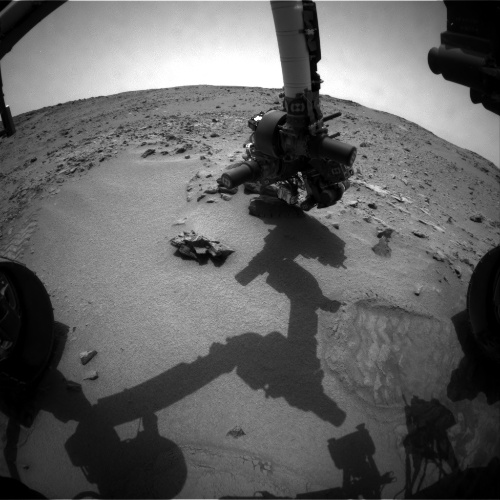
The Mars Science Laboratory team has hinted that they might have some big news to share soon. But like good scientists, they are waiting until they verify their results before saying anything definitive. In an interview on NPR today, MSL Principal Investigator John Grotzinger said a recent soil sample test in the SAM instrument (Sample Analysis at Mars) shows something ‘earthshaking.’

“This data is gonna be one for the history books,” he said. “It’s looking really good.”

What could it be?

via Has Curiosity Made an ‘Earth-Shaking’ Discovery?.

So, my guess is that Curiosity has identified organic compounds in the Martian soil that strongly indicate the presence of both water and complex organic processes that can really only be explained by the presence of some sort of "life." I doubt they have any smoking gun because the basic molecules of "life as we know it" are not very resilient outside of the protection of cellular constructs. DNA or RNA breaks down very fast in the presence of radiation or even just heat. So I doubt they've found Martian DNA. But they might very well have found traces of organic molecules that we only see associated with living things.

3D printing update

By CosmicConservative
Yes, I am still fascinated with the potential of 3D printing. I am still regularly checking on the progress of the current 3D printing technologies, and I am looking into the cost and convenience of 3D outsourced printing. I have been using "Sketchup" lately. I need to use it more. I think today I'm going to finally watch some of those Sketchup Youtube tutorials. But, the reason for this post is that last night I was at a local bookstore ("The Tattered Cover", a bookstore I highly recommend to anyone coming to Denver) and happened to see a copy of a special winter edition of "Make:" magazine. (Yes, the colon is part of the title). I was quite surprised to see the number of products that are now available for 3D printing. There's over a dozen 3D printers that you can buy, ranging from about $400 to about $4,000. The most popular printers are in the $1,500 range. The magazine has a section of reviews of about a dozen of the most popular models, but I've only managed to get through a couple of them so far. Not surprisingly, I suppose, there is a rough correlation between functionality and price, but not a hard and fast one. There appear to actually be some bargains out there if you are in the market for a printer today. But more and more I am thinking that for now it is probably more cost-effective and wiser to outsource your 3D printing if you can deal with the delays associated with printing. There are a number of companies that will take your 3D digital file and print your result and mail it to you. Since the technology is still advancing rapidly and costs are still on the way down while capability is still on the way up, outsourcing the printing might very well be the best option by far. It also allows you to experiment with different materials and allows you to print using materials (such as bronze-infused stainless steel) which would be impossible to print at home. Ponoko.com is one such 3D printing company. I think the approach I'm going to take is to first and most importantly get up to speed with Sketchup to see if I can even create the sorts of digital files needed to print FROM before I look at the next step of actually printing something.

More for the "duh" files...

By CosmicConservative
No surprise to me here...

Human ancestors were fashioning sophisticated hunting weapons half a million years ago. An analysis of stone points from a site in South Africa called Kathu Pan 1 indicates that they were attached to shafts of wood and used as spears. The finding pushes the earliest appearance of hafted multicomponent tools back by some 200,000 years.

Previous discoveries had hinted at the potential antiquity of this technology.  Based on evidence that both early modern humans and our closest relatives, the Neandertals, made stone-tipped spears, some researchers hypothesized that their common ancestor—a species called Homo heidelbergensis–shared this know-how. At half a million years old, the newfound stone points are old enough to be the handiwork of this common ancestor.

via Human Ancestors Made Deadly Stone-Tipped Spears 500,000 Years Ago | Observations, Scientific American Blog Network.

On colonizing newly discovered exoplanets...

By CosmicConservative
I don't know how much differently my mind works than other people's minds. For example, when I see the discovery announced of a "new earthlike planet discovered!" my immediate reaction does not stop with "Oh cool!" It immediately jumps to "Hmm... if that planet is actually a rocky planet with surface water, could humans actually live on it?" For example, there is a story out right now about a newly discovered "super earth" which is a planet about 45 light years away (right next door in galactic terms) that is in its star's "Goldilocks zone". Sounds good so far, right? But then it turns out that the planet is 7 times the mass of the earth. Hmm... seven times the mass? What does that mean? Does that mean gravity is seven times as much as earth? Because if so that means humans would experience a "g force" of 7g just trying to stand on the surface. That's comparable to the g force you would experience at the bottom of an extreme roller coaster loop. (Actually, a bit of research shows the highest roller coaster g force to be rated at 6.3g. Most are in the 5g range for their highest g force.) You MIGHT be able to stand up for a few minutes, but it would not be long before you simply could not stand. But what would the force of gravity be on a rocky planet with seven times the mass of earth? Well, fortunately we can do some math. If we assume that the "super earth" has the same basic density as earth (not much of a reach, Mercury and Venus have densities very similar to earth), then a planet with seven times the mass of earth with the same density of earth, would end up with a surface gravity of almost exactly 2g. 2g is not ideal, but it's not necessarily impossible to deal with. Especially with exoskeletons to help people move and special beds to support them as they sleep. How long a person could survive on such a planet is debatable, but if that planet has seas, sea life might be able to live with very little adjustment since sea life is generally buoyant. So even if humans couldn't live permanently on the surface, such a planet could very possibly be farmed extensively and short visits to the surface by humans would be possible. I don't know what sort of experiments have been done on humans to determine the absolute g limits for humans to be able to live permanently on the surface of an exoplanet without suffering so much from the different g forces that living wouldn't be worth it. But just for the sake of argument I'm going to say that living within .75 to 1.25 g is probably acceptable. That would mean g values of between about 7 m/sec^2 to about 12 m/sec^2. So, with those parameters, and assuming equal density with earth, what does that mean in terms of the mass of exoplanets? Well, it turns out that would mean that inhabitable planets would be those that range from 1/2 to about 2 earth masses. But... there is actually reason to believe that earth is somewhat denser than most exoplanets. For whatever reason our solar system seems to have a higher concentration of heavy elements than most star systems. I don't know exactly what that means in terms of density, but since iron is one of those abundant elements that is apparently not so abundant in other systems, and earth is almost a big iron ball, I think it's not unreasonable to suggest that many exoplanets probably have a density that is as much as 20% less than earth. So, if that is true and we find exoplanets with 80% the density of the earth, what masses are we now looking at as potential for habitation? That changes the habitable mass to be from .6 earth masses to 3 earth masses. Since we have found several exoplanets in the range of 4 - 8 earth masses, this is starting to look more promising. Of course by the time we reach out to such planets, we might well have developed bio and genetic engineering to such a degree that living on planets with much higher g forces might even be possible. I suspect that in the long run we are likely to find lots of planets with masses in the acceptable range. After all we have two in our own solar system, along with two more that are pretty close and a couple of moons that are also in that range.

Michael Mann suing bloggers critical of his "research"

By CosmicConservative
Heh, I guess I should be glad my own little blog is so inconsequential since I've been one of Mann's harshest critics. Anyway, Rand Simberg runs one of my favorite blogs, called "Transterrestrial Musings" which is an astronomy/space policy blog and is actually more of what I had originally envisioned THIS blog to be before I got lazy, personal and boring. To get to the point, Rand is being sued by Michael Mann for having pointed out Mann's dubious "scientific" methods. He is also suing Mark Steyn, which I think was a very foolish thing for Mann to do. Steyn has dealt with legal issues around blogging for years, and fought the Canadian government to a standstill over his blog being declared a "hate speech" site for pointing out that jihadists are, in fact, jihadists. Michael Mann, in case you don't know, is the guy who is famous for the bogus "hockey stick" graph that rocketed Al Gore's "Inconvenient Truth" to fame and fortune. He is also, I think, they guy who made the famous "hide the decline" quote, or if not, he was right in the middle of it. Mann has been a rabid global warming advocate and has built a lucrative career out of gaining government grants for his "research". Anyway, here's a post on Rand's site suggesting that he is a bit worried about potential litigation costs. I don't contribute to causes much, but this is one I would help with.

Petrol from the air...

By CosmicConservative
Interesting story here:
A small company in the north of England has developed the “air capture” technology to create synthetic petrol using only air and electricity. Experts tonight hailed the astonishing breakthrough as a potential “game-changer” in the battle against climate change and a saviour for the world’s energy crisis. The technology, presented to a London engineering conference this week, removes carbon dioxide from the atmosphere. The “petrol from air” technology involves taking sodium hydroxide and mixing it with carbon dioxide before "electrolysing" the sodium carbonate that it produces to form pure carbon dioxide. Hydrogen is then produced by electrolysing water vapour captured with a dehumidifier. The company, Air Fuel Synthesis, then uses the carbon dioxide and hydrogen to produce methanol which in turn is passed through a gasoline fuel reactor, creating petrol. Company officials say they had produced five litres of petrol in less than three months from a small refinery in Stockton-on-Tees, Teesside. The fuel that is produced can be used in any regular petrol tank and, if renewable energy is used to provide the electricity it could become “completely carbon neutral”.
I guess the reporter who wrote this piece wasn't interested in the overall energy input required to generate the petrol. My guess is that it's five times as much energy to make the stuff than you get from burning it. Just my guess.