Cosmic Conservative

Rational Conservatism from the heart of America

Metaphysics & Spirituality

Oldest

By CosmicConservative
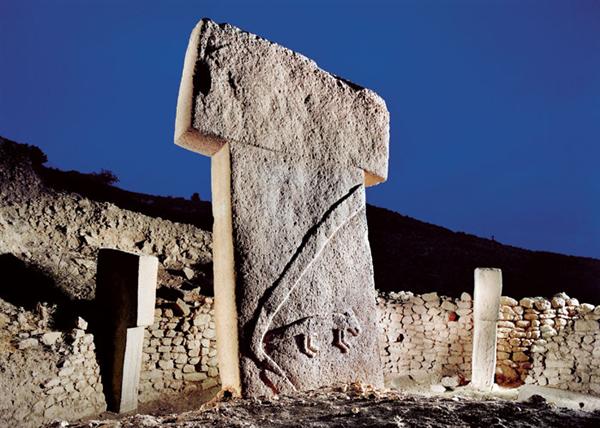
Oldest monolith You are looking at the oldest known human-built structure. This monolith and wall is part of a temple complex recently uncovered in Turkey that is 7,000 years older than the Pyramids, 6,000 years older than Stonehenge, and according to our current understanding of human cultural progression, older than agriculture by almost a thousand years, and older than domesticated animals by more than that. Old.
They call it potbelly hill, after the soft, round contour of this final lookout in southeastern Turkey. To the north are forested mountains. East of the hill lies the biblical plain of Harran, and to the south is the Syrian border, visible 20 miles away, pointing toward the ancient lands of Mesopotamia and the Fertile Crescent, the region that gave rise to human civilization. And under our feet, according to archeologist Klaus Schmidt, are the stones that mark the spot—the exact spot—where humans began that ascent.
This is completely rewriting early human history. And doing so emphatically since these constructs are far more sophisticated and abundant than any archaeologist would have imagined before stumbling across this site. There are at least 50 separate temple sites, each with its own monolith and carefully constructed walls. Many of the monoliths are exquisitely carved in a naturalist style far removed from the cave paintings known to have been done at about the same time. This is just at the tail end of the last ice age. Just when humans were finding a world that was not a brutal fight to survive against the cold. Neanderthals roamed Europe at this time. It is possible that these temples were built before the first human city was built. In fact the archaeologist who found them theorizes that it was the building of these temples that led to the construction of cities, the cultivation of wheat and the domestication of animals. He might be right. Currently all the evidence we have is that wheat was first cultivated within a few miles of this location, and the first domesticated pigs were also traced to a short distance away. What strikes me is how solid and clean the construction appears to be, especially the monoliths themselves. They are presumed to be carven idols of gods, and their "T" shape is thought to be an attempt to mimic the shape of the human body. If both of those presumptions are true, and they are both plausible, then that would mean that the builders of these temples contemplated gods as being similar to man. Again, to try to put this in perspective, if these dates and conclusions are right, these 50 some odd temples with these huge monoliths (up to 17 feet tall, built with quarried rock from a nearby hill and weighing several tons each) were built by a culture that had no written language, no mathematics, no agricultural base and no domesticated animals, meaning every block was moved through pure human muscle power alone. Without even copper tools, all the stones were carved with stone tools. I find this to be fascinating. I also doubt that we have just happened to stumble onto the oldest structures ever built. I am sure there were other, older structures, but this is undeniably old. Interestingly, the site shows signs that it was deliberately buried some 3,000 years after it was built. To me that is just as curious as the building itself. Why would a new culture completely bury the temples of an old culture? They didn't destroy it, they buried it. Interesting indeed.

You are here

By CosmicConservative
In case you wondered about your place in the universe.

Angry Gods...

By CosmicConservative
So everyone should know by now that Pat Robertson blamed the Haiti earthquake on God's retribution for a supposed Haitian pact with Satan that was supposedly done back in the 18th century, and Danny Glover blamed it on an angry Gaia venting her anger over the lack of progress made in Copenhagen's UN climate meetings. I've also had conversations with other people and the Pat Robertson "Retribution of an Angry God" due to Haiti's pact with Satan is surprisingly common. In the Avatar-worshiping environmentalist wacko crowd, I'm sure Danny Glover's "Vengeful Gaia" view is very common as well. This is, of course, one reason I call Anthropogenic Global Warming is a religion. These people really believe that Gaia is real and that human beings are a sort of virus destroying the Earth-mother. Of course to me this strikes me as a return to rank superstition and ignorance. We know exactly why Haiti had an earthquake. Scientists had been predicting a devastating earthquake in the 7.0 range on the Richter scale would hit Haiti for several years. The only surprise here is that Haiti ignored all those warnings and continued to build without any codes that would have reduced the damage caused by the earthquake, and they had no plan to deal with the aftermath. Sometimes when I look at the world I see a dangerous trend towards superstition, usually involving angry, retributive Gods or demons, or more and more frequently, an angry Earth-mother desperately trying to control a pesky infestation of human beings. Pat Robertson and Danny Glover should join hands, they are two of a kind.

Avatar depression syndrome (ADS)

By CosmicConservative
Apparently there are a significant number of people who have seen the movie "Avatar" and who have been unable to deal with the daily reality of our imperfect earth after beholding the utopian stone-age depiction of plug-and-play aliens internonnected through an organic worldwide web.
(CNN) -- James Cameron's completely immersive spectacle "Avatar" may have been a little too real for some fans who say they have experienced depression and suicidal thoughts after seeing the film because they long to enjoy the beauty of the alien world Pandora. On the fan forum site "Avatar Forums," a topic thread entitled "Ways to cope with the depression of the dream of Pandora being intangible," has received more than 1,000 posts from people experiencing depression and fans trying to help them cope. The topic became so popular last month that forum administrator Philippe Baghdassarian had to create a second thread so people could continue to post their confused feelings about the movie. "I wasn't depressed myself. In fact the movie made me happy ," Baghdassarian said. "But I can understand why it made people depressed. The movie was so beautiful and it showed something we don't have here on Earth. I think people saw we could be living in a completely different world and that caused them to be depressed." A post by a user called Elequin expresses an almost obsessive relationship with the film. "That's all I have been doing as of late, searching the Internet for more info about 'Avatar.' I guess that helps. It's so hard I can't force myself to think that it's just a movie, and to get over it, that living like the Na'vi will never happen. I think I need a rebound movie," Elequin posted.
Of course part of me wants to respond to these sad souls with a snicker and a hope that their inability to deal with the imperfections of the real world causes them to be too depressed to actually get out and vote since I am sure that the vast majority of ADS sufferers would vote against my own self interests. But that wouldn't be nice, would it? So instead I am just going to offer some sage advice about dealing with the feelings of despair and utopian longings that afflict these poor souls. Grow the heck up.

Lirak's knife

By CosmicConservative
Lirak is the protagonist in the novel I have been not writing for the past week. Anyway, I've been looking for a month to find a knife that matches what I had in my head writing the story. This is by far the closest thing I've found, so I purchased it last night. No, I won't tell you what I spent on it. The size and shape are nearly perfect (well, according to the description the size is nearly perfect, I don't actually have the knife yet, it is being shipped here.) The obsidian blade, the sinew wrapping (although this is synthetic, which is fine with me) and the deer antler handle are all near perfect. The only thing is the walnut plug on the end of the handle, which I think looks really cool, but I didn't have such an end cap on the knife in the book. Now I have to decide whether to put that in the book. It definitely looks unique, and unique is what I want. So, of course, what this means is that I've been researching Native American woodworking techniques. It turns out that wood working is a rather difficult subject to research because different tribes had vastly different techniques to carve or shape wood. Most used chert or obsidian knives, chisels and adzes to shape wood. But some used copper, some used seashells, and some used other materials. Copper was also used with some frequency as a flint knapping tool. That's a sort of interesting merging of stone and bronze ages which I never really thought about. I sort of thought that when copper became in common use, it replaced stone tools, but if native American examples are similar to other locations around the world, it was first used as a superior tool for MAKING stone tools. Very interesting. I can imagine that carving with a stone knife was probably an extremely frustrating experience. Anyway, here's his knife.

Newsweek Magazine: Obama more "Catholic" than the Pope

By CosmicConservative
Slobbering, fawning, sycophantic, lap-dog press update number whatever...
Is Obama More Catholic Than the Pope? | Newsweek Religion | Newsweek.com Tomorrow Pope Benedict XVI and President Barack Obama meet for the first time, an affair much anticipated and in some circles frowned upon by American Catholics in the wake of Obama's controversial Notre Dame commencement speech in May. Conservatives in the church denounced Obama's appearance as a nod by the premier Catholic university to a conciliatory politics that heralds the start of a slippery moral slope. In truth, though, Obama's pragmatic approach to divisive policy (his notion that we should acknowledge the good faith underlying opposing viewpoints) and his social-justice agenda reflect the views of American Catholic laity much more closely than those vocal bishops and pro-life activists. When Obama meets the pope tomorrow, they'll politely disagree about reproductive freedoms and homosexuality, but Catholics back home won't care, because they know Obama's on their side. In fact, Obama's agenda is closer to their views than even the pope's.
What I would LOVE to see the press have the guts to do is publish an article saying "Obama more Muslim than Muhammed!" Oh my that would be rich. I continue to be totally astonished by the depth of the Obama-worship in outlets like Time Magazine and the NY Times. They actually believe that Obama is a better Catholic than the Pope. Their reasoning is as follows: "American Catholics don't follow Catholic dogma. Obama also doesn't follow Catholic dogma. Ergo Obama is more Catholic than the Pope." I will say this. I will never understand why the Catholic Church doesn't simply kick out prominent Catholics who flout their most fundamental principles. How John Kerry and Ted Kennedy can still go around claiming to be "Catholic" while supporting abortion, gay marriage and a host of other anti-Catholic positions without the Pope simply coming out and saying "You ain't Catholic" is a mystery to me. If I were Pope, I guarantee I'd do it. The Catholic Church DOESN'T do it because it fears what would happen to its "flock" (and therefore it's donations) if they actually kicked out non-believers. But that just makes it worse since it clearly is sacrificing its principles for sheer naked greed. Doesn't the Bible say "What does it profit a man to gain the world and lose his soul?" (Or something like that.)

The "Explosion" of culture

By CosmicConservative
Drax, in another post, presented is skepticism that human culture could have suddenly "Exploded" from stone-age neanderthal-like beginnings, into complex societies which exhibit a full range of language, art, tools and culture. This was in response to a documentary he watched on TV about how neanderthal and "cro-magnon" cultures co-existed at more or less the same level for thousands of years, but neanderthals disappeared and "cro-magnon" developed the cultures we see as human civilization. The documentary explained this by asserting that the explosion of culture was driven by the development of complex languages. (Drax, if I'm misrepresenting, let me know). I don't have time at the moment to give this due attention, so I'll add to this later today when I get a chance.

Do "Human Rights" exist?

By CosmicConservative
In the context of the discussion around the "right" of Iran to have nuclear power, the question of the actual existence of human rights has come up. Since that is a more abstract and fundamental question than the narrow context of nuclear power (and weapons), I decided to create a new post to discuss whether there is any such thing as "human rights." The concept of "human rights" is not a new thing. In most history books of Western Civilization, the first "official" mention of such rights is usually traced back to the "Magna Carta" in 1215. This document proclaimed that English subjects of the King had certain "rights" that the King himself could not LEGALLY override, primarily including the rights of habeus corpus and due process. The Magna Carta was a powerful influence on the early settlers of North America and inspired, among other documents, the Mayflower Compact, the Declaration of Independence and the United States Constitution. It was the Declaration of Independence itself which first and most forcefully proclaimed the "self-evidence" of "natural human rights." The "natural" in those quotations is important because Jefferson and most of the other founders of our country believed in "natural" rights as being rights granted by an all-powerful being (not necessarily the same thing as the modern concept of "God" by the way) to ALL men. The actual wording in the Declaration of Independence is: "We hold these truths to be self-evident, that all men are created equal, that they are endowed by their Creator with certain unalienable rights, that among these are life, liberty and the pursuit of happiness." When the first completed draft of the US Constitution had no reference to Human Rights, Thomas Jefferson refused to support its adoption until the first ten amendments, now known as the "Bill of Rights" was added to the Constitution. Jefferson and Madison in particular wrote at length about the existence and providential source of natural human rights. It was this expression of natural human rights that led to the rejection of the feudal system of Kings, barons, dukes and lords. In fact it was the very expression of these "natural human rights" that led Jefferson and most other founders of this nation to proclaim independence from England. But all that means is that our founding fathers BELIEVED in human rights, it doesn't mean that there actually are any such rights outside of the imaginations of certain enlightened and libertarian minds. It is just as questionable whether any two people would agree upon the deliniation of any discrete and complete set of such rights. So it is a fair question to ask whether there is any existential reality behind "natural human rights" or if the concept is purely the product of human political and philosophical debate. Similar questions could be asked about the existential nature of such concepts as "justice" or "honor" or "liberty" or "freedom" or any other abstract concept which governs (or should govern) human affairs. I personally take the position that such concepts may be abstract, but they still exist. In some respects most, if not all, such rights can be traced back to the philosophical concept of "reciprocity" which is most commonly described as the "Golden Rule" or "Do unto others as you would have them do unto you." In my mind this concept is so universally acknowledged in the world's religions and enlightened government systems that it is unlikely to have spontaneously arisen simply out of random chance. Reciprocity IS the fundamental expression of natural rights. It is the wellspring of the concepts of justice, fairness, honor and many, many other things that people think of as abstract concepts. But it is not an abstract concept in itself. In fact it is unlikely, in my mind, that ANY sufficiently advanced culture would not eventually recognize and adopt reciprocity as a core underpinning of any social system governing the actions of a group of individuals. In that sense I believe that human rights are "real" not simply abstract statements that have no basis in reality. To me reciprocity is as fundamental to the universe as gravity or electro-magnetism. It is not merely a concept, it is something which provides a fundamental force in societies towards fairness and justice. Yes, there are no doubt many societies which move against this tide because there are OTHER forces, such as selfishness, which oppose reciprocity. In fact the interplay of selfishness and reciprocity drive much of a society's fundamental conflict. Both are real. Both are forces which affect the real world and the real universe.
The coming evangelical collapse

By CosmicConservative
From the Christian Science Monitor...
The coming evangelical collapse | csmonitor.com Oneida, Ky. - We are on the verge – within 10 years – of a major collapse of evangelical Christianity. This breakdown will follow the deterioration of the mainline Protestant world and it will fundamentally alter the religious and cultural environment in the West. Within two generations, evangelicalism will be a house deserted of half its occupants. (Between 25 and 35 percent of Americans today are Evangelicals.) In the "Protestant" 20th century, Evangelicals flourished. But they will soon be living in a very secular and religiously antagonistic 21st century.
Read the whole thing. For the most part I concur with the sentiments expressed, although I'm not quite convinced of the scope or the timeline expressed. The "culture wars" discussed here did not start in 1960, and they won't end by 2020.

Reality musings...

By CosmicConservative
I've been having a particularly troublesome bout of profunditosis lately. Profunditosis is that ailment which periodically causes me to ponder deeply difficult questions such as "why are we here?" or "What is free will" or, as in this case, "What is it that keeps everything from just being in the same place at the same time?" Well, the answer to that last question is actually the Pauli Exclusion Principle. In a nutshell the PEP is the physical property which keeps bricks from passing through each other as if the other brick didn't exist. Before you go "duh" let me explain. In the universe as we know it there are basically four kinds of "stuff." There is "dark matter stuff", and "dark energy stuff" and "fermionic stuff" and "bosonic stuff." (OK, I made up the words "fermionic" and "bosonic", but they describe things made out of fermions and things made out of bosons. Fermions include protons, neutrons and electrons while bosons include things like photons.) What that means is that "ordinary stuff" (which is to be distinguished from "dark matter" and "dark energy") is all fermions and bosons. There are lots of differences between bosons and fermions, but perhaps the most critical difference is that bosons seem to ignore the concept of "space" while fermions religiously adhere to the concept. That is to say that any number of bosons are perfectly happy to occupy the same "place" at the same time, while fermions absolutely will not occupy the same "space" as another fermion. One way of thinking about this is to realize that photons are invisible to each other. Two photons never collide. They simply pass right through each other as if the other one was not there. Two electrons, on the other hand, cannot occupy the same quantum-mechanical space in orbit around an atomic nucleus. This is why electrons form up in "shells" and gives us everything from the periodic table to our ability to stand on the surface of the earth without passing through it. And what is really amazing about the Pauli Exclusion Principle is that it is empirically derived. That is to say it was developed based on the observation of how fermions interact, it was not predicted by quantum mechanical theory. In fact the principle was incorporated into Quantum Mechanics due to the observations of experiments. In fact, the Pauli Exclusion Principle is now described in physics literature as a "force". Especially in cosmology where astrophysicists attempt to describe the physical nature of exotic objects such as white dwarf and neutron stars. Both of which are defined by the "force" exerted by the Pauli Exclusion Principle. In effect the definition of a "White Dwarf" star is one where the force of gravity has overcome all repulsive forces EXCEPT the Pauli Exclusion Principle "force" that keeps electrons out of the same "space" as protons. "Neutron stars" are stars where the force of gravity has EXCEEDED the PEP force and "crushed" the electrons into the protons creating a giant "atomic nucleus" of nothing but Neutrons. Why it stops there is because of the greater PEP "force" of neutrons when compared to electrons and protons. And what happens when the force of gravity exceeds the PEP force of neutrons? You get a black hole. But you know what I've never seen? I've never seen an explanation of how the PEP "force" is manifested. I've never heard of "pepions" which carry the PEP force from one fermion to another. All other forces are described in terms of particle exchanges which "carry" the force from one particle to another. But the PEP is just described as things not sharing the same quantum space. I wonder why that is. I wonder if we'll see in the future a new SUPER LHC searching for the PEP force carrier, and how much energy it would take to see it. I just think it's weird that there's a fifth fundamental "force" in the universe that is generally recognized as critical to quantum mechanics but nobody talks about the force carrier.