People who know me know that I rarely get excited about anything. Consider it a character flaw, or consider it a deeply ingrained cynicism based on my life experiences. Doesn't matter, the end result is just that I almost never get excited enough to grin and say "Oh boy oh boy oh boy!!!"
But I did this morning. And it's all about my book.
My experience with investigating the query letter and the need to do some rewrites to make the book more compelling had me contemplating the final chapters of the book (and some of the lead-up to that) and I realized that I had to come up with some way to end the book with a major victory for the protagonist, even though he HAS to suffer an ignominious defeat to advance the plot. I was wracking my brain over this and how to do it without derailing the carefully laid out three-book story line.
And on my way to work this morning, I got an idea. And the more I contemplated it, the better it got. In the end it provides exactly what I need to end the book with the protagonist being heroic and dramatic, and more than that.... it allows me to advance the most important part of the overall story line more effectively than I had been doing it, and it sets up the second book to be more powerful and exciting.
So... "Oh boy, oh boy, oh boy!!!
Now I just want to get home to sit in front of my computer and make the rewrites.
This is a post that originated in my gaming activities, but I think it has relevence beyond that, so decided to post it here instead of on my gaming blog.
As most of you know, I have been expanding my gaming materials at a rapid pace for the last few months. For several weeks I was creating as many as a dozen playable game miniatures per day, sometimes even more than that. As a result my collection of available miniatures, terrain and other items has grown from a small collection of a couple hundred items, to a large collection that is near or a bit beyond 1,500 items. The largest part of this collection is my game miniatures collection which used to fit in a couple of plastic collectible trays, but now sprawls across a dozen 13"x24" foam trays and overflows even that to the tune of about 50 or so miniatures I don't have room for at this time. It also includes a large number of terrain elements, some structures and even some digital artifacts, such as drawings, maps, sounds and even a few videos.
Of course I have done a lot of research into other people's gaming activities as a part of this buildup of materials, and doing so has caused me to contemplate the whole idea of "practical aesthetics" vs "aesthetics for aesthetics sake."
Which takes me back to the miniatures. My collection of 1,500 or so miniatures includes several different sources for the miniatures. But in the end they can be broken down into the following categories:
1. Professionally made commercial grade pre-painted game miniatures.
2. Professionally made commercial grade un-painted game miniatures.
3. Commercial grade toys repurposed as game miniatures.
4. Commercial grade toys used as raw materials for custom miniatures.
5. Professionally made or commercial grade miniatures with custom modifications.
6. Custom miniatures made from scratch by me personally.
The question of "how good is good enough" came to mind while contemplating my collection of dragon miniatures, which are made up of miniatures from all six of the categories mentioned above.
Technically all you need to play the game is some sort of token which represents the characters and monsters that are in the game. In other words a "dragon" could easily be represented by a simple featureless block of wood, and the characters fighting it could be represented by various small coins or bits of paper.
So in that sense "good enough" is not much of a standard to meet.
But what really set me off on this line of thought was a series of posts on a miniature making message board which demonstrated what I thought was a strange inconsistency of opinion on what is "good enough."
One thread began with the post "Paper miniatures" and the poster described how he/she had satisfied their gaming needs by printing out images on thick paper, then cut them out and mounted them on flat plastic bases. The end result was a two-dimensional paper figure taped to a plastic base. The general reaction of the message board participants was very favorable, with many commenters remarking on the low cost and utility of the paper "miniatures."
Another thread began with a post on custom painting and requested criticism and comments on the quality of a paint job on a professionally made commercial grade un-painted miniature (from Reaper minis, perhaps the most respected manufacturer of game miniatures in the world). The commentary on the resulting quality of the paint job ranged from "great job" to "I'd never use something that ugly."
Now, some of the very same people being critical of the paint job on the Reaper mini had posted favorable responses to the printed out paper minis. Yet while they seemed to accept the printed, folded paper miniature as acceptable for gaming, the far superior and better looking commercial miniature did not meet their standards because they considered the paint job to be below their standards.
So I posted some of my "frankensteined" dragons which were made out of lizards which had been modified by adding wings made of foam and necks and other dragon elements made out of epoxy putty. While most of the responses were very positive, there were again some comments about how some players would never accept as a dragon a miniature that was based on a cheap plastic gecko. And yet some of these same people seemed to be just fine with the paper printed out dragons taped to plastic bases.
To my mind, by any objective measure, my lizard-based dragons are far superior to the cheesy paper printouts of dragons that were posted. They are solid, three-dimensional, require skill to sculpt and paint and actually look like dragons.
And yet they don't meet the expectations of some people who are just fine with a folded up piece of paper printed out on an ink-jet printer and taped precariously to a plastic base.
In the end the only thing I could come up with is that the printed out "dragons" are acceptable to those people because they were INTENDED to be dragons by the artist, and they matched the players' expectations of what a particular dragon was "supposed" to look like, while my lizard dragons, or the painted miniatures did not conform to those same expectations.
But I don't know if that's the case. That's just speculation. Still it is almost as though the definition of what is "good enough" for use in the game is based on what the original intended use was for the item, not what it's final execution turned out to be.
I can't help but think this is an important thing to understand about how people value objects and assign "quality" values to them.
I was reminded of the classic scene in "Zen and the Art of Motorcycle Maintenance" when the author attempted to fix his riding partner's loose handlebars with a piece of aluminum cut from a soda can and the riding partner was outraged that his expensive, high-quality motorcycle would have incorporated into its chassis a bit of soda can, and instead went to a motorcycle repair shop and paid a lot of money for a "shim" which was essentially functionally and materially identical to a bit of soda can to be installed instead. Only then was he satisfied that his bike had been "repaired" properly.
Food for thought...
Yeah, I'll plug my new blog again...
I put up a bunch of posts about making miniatures and one on terrain on "rpgobsessed", my new blog. Lots of pictures of miniatures I've made and a photo of a woodland cottage as well. Worth taking a look. :)
When NASA first conceived of the Space Shuttle I was excited about the prospect of a reusable vehicle. But when they decided to scrap the Saturn V rockets and focus the bulk of their funding on a hugely expensive system that could only barely reach a low-earth orbit my enthusiasm died quickly. When NASA started killing other projects I was interested in to feed the rapacious funding appetite of the Shuttle program I became downright hostile to the program.
In my opinion the Space Shuttle program set back US space exploitation by at least 30 years and perhaps by as much as 50.
Still, the Shuttle program did allow us to fix the Hubble telescope, so I'll give it that.
History will one day consider the Space Shuttle to be one of mankind's most critical and inexplicable failures of vision and opportunity.
Since I've had so many of my posts lately be more game related than political, I've decided to create a separate blog for that and host it on the free wordpress blog service. I might from time to time post something here still on gaming, but for the most part I want to keep gaming separate from now on.
Here's the link, in case anyone is interested. It's brand new, I'll be filling out content and posting thoughts going forward.
Yeah, another self-serving post dedicated to my bizarre hobbies...
I like dragons. I've always liked them. Some of the earliest examples of my feeble attempts to draw that I still have today are sketches of dragons. Some of the first books I remember reading are books with dragons in them. My family's supposed crest is composed of a dragon along with some other things.
I've been "collecting" dragon figures for a while, but not with any real zeal. I've also sculpted a few dragons, mostly just for fun.
Lately, as I've been expanding my overall gaming miniature collection (now approaching 1,500 miniatures), I've been focusing on dragons. I want to have a collection of dragon miniatures that will support my potential gaming needs.
That doesn't sound too bad, does it? Just a few dragons should do it. Except...
In the games I play there are many kinds of dragons, and all of them are unique in abilities, coloring, weapons, etc.
For example, in D&D and Pathfinder (the two games I play most frequently) dragons are split into two different classes. There are the "chromatic" dragons and the "metallic" dragons. "Chromatic" dragons are defined according to their color. For example red dragons or green dragons. "Metallic" dragons are defined according to a specific metal which more or less determines their nature. For exmaple, gold dragons or silver dragons.
Chromatic dragons are typically evil, nasty and brutish. Red dragons in particular are mean, greedy and vicious. Red dragons are probably the closest thing in the game to a typical "dragon" concept. They hoard treasure, they raze towns, they breathe fire, etc. But they are only one color of dragon. The other most common colors are blue, green, black and white. Each color of dragon has unique abilities, habitat, habits, temperament, etc. White dragons live in frozen wastes and they don't breathe fire, they shoot a blast of cold at you. Blue dragons live in deserts and shoot lightning bolts. Black dragons live in swamps and shoot acid. Etc. Dragons also gain the ability to cast spells, and different types of dragons have different types of spells they can cast.
Metallic dragons are typically good, noble and lawful. They are protectors of their lands, not raiders. As they get older and more powerful they typically use magical abilities to take on humanoid forms and travel around as humans or elves, keeping their true nature secret. They also have the same abilities as the chromatic dragons, but with their own spin. The primary metallic dragons are gold, silver, brass, copper and bronze. In terms of paint that equates to five new colors which are (by design) not really close to the colors of the chromatic dragons.
Now, in game you can always slap a generic dragon down on the battle mat and say "I know this is a green miniature, but remember, it's really a black dragon." But that sort of thing gets old fast. So it just makes the game more immersive if the dragon miniature you plop down is actually representative of the dragon the party is actually encountering.
So, to cover all those bases, you'd think you need ten dragon miniatures.
But that's not quite right.
Because... dragons come in different sizes. Dragons can grow to enormous size, but they start as baby dragons. In the game rules dragons move through stages as they grow, and each stage has specific abilities corresponding to their age. So a "young" dragon is less powerful and smaller than an "adult" dragon and an "adult" dragon is less powerful and smaller than an "ancient" dragon.
There are twelve specific age categories for dragons. Those map into seven size categories; tiny, small, medium, large, huge, gargantuan and colossal. Yes, in game terms "gargantuan" is smaller than "colossal." I would have put those in the other order. But still that's seven sizes. For comparison, a standard humanoid is "medium" in size. "Tiny" is roughly the size of a bird or a squirrel. "Small" is roughly the size of a standard dog. "Colossal" has no actual upper limit, anything larger than "gargantuan" is just called "colossal." So you could technically encounter a dragon that is twice as big as a "gargantuan" one and it would still be called "colossal."
But even if all colossal dragons were the same size, that's still seven size categories of ten different colors. So to have "full coverage" of the BASIC dragon types would require 70 dragon minis. And that would only provide ONE dragon of each color and size.
But then there are all those dragon variants... Like "adamantine dragons" or "purple dragons". Then there are all those two headed dragons... Well, you see the point.
I currently have 24 dragon miniatures ranging in size from medium to colossal. Twelve of those are medium sized dragons. Well, two of them are technically wyverns, but they can pass for dragons if necessary. They are all white, green, blue, black or red, except for one gold. The twelve larger dragons are all chromatic except for one "adamantine" dragon that will pass for black if necessary. Most of my large, huge, gargantuan and colossal dragons are red, green or black. I have one huge white dragon, and last night I completed a large green dragon.
Now, of those 24 dragons only five of them are actual game-specific dragons. The remaining 19 are dragons I pressed into service from other areas. Most of the medium dragons came from a "Bucket o' Dragons" which has three each of five different dragons from the movie "How to Train Your Dragon." I've painted them and they actually came out pretty well. Three of the large and huge dragons were originally mounts for other miniatures which I detached the rider and created wings from epoxy and resin. That's what I finished up last night. A couple are dragons I purchased at toy and/or hobby stores. And a couple are dragons I sculpted entirely by myself.
So, 24 dragons and I still feel a need for more to be adequately covered. I could probably have a hundred dragons and still feel that way.
Plus I just like collecting dragons. I think they are cool. And nobody questions why you have a dragon collection, so they can be on display like any other collectable figures.
I'll try to post a photo of all my dragons tonight.
And I just realized that 24 is probably a little low, I have a couple of dragon miniatures that I haven't added to my collection yet since they were purchased well before I got back into gaming and have been sitting on a bookshelf for years...
If anyone has ideas about how to make or acquire dragons (cheaply) please let me know.
A few months ago I bought a slingshot. Slingshots are not the same today as they were when I was a kid. This slingshot looks like something you'd find on the Space Shuttle. It's all aluminum metal with plastic handle and a forearm brace that allows you to relieve stress on your wrist when you haul back on the surgical tubing rubber "bands."
But in the end it's just a singshot, with two rubber cords attaching to the handheld forked mount with a leather pouch to load pellets, rocks or marbles.
I practiced with it for a few days and then started carrying it with me when I walked the dog, shooting a dozen or so pellets (bio-degradable ones, 'cause I'm Al Gore's slingshot disciple) at trees, stumps and decrepit bird-feeders in the yard.
I've made some pretty amazing shots with that slingshot. And I've pelted a couple of annoying wildlife denizens who wake us up early on weekend mornings.
But as many amazing shots as I've made, it's still a rather scattershot means of hitting a target. Especially when your target is the size of a small bird or a squirrel. So the few times I've fired my entire handful of pellets at an annoying woodpecker only to miss time after time, I've contemplated purchasing a BB gun for a more reliable means of hitting such small targets.
Well, this weekend I took the plunge and bought a Crossman pump-action single-shot bb/pellet gun.
It's really more a pellet gun since the BBs tend to roll out of the barrel if you tilt it downward before you fire. The pellets stay put.
So yesterday I did some target practice with the BB gun. I set up a 10m competition target (purchased at Bass Pro Shops, just like the gun) at roughly 15m (paced off to 15 yards) and took some shots at it.
Yes, it's much more reliable than the slingshot. I never missed the target and put almost every shot into the black part of the target (a circle roughly the size of a soda can diameter).
Just for fun I also took a couple of shots at the target from the same distance with my slingshot.
Right. In. The. Dead. Center. First shot. When I say "dead center" I don't mean "sorta close to the dead center if you tilt your head and squint a certain way". I mean Dead. Center. You couldn't get closer to the center with a compass and straight edge.
So I set up another target and pelted it with the BB gun. Never once hit the dead center.
So today I went out and set up a target at 100 meters and started shooting at it. Out of ten shots I only got two in the target's circles. Two.
So I tried the slingshot. Didn't even hit the PAPER.
Shot another ten shots with the BB gun. Another couple of shots in the target, but NOTHING in the black. The black was pure and untouched.
So I cut the distance in half. 50 meters. I pelted it with another ten rounds from the BB gun. I missed the black twice, which sorta bugged me.
So I then just whipped out the slingshot again and hip-shot casually at the target.
Right. In. The. Dead. Center.
I mean perfectly in the center.
Perfectly.
Now, does this mean I'm a better shot with a slingshot?
How in the heck did I do that TWICE?
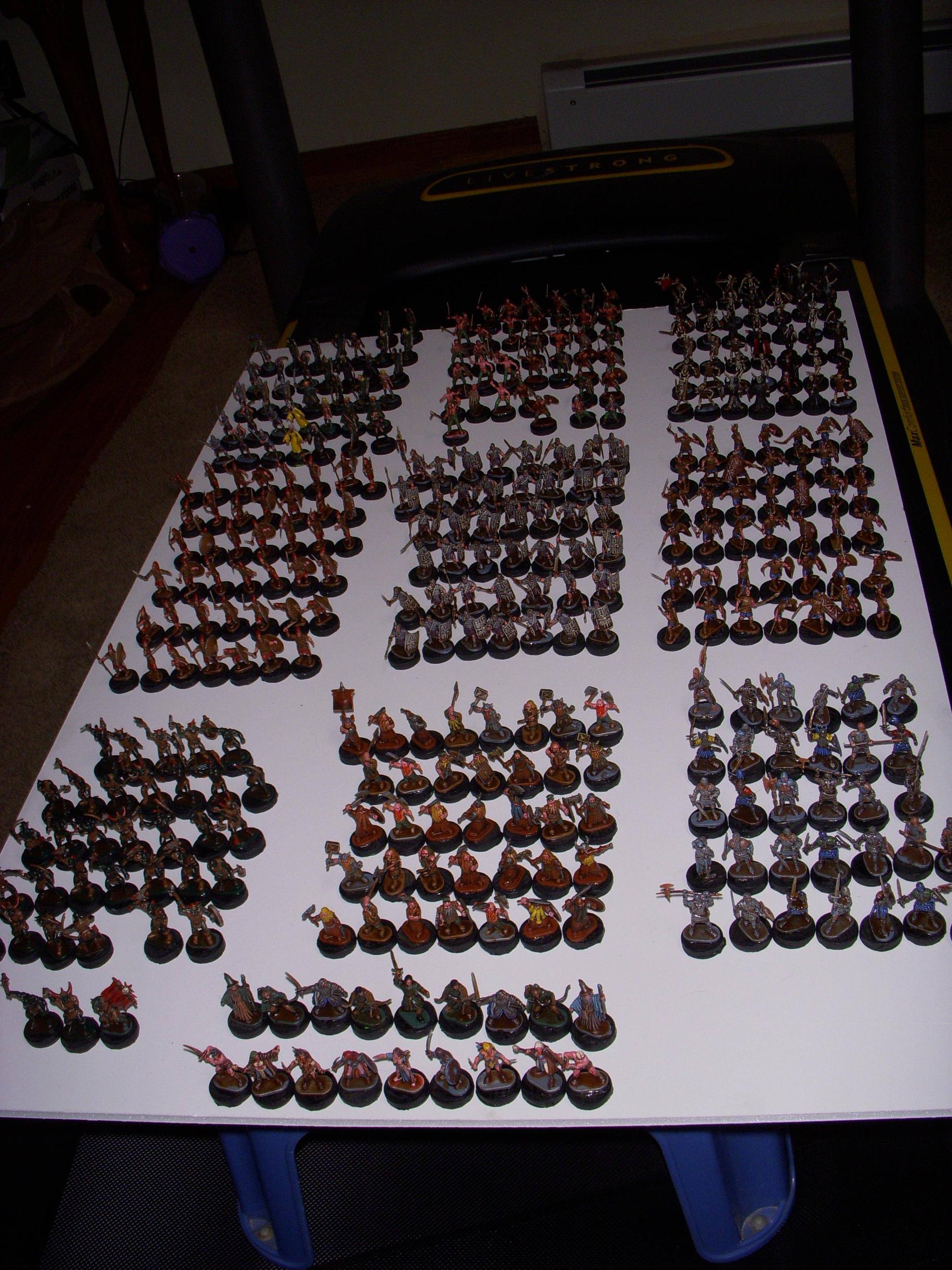
Last night I finally wrapped up the final steps of the mini painting marathon I've been on. Those final steps were the assembling and painting of the bases, the spraying of a final matte finish sealer/glaze on the minis and the glueing of the minis onto the bases. All done now. They are now playable minis that will get stored with my pre-existing mini collection.
The total cost on this little endeavor?
- Miniatures $71.55
- Shipping $6.50
- Paints $2.00
- Bases $3.49
- Shipping $1.50
- Glaze/Sealer $3.00
- Glue $2.00
- Brushes $1.95
Total - $91.99, let's call it $92.
For that I received 360 or so miniatures in ten different sets. The sets were:
- Roman Legionnaires
- Mycenaean army
- Assyrian army
- Celtic army
- Undead
- Elves
- Dwarves
- Adventurers (this included a large troll that was easily worth the $7.95 cost all by itself)
- Orcs
- Knights
Not counting the troll (which I see as a sort of bonus) I spent basically $.25 each on the minis. I don't think you'll find a better deal on minis. Mini collections selling on eBay tend to run from $1 - $2 per mini for large lots of 100 or so, and most of those are usually common minis along with random uncommons or rares and aren't generally composed of sets that can serve a particular purpose. So since I got pretty much exactly what I wanted and need for my RPG campaigns, I think the cost is more than reasonable.
Now, I received the minis last Thursday, but wasn't able to open them and start doing anything with them until Friday. I've been doing a lot of painting since then. My guess is that I spent 45 hours on the project, which means I spent roughly seven and a half minutes working with each individual mini. In that seven and a half minutes I cleaned them up (removing plastic flashing or sprue remnants), painted at least 4 and up to 6 layers, dry-brushed roughly 1/4 of them and then assembled the base, glued them to the base, dunked them in varnish and then sprayed them with matte sealant. That's a lot to get done in seven minutes.
I will post pics tonight. I got done too late last night to take photos and post them. I think they came out pretty well.
So, what did I learn from this nearly $100 experiment in miniature painting/collecting? Well, here's a sort of list of lessons learned:
Nothing is more important than a good brush. I mostly used cheap brushes (bought a pack of economy brushes from Hobby Lobby for $1.95 for like eight brushes). You get what you pay for. When I started doing the detail work, I started going through brushes pretty fast. I could have done much better detail work, and done it faster, if my brushes hadn't kept getting loose fibers that tended to leave paint where I didn't want it, and if the end of the brushes didn't keep curling up and/or bending into permanent contortions from the painting/cleaning process. A good brush costs a lot of money though... so I ended up mostly using up the cheap ones. When I paint minis in the future I will use better brushes.
Painting such tiny items with any level of precision and detail seems to be almost entirely a lesson in self-confidence. I tend to use a "dab-dab-dab" technique because I don't really trust myself to be able to put the tip of a paint-filled brush on a tiny detail (say a tooth sticking up from a lip on an orc) and "paint" the brush along the surface, keeping paint only applied to the detailed item. However, when I did force myself to actually paint with the brush instead of dabbing at the mini with the brush, the results were invariably superior. Belts are a perfect example, With the right level of confidence I could get the tip of the brush on the edge of the belt and then draw a smooth, straight line all the way around the mini with virtually no paint leaking over from the belt onto the pants or shirt, and doing that took at most a second or two, and I was done. The "dab-dab-dab" technique almost always ended up with one of my dabs going awry and took several seconds to get around the entire mini. The more I painted, the more confidence I gained, and the more I was able to paint the mini instead of just dab at it. If I could actually get my head out of the idea that I'm going to spread paint all over the mini when I try to paint it, and just paint the dang things I need to paint, I would be a much, much better painter. Even after spending a full week painting, I still find it hard to make myself use the brush and paint the mini instead of dab at it. And to make matters worse, dabbing at the mini is what tends to wreck my brushes, which just makes the process more difficult. It's amazing how much confidence and willingness to take a risk comes into play. Probably a life lesson there.
I found it much easier to do the painting with magnifying reading glasses on than to use the desk magnifying glass to do the painting. However, the desk magnifying glass has some clips on it that would be very helpful in painting if I were doing just one individual mini instead of trying to slog through hundreds at a time. So this is sort of a way to improve effeciency, not so much to improve quality.
Paint is much, much easier to apply if it is thinned first. So much easier that it's sort of crazy. Unfortunately I never figured out a way to reliably and consistently thin the acrylic paint I was using. Water caused the paint to sort of get lumpy and inconsistent, no matter how much I stirred it, and rubbing alcohol created a weird metallic effect, had the same lumpy problem, and dried out in just a few minutes, leaving the paint crusty and unwilling to stick to the figure. If anyone knows a way to reliably thin acrylic paints, I would be glad to hear it. This was perhaps the single most frustrating part of the whole process, and was particularly bad on my flesh-colored paint mixes and my gray mixes.
Certain spray paints never seem to dry. I spray painted some other items along with these purchased minis and over a week later those I painted green and gray are still tacky to the touch and leave green marks on any other minis they touch. I am really amazed by the unwillingess of these paints to dry.
Certain spray paints are very difficult to apply the acrylic paint to. The acrylic simply doesn't want to stick, requiring several coats at best, and the "dab-dab-dab" technique at worst. This was particularly frustrating since I was trying to learn to stop doing the "dab-dab-dab" technique and when working on a mini with one of the teflon spray paints, I immediately dropped back into that technique because it was the only thing that seemed to apply paint, and then found myself 20 minutes later on a completely different mini, still dabbing. Arg. Inertia....
Mixing paints to create specific colors is an art form all in itself. One I never remotely mastered. Especially on flesh tones. No matter what I did I could not come up with a flesh tone that didn't look too pink, too dark, or like some totally unnatural color. I ended up with a sort of dark pink that I used for virtually all of the minis, but when it dried, it came out as a sort of bright pinkish-red that looked more like a sunburn than normal skin. I figured the varnish dunking would darken that and just went ahead with it instead of wasting more time on the fruitless search for an ideal mix of paints. For individual minis I will have to figure out this step because I can't have all of my "special" minis look like sunburned lobsters.
Don't hold the mini you are painting directly over the paint you are using. Because you will drop it, and when you do, you will have one entire side of the mini immediately painted that color. And trust me, it is dang near impossible to clean up that sort of mess.
Details on the mini are very hard to see. Even things that would seem to be fairly obvious. Like whether the mini is wearing boots or sandals. On the Roman Legionnaires I was certain that they had metal boots because the legs had a raised lip above the ankle, just as all the other booted minis did. After painting all 40 or so of the Legionnaires with gray "boots" and letting them dry, I realized when I was assembling their shields and weapons that they actually had sandals, not boots, and they had individual toes that I had not seen. So then the question became whether to leave it with the gray feet, or to attempt to remix the flesh color (see above) and try to paint them and then paint the complex weave of sandal straps on top of the bare feet. In the end I decided that these miniatures may have technically been Roman Legionnaires, but they actually represented soldiers of the "Hanorian Guard" in my campaign, and those soldiers wore boots. Leaving their sandal clad feet painted like boots looked fine unless you looked very closelyl at them, so I ended up just leaving them painted like boots. There were many other such things, such as minis who had necklaces or wrist bands that looked like gloves at first glance. This became a common problem and there were many times after completing painting I realized that I had painted gloves when there were none, or vice versa. Oh well.... you have to look close to see these things.
The varnish-dunking technique is amazingly effective. It hides a multitude of painting errors, and gives the final result a sort of glazed look that appears very professional. On the other hand, when dunking 360 minis, there is no way to keep an eye on how each one is drying so there are inevitable problems with varnish pooling at the bottom of areas and causing those areas to be darker and to hide details. If I were doing only a few minis, I would be able to monitor each one individually and use a paper towel or q-tip to wick away the pools of varnish that collect in certain areas, but with 360 of them, just the dunking alone took me about four hours, and there was no way to monitor each one and look for pools of varnish to deal with. So these minis have many examples of varnish drying in uneven depth across the surface of items like shields, banners, cloaks, etc. But in the end the good seems to outweigh the bad, and I did a fairly decent job of flicking off the excess varnish so that this was kept to a minimum. In fact my arm still hurts becuase each mini required from 10 - 15 arm and wrist snaps to remove excess varnish after dunking. That means I whipped my arm and wrist up and down a total of over 4,000 times in that four hours. I need to find a better way to do this, although if you are only doing a few minis, this is probably fine.
The varnish dipping approach tends to render several colors that look quite distinct on first painting into almost identical colors. So the browns, grays, purples, blues and greens I carefully painted to show the details of cloaks, pants, belts, etc. was quite frequently overcome by the varnish and everything came out looking like a dull brown, which greatly reduced the color variation that I was looking for. To combat this I ended up using two kinds of varnish, one for the darker minis and one for the lighter ones (mostly the elves, knights and barely clothed female figures). Finding just the right color of varnish is probably a quest all in itself.
So, probably a lot more lessons to learn, but this is a fairly good list. Was it worth the cost and effort? Well, I won't know until I play with them. But at the very least I now have a whole lot of minis that I can use when I would have in the past used glass beads, pawns or other markers to show where non-player characters were located. That's got to be an improvement.