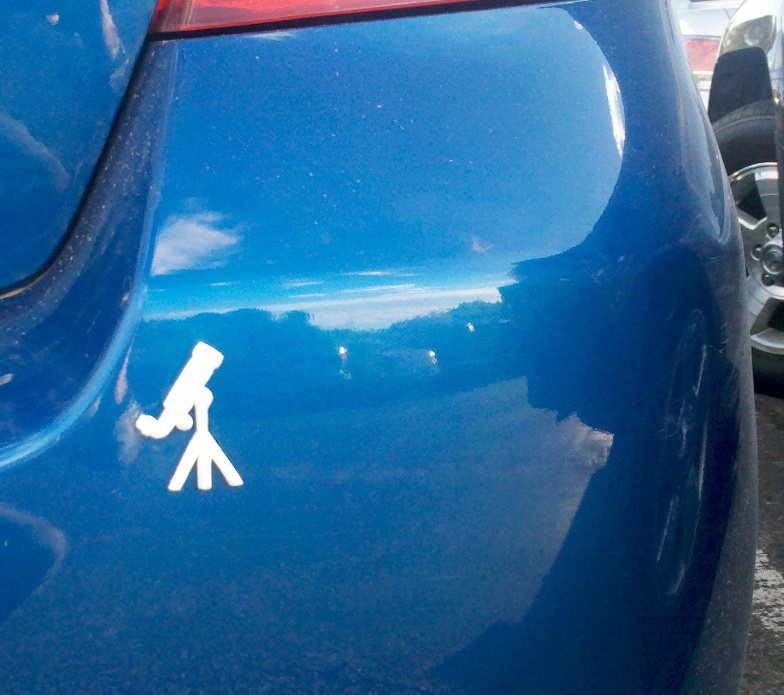
So... the epoxy resin product idea moves forward. Prototypes 1 & 2 (dry fly and telescope, respectively) are complete, installed on my Yaris bumper and looking pretty snazzy to my eyes anyway... The creation of a mold, the production of final product and the affixing to a vehicle all seem to be working out OK.
So the project is feasible from a purely technical perspective. I can make them.
Now the question is, can I sell them?
Or more precisely, can I sell enough of them to make it profitable?
So, that means it's time to break out the Excel spreadsheet...
Interestingly it turns out that there's quite a few different ways to look at this endeavor and call it success or failure...
I'll just stick to a few.
Basically the material cost of one of these things turns out to be about a buck apiece. That's a lot more than I expected, but to get it lower I have to both buy larger bulk amounts of casting compounds, and I have to get more efficient with my use of the compound. But at the volumes I am buying now, and the efficiency I am seeing today, it's about a buck apiece.
Advertising in a suitable magazine will cost about $250 per month. Figuring my own labor is worth at least $15 per hour, and ignoring mailing costs (I know, that's a potential profit source itself...) I would basically have to make and sell about 60 of these per month at $9.95 apiece to generate enough money to fund the next month's purchases, buy next month's advertising and pay for my own labor.
So I'd have to sell more than two per day on average to make any long-term profit.
Then, of course, there's the potential problem of reaching a saturation point with the market to deal with...
Hmm.... selling 60 of these a month is something that seems remotely possible if they appeal to folks...
Basically it will cost me about $250 out of my own pocket to see if this could actually work.
To be a "success" all I really need is to make enough to fund my molding and casting hobby, which would easily be done for $100 per month. To see a clear profit of $100 per month would mean selling 70 or so per month...
What do you guys think about that?
Here's a few photos of my prototype dry fly and telescope car decal/stickers...
They are essentially plastic molded stickers, each about a quarter of an inch thick and about two inches high. They are currently glued on with superglue, but I am considering purchasing some rare earth magnets and casting them with the magnets inside so that you can just slap them on your car and move them around or remove them for car washing etc...
Anyway, here's the whole Yaris bumper with both stickers:
And here's a closer-up of the telescope:
... and a closer-up of the dry fly:
The whiteness of them caused them to be a bit washed out, there is actually some detail that you can see with your eyeballs...
Would be interested in hearing feedback...
Last night was my 8th and final "Beginner Novel Writing" class. I am a pretty harsh critic sometimes, and I have high expectations for any time I spend a chunk of money. The class cost me $315 to take, which is a lot of money to me for a class which has no immediate and obvious financial return. In fact I found it very difficult to pull the trigger on the class because of the expense. I can buy a lot of books on wrting for $315. In fact I could buy a fancy Kindle and a lot of books for $315. And I like techno-toys and books...
But I actually think it was $315 very well spent. I learned a lot about writing, both on the content side and the mechanics side. I added a number of new tools and tricks to my repertoire of writing techniques. I also got a good feel for my progress as a writer compared to others who are trying to write their own books. In general I came away feeling very optimistic that I will finish my book, even though I've also learned that I have a lot more work to do than I thought I did when going into the class.
So I ended up pretty happy about the class. Happy enoough to sign up for the "Intermediate Novel Writing" class for another $285...
So, as part of my ongoing novel writing class, we were assigned to write a certain number of pages each week (which I am well ahead of) and to read one book on writing novels (I'm about halfway through) and to read at least one book in the genre in which we are attempting to write our novel.
So I picked "Game of Thrones" as the book I would read. I mostly picked it because I was curious about it having heard lots of good things about it, as well as seeing part of the first episode of the HBO series based on the book.
Of course "Game of Thrones" is just the first book in an ongoing series that was intended to be a trilogy, but has now grown into five published novels (each with more than 1,000 pages) and at least one more in the works. The series is known as "A Song of Ice and Fire" (hereafter referred to as "ASOIAF").
Reading ASOIAF I have been struck by some rather startling similarities between that and my own novel. Things like main characters having a connection with animal companions, or obsidian blades having special powers/uses. But those similarities are completely overshadowed by the differences.
ASOIAF is a bloated monstrosity of a story. It rambles from one viewpoint to the next seemingly at random. Characters live and die as if on the whim of the author. Gratuitous sexual encounters and foul language are so commonplace that even in the royal court obscene words are thrown around with wild abandon.
ASOIAF is a wildly successful series. It has received widespread critical acclaim, and has been nominated for numerous awards. Books from the series have topped the NY Times bestseller lists.
So why do I find it so laborious to read the books? I enjoyed the first book, but as the story has plodded (and I mean "plodded") along, I am finding it harder and harder to care about some of the story lines. I can't read more than a few pages without thinking about why the author chose to do this or that or some other thing. Each chapter ends with a breathless crisis, many times ending with a clear intention of the author to make the reader wonder if a character has been killed or not. The first couple of times he did that it was sort of interesting to wonder if the plunging knife had found a heart or was turned aside at the last instant by a shield or armor... But it has become old and tired, and I no longer really care about the outcome. He kills so many characters to so little purpose that any sense of urgency about a threat has been long lost. I understand that he wants to make the reader think that anything can happen to any character at any time, but all he's really done is teach me not to care about any character since I can't expect any character to survive any length of time.
Also his characters are described in all of the reviews I've read as "deeply complex characters" and I disagree entirely. Virtually all of his characters are mostly a caricature, and have ridiculously appropros names to boot. In his efforts to distinguish characters one from another he has them repeat actions or words to the point of absurdity. "You know nothing Jon Snow." I swear, I was GLAD when Ygritte died so I didn't have to read that ten more times per page. It's like he thinks rote repetition of actions or dialog is the only way to distinguish a character.
I do think he does an excellent job with "names" that are given to characters against their will. The Imp, Kingslayer, Hound, Littlefinger, etc. I really like that. He also does a credible job of building a "palace intrigue" backstory, although not nearly so well as Frank Herbert in "Dune." The rapidity which major characters reassign their alliances is unrealistic, imho, but entertaining.
What really interests (and concerns) me is that his approach to writing seems to be competely counter to my own approach. And he writes a bestseller which get great critical reviews. Where he is verbose, I try to be concise. Where he is profane, I try to be subtle. Where he is arbitrary, I try to be logical. Where he is in the reader's face, I try to stay behind the curtain. All in all my whole approach seems to be counter to his. And yet our stories have surprising similarities.
It makes me wonder if my writing style has any market at all.
I canceled my World of Warcraft account. Rhlyssa, the awesomest rogue in the history of the game, has retired forever... Sigh...
Sent all my gold to JSullins here... Hope he uses it better than I did.
I know I'm a pretty strange person. But how strange I am is sometimes only revealed even to me when my brain takes a hard, sharp turn out of normal life for no discernable reason...
That's what happened today. Or really, it started last night.
I just got fed up with my office/hobby room. Over time it had acquired so much junk that it was simply bursting at the seams. My compulsive pursuit of newborn interests tends to act like a giant junk magnet, and I just pull stuff into the room by the bucket load, but nothing ever goes out. This tends to continue until I start having visions of the TV crew from "Hoarders" showing up.
So for the past day I've been boxing up junk and hauling it out of my room, probably to end up in a storage unit as we start seriously trying to sell our house next spring. Here are the things I've been dragging out of my room...
Old computers. Old hardware. Old electronic equipment. I had two shoe boxes full of old floppy disks. I don't even have a SINGLE computer in the house anymore (and I've got something like a dozen computers here) that can read a floppy disk anymore. A dot matrix printer. My Apple Newton. My original Macintosh (OK, I correct myself, I DO have a single computer that can still read floppy disks, but it can ONLY read floppy disks...). Games by the dozens. Sometimes multiple copies of the same games. When and where did I get a Pokemon version of Monopoly? And why do I have two identical boxes of Scrabble?
I've got three huge boxes waiting to go into the garage now (I can't put them in the garage because the Cosmic Wife had a similar urge to clean out the garage, so I can't put anything in the garage, including the car, until we get the garage all cleaned out.) They are jam-packed full of stuff that I still think is too important to throw away or try to dump on some unsuspecting school or church. And my room is still full of crap!
Model airplanes, calendars, jigsaw puzzles, entire collections of magazines (Papier, the Origami magazine, Sky and Telescope, Outdoor Photography...) a veritable library of programming books (Linux, C#, HTML, XML, XSLT, Java, Java, Java, C, C++, hell I've even got a PASCAL programming book in here!) I have an entire shelf full of D&D gaming books going back to the old version 1 of the game. Not to mention four or five notebooks full of old campaign notes, maps and NPC sheets...
I've got three boxes of LEGOS! One is a huge box that I bought for a work team building exercise years ago. Radios, watches, iPods (yes IPodS, plural. An original 40G model that still has a hard drive, and two versions of Nanos), iPod accessories, photographs, cameras, telescopeS (again, yes, plural, I have three telescopes just in THIS ROOM, I have two more in the walk in bedroom closet..)
Paints, clay, foam poster board, foam sheets, bags of rocks (yes, I have three different bags of rocks in the room... two are for making terrain for my gaming, and one is a bunch of flint and obsidian that I have been using to make arrow and spear heads as well as one sweeeet piece of obsidian that I am determined one day to turn into a knife blade).
Oh, did I mention my guitars? Three of those in the room.... oops, no, I can't count. Four. I have another one downstairs.... And music books, amplifier RCA jacks and cords, music stand, guitar cases, tuners, metronomes...
Two entire shelfs full of cartoon books, Calvin & Hobbes (eight books, plus the still shrink-wrapped collectors full set of strips), Peanuts, BC, Pogo, Bloom County, Tumbleweeds, Doonesbury... heck I've got over a dozen Doonesbury books alone...
Then there's all the tools. Why I have an entire set of socket wrenches, two hammers, a rechargable drill, allen wrenches... At least I KNOW why I have the Dremmel tool, that's for working on my miniatures....
Oh, did I say miniatures? I'm not even going to bore you with the extent of my miniatures that are overflowing the room...
I've been at it all day and I'm still not seeing daylight. I just uncovered a bunch of old papers including a bunch of report cards going back to third grade, the entire set of paperwork for my Close-Up trip to Washington back in 1977, every article I ever got published, two games I created and tried to market, and the rules for three more I never did market, a box of old letters from ex-girlfriends...
This room is like some sort of bizarre archaeological dig of my life. It's downright frightening....
Oh well, I have to get back to it. I've got three boxes and a couple bags of old origami to figure out what to do with....
I'm not sure if I have previously posted that I am taking an 8 week novel writing workshop. I'm too lazy to look back to see. We have just finished week 3.
Part of the workshop (the biggest part, apparently) is having each writer submit a 15 page sample of their work which the rest of the group then reads and comments upon. I volunteered to go first, so last night we had our first critique session and chapters 1-3 of "Warrior" were up for critique from a group of ten folks I barely know and have only interacted with in the workshop.
The rules of engagement for the critique session are that the writer is not allowed to respond to any comment or even to talk at all until all of the critiques are finished. So you have to sit there on the hot seat taking notes while the results of pouring your heart onto pages are examined and analyzed from ten different perspectives. Really an uncomfortable and exposed situation to be in. There's no place to hide and since you can't rebut, you have to just accept the criticism and move on to let the next person critique.
To summarize the results, here are the things that were identified as problems by more than one of the group:
1. Not enough detail in my descriptions of the environment. This led to readers not being sure they were picturing events accurately.
2. Colloquialism and casual sentence structure in dialog. Some felt this was too "modern" and detracted from the stone age pre-industrial culture.
3. Not enough detail in describing my characters, and too many characters being introduced too early and at once. This coupled with the unusual names left readers confused about roles and relationships.
4. Some minor technical criticisms about specific sentence structure habits that editors don't like.
5. Lack of clarity around the obvious conflict between the protagonist and his older brother, exascerbated by the lack of clarity on the age of the two.
On the positive side, everyone said they enjoyed the read and wanted to read more. I'm sure some were just being nice, but some seemed very sincere about that. I figure that's got to be good.
The class instructor/facilitator does not provide his feedback in class. He dissects your writing in an email and sends it to you privately. I received his late last night (which kept me up later than I should have). His critiques were very specific about structural things, points of view, voice and story.
I came away from the experience more positively motivated than I thought I would. Everyone had specific parts of the story that they really liked, and some of the comments were dowright embarrassing they were so complimentary. Almost every criticism and suggestion for improvement was already on my list of fixes for the rewrite, so that made me feel like I had a fairly good sense of my own work and its weaknesses. That's very encouraging to me since it gives me some confidence that I am somewhat effective at identifying weaknesses in my own work.
The one thing that surprised me were comments about the casual, colloquial nature of the dialog. Some found that to be too "modern" and felt that it broke the spell of the story. I did it deliberately though because I felt like the more stilted, older style of speech was like hitting a literary speed bump every time someone said "I can not do this." or "You will need to do that." Instead of "I can't do this" or "You'll need to do that." The characters don't speak English so I don't see any reason I should translate their fictional language into archaic speech in English. I want the dialog to flow and I want the reader to be engaged in the story and I still feel that the stilted, formal approach just jars the reader.
But I am going to think about it...
Bottom line is I've got a ton of rewriting to do. A ton. Probably as much rewriting as I've done writing so far.
OK, so let's assume that you master the basic rules of spelling and grammar, and you've even managed to work out the use of active voice in your story. Is it compelling yet?
Sadly, no.
Look at your story. Now look at mine. Now back to yours. Now back to mine. Sadly yours is not mine. But it could read like mine if you knew how to make it compelling...
Some "experts" will say that the way to make a story compelling is to ensure it has the following elements:
1. Great character development.
2. Relatable culture and social interaction.
3. A believable and interesting world.
4. Economic interaction and consequences
Others give similar if slightly different lists. And of course they are usually all right. Great compelling stories usually have all of these things. But lots of totally boring and uninteresting stories do too.
Like mine.
I know my story has all these elements because I worked hard to make them all. My main characters and a dozen or so supporting characters have been mapped out, given motivations, backstories, quirks, ambitions, physical appearance, etc. And they evolve over time due to the circumstances of the story. That's part of the whole point of telling or reading a story, is to see how the characters evolve. I've detailed out the setting to include countries, mountain ranges, rivers, seas, forests, towns.... I've got friggin' MAPS of the world. I can tell you exactly how far it is from point A to point B, and show you the path you'd have to take to get there.
I have done my best to create completely different cultures for different areas of the story and have done quite a bit of research to get a feel for those cultures. (Yes, I learned how to make stone arrowheads, spearheads and knives because it was important to my story for me to have a feel for the process.) My goal is to make the cultural elements of the story PALPABLE.
OK, I've got some work to go on the economies of the world. I should have given that more thought. I couldn't tell you right now what the main imports and exports of the largest city in the story are... I definitely should know that... But still....
But I still don't feel my story is "compelling."
One blog I visited said a story is "compelling" if the reader identified with the protagonist, the event which triggered the protagonist's difficulties in the story, and the way the protagonist dealt with and (hopefully) resolved those difficulties.
Again, yeah, a good, "compelling" story will have that. But having that doesn't MAKE your story compelling...
So I have fallen back on what I personally found compelling about my most favorite books. And I've concluded that the answer is different for each of the books.
My favorite things about Tolkien's writing are not the same as my favorite things about Steinbeck's or Salinger's.
The one thing I can say is that when I read those stories, I CARED about the people and the world the story was about. So my current take on "how do you make a story compelling" has evolved into "How do you make the reader CARE about the characters and the cultures?"
But I feel no closer to having the answer than I did when I started.
So all of the web research I've done on writing query letters and engaging a literary agent say that the way to get your book published is for it to be "compelling." What it shouldn't be is "boring" or "derivative" or "confusing"...
But when you try to dig down and determine what makes a story "compelling" the only answer is basically the old SCOTUS definition of pornography... "I can't define it, but I know it when I see it."
There are lots of mechanical things that have to be done to give a story a CHANCE to be compelling. For example, you have to do everything you possibly can to put the story in an active voice. That means using active verbs and sentence construction. Then you have to be sure your story is SHOWING not TELLING the story. This is a big thing. Long paragraphs of exposition describing what the characters are doing from a disembodied distance is "telling" the story. Short concise paragraphs filled with dialog and active voice is SHOWING the story.
Right now I'd say about half of my book is showing and half is telling. I've got a lot of work to do to rewrite the "telling" chapters into "showing" chapters. Why is there so much "telling" in the first place? Well, in my case it seems to be my natural style to take the disembodied distant view and describe it dispassionately. And when you are writing the first draft all the advice and expertise says "don't worry about ANYTHING except GETTING THE STORY DONE!" The assumption is that the hardest part about writing is the initial story construction and the work effort involved in slogging through 100,000 words in an effort to get the dang story out of your head and into the real world in the first place. The thought seems to be that you can always go back and do edits and rewrites once that "hard part" is done.
Well, in my case that doesn't seem to be the case. Churning out page after page of text is no problem for me at all, as most who read this blog probably already know. I'm a wordy bastard. I like words and I type fast and accurately, so words tend to flow directly from my consciousness and stream onto the monitor without me even thinking about the keyboard or typing in between.
But rewriting is hard. Editing isn't too bad, it's mostly cleaning stuff up and you can use some actual spelling and grammar tools to make that easier.
When I try to rewrite I get really bogged down in the conversion from passive to active voice and something like this:
The pale disk of the setting sun scintillated behind the veil of distant clouds hovering over the brooding mountains as Joe carefully adjusted the throttle on his speeding motorcycle, cognizant of the fog-slickened road and the many inattentive drivers whose momentary desire to change their music player's playlist could lead to a sudden and unwanted early grave for Joe and a difficult life for his children.
... becomes something like:
Twisting the throttle forward on his roaring Harley, Joe ignored the setting sun and cursed the line of cell-phone squawking commuters ahead, determined not to leave two fatherless and penniless children.
One consequence of the rewriting is that I tend to reduce the word count by something like 20%. But I also tend to find new things to write about, so I add content while reducing word count. Which means I tend to end up after a rewrite with roughly the same number of words, but might have added two new chapters... As I did this week in my initial rewrites... More to come later...