FOXNews.com - Nearest Star System Might Harbor Earth Twin - Science News | Science & Technology | Technology News Because Alpha Centauri B is so bright and nearby, detecting a small terrestrial planet's miniscule wobble would be that much easier. Also, its position high in the sky of the Southern Hemisphere means it is observable for most of the year, just as the Big Dipper is observable for most of the year in the Northern Hemisphere. According to Laughlin, five years of observations using a dedicated telescope would be needed to detect an Earth-like planet around Alpha Centauri B. If astronomers do dedicate substantial resources to detecting an Earth-like planet, this is the star to focus on, he added. "We're advocating that there's a strong possibility a planet could be there," he said.
Alpha Centauri planets?
By CosmicConservativeThis is an interesting story. Of course computer models are not the same thing as observations (something that should be obvious from our Global Warming hype). But still, it's promising. Stellar evolution computer models are quite a bit simpler than climate computer models so I tend to give them a bit more credibility in their ability to predict star formation. If this is taken seriously by planet-searchers, then we might see a major effort to detect planets in that system.
Of course I have always advocated searching our closest neighbors for planets as a "duh" moment for science. It has frustrated me over the years how astronomers have ignored the Centauri system, and other close systems.
My logic is, as usual, quite simple and completely defensible.
If there are planets around nearby stars, we might actually be able to do something with them. Finding a planet circling Betelgeuse, for example, would be a complete waste of time unless we wanted to spend a couple thousand years trying to get there. Five or six light years is quite far enough for us to contemplate traveling for the next, oh, 200 years or so. So in my mind, we should be focusing our search for habitable planets on star systems we might conceivably be able TO inhabit some day. So if I were running the show, I'd be focusing on, say, the closest 20 star systems with about 80% of my ability to search for planets. Who the heck cares if we find a planet in a star halfway across the Milky Way? I want something close.
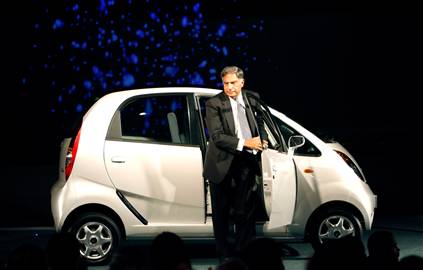 If you've been paying attention to the auto industry and auto legislation, you have to realize that this is where auto makers are being forced to go. Not to a "$2,500 car" but to cars that are tiny, have tiny engines and get 50mpg or so. The "sub-compact" is most likely the sort of car you will be buying in ten years.