So, I've indulged my own selfish pursuits the last few days and among the posts I've made are some about a book I started writing about two years ago, but which I have not touched for, well, almost two years.
I thought I'd reveal a bit of the work I've done, and maybe even give some clues about the story itself, just to see if anyone finds it interesting.
First, before I could start writing a book, I had to create a setting for it. In my case that meant creating an alternate universe, more or less from the ground up. Because this is a fantasy novel with magic as a key part of the story, I felt there needed to be some plausible background for magic to exist.
So to do that I followed the Tolkien model and actually wrote up a basic theology and creation story for the universe. I won't go into the details here, and I am not using this as an analogy for any specific earthly creation myth so there's no ulterior motive. To talk any more about the creation of the universe would give away too much of the story's intent, so I won't. Suffice it to say that the gods of this universe are real and actively concerned with what happens in it, but limited by their own design in what they can actually do to intervene. In general cosmic terms the universe is much like our own, there are galaxies, stars, planets, moons and the laws of physics are pretty much identical to our own, with a few rather critical exceptions. Next I created a solar system with planets and moons, and then created the main planet, it's continents, seas and basic political subdivisions.
From a comparison to earth perspective the planet is roughly comparable to earth around the tenth century. The most advanced societies have some basic technology and some knowledge of gunpowder, and there are large areas of the planet which are still very much in the stone age. It's a period of empire building by a few aggressive cultures who have no qualms with things like racial genocide. Some of the empires are worse than others though, and one in particular seems to deliberately project a palpable sense of evil. At least one other powerful empire is at war with the evil empire and has managed, so far, to battle them to a stalemate, leading to a years-long standoff between the two empires with constant skirmishes fought in remote areas, while major cities have been fortified in every possible way. Well-defended and maintained stone walls stretch for hundreds of miles through the countryside.
The story, however, does not begin in either of those empires, nor in any other "civilized" nation. Instead it begins in a "heart of darkness" area of the map populated by a stone-age culture which has long been ignored by the rest of the world, both for its general inaccessibility and for its perceived lack of valuable resources. However, all that is about to change.
The protagonist of the story is a young man (we would call him a "boy") who is apprenticed to the village stone-knapper, the man who makes the village's best knives, axes, arrowheads and other stone tools. His older brother is the village's most skilled hunter and his father disappeared years earlier on a trip to a faraway place on a mission even his own mother will not talk about.
In this culture as a boy reaches a certain age, he is sent on a spiritual journey chosen for him by the village shaman. In this case the journey chosen is to travel to a sacred cave far away over an imposing mountain range, to gather sacred stones which the village uses to protect itself from evil spirits, and sacred herbs which the village uses to perform certain rituals. It is a dangerous journey, and not all who have been sent on it have returned. Without the stones and herbs, the village suffers greatly, so the responsibility for a successful journey is not simply a personal mission, but is one that the village depends upon for its very existence. Or so he is told.
The first few chapters of the book are about this personal journey. Hopefully it's a compelling story in its own right. On the trip he has to contend with dangerous mountain passes, difficult to follow instructions, hungry wildlife and powerful storms.
Upon his return (I won't reveal if the journey is successful) he discovers that his entire village has been wiped out, the bodies of the villagers have been despoiled and the females have been viciously abused. There is virtually nothing left of his village except some half-burned out huts and a large number of corpses. Not knowing what else to do, he begins burying the corpses as well as he can according to the village customs. This takes more than a few days.
As he is doing this some survivors come trickling back to the village, among them are his older brother, who had been on an extended hunting trip, a young woman he had been developing a relationship with, but who had been viciously raped and left for dead by the attackers, and a ragtag collection of several stunned village survivors.
Wracked with grief and driven by revenge, our "hero" sets about to hunt down and exact his revenge on the people who destroyed his village. There is a lack of universal agreement on this course of action, and this leads to conflict and hard feelings between him, his brother and others in the group. Yet eventually he prevails and the group of villagers follows him as he pursues the raiders.
That's sort of the first "section" of the book. I don't recall how many chapters that is, but it's a chunk of story, and there is a lot going on. All of this is to set up the next portion of the story, which is a sort of grim version of Robin Hood where the ex-villagers become guerilla fighters harassing a far superior army as that army leaves a trail of destruction behind. All of the destruction of the army is simply a consequence of a larger goal, which is to attack and destroy a portion of the defensive wall surrounding the "good" empire, as part of a larger offensive which is intended to crush that empire for good.
As this part of the story develops, our hero's guerilla force grows as survivors of other villages join them. They quickly learn to appreciate and appropriate the technology of the invaders and eventually they become effective enough that they force the invaders to deal with them, creating delays that threaten the larger strategy itself. During this period the hero demonstrates a remarkable ability to lead tactically and strategically, so much so that eventually his own older brother accepts a subordinate position in their "army".
That's enough to talk about now. The story arc of the book takes this group and eventually has them join with the larger army of the "good" empire, where the hero (honestly I have been away so long, I've forgotten his name... sad) has become legend due to his actions as a guerilla fighter. He is offered a position in the empire's army and leads a climactic victory over the evil empire's general, effectively driving them back to their homeland, and freeing up the ancestral lands of the stone age cultures. However, our hero remains behind as he has become the favorite general of the emperor. That ends book 1.
Book 2, when I get to it, will be called "Warlord" and will be about the battle between the two empires from the perspective of our hero, who eventually becomes the supreme commander of all the "good" empire's troops, and whose popularity and skill eventually becomes a threat to the emperor himself.
Book 3, when I get to it, will be called "Warlock" and will reveal that the whole empire vs. empire battle was part of a larger spiritual struggle where supernatural forces square off against each other in an ultimate battle of good vs. evil with the future of the universe on the line.
Throughout all three books I intend to incrementally increase the use of magic. At first our hero seems to have no magical abilities, but it is revealed over time that he actually does, as do others in the book. The discovery and mastery of magical abilities is a key part of the character growth and development, and by the time the reader is in the third book, magic is more important than non-magical abilities. (Thus the "Warlock" title).
So far I've gotten about 2/3 of the way through Book 1.
I've been meaning to write on this for a while, but I tend to shy away from any game postings because of the derisive commentary that follows any admission that I play games, especially tabletop roleplaying or online roleplaying games, such as Dungeons and Dragons and World of Warcraft.
But as I've played WoW over the summer, I have definitely noticed some things about my own reactions and those of the other people online that I think are worth blogging about.
I hate Horde. I mean I know that the players behind the online characters are people just like me, and that I no doubt would have a lot in common with a person who plays a Horde undead rogue, for example, but when I'm playing the game in one of the Player vs. Player battlegrounds, and I see that telltale loose-limbed, hunched over gait of an undead rogue ambling across the battlefield, my reaction is feral and visceral. I want to kill that evil thing, and kill it as efficiently and thoroughly as possible. In fact I want to humiliate it as I kill it.
Now this is all in good fun, isn't it? Sure it is. I'm not really hurting anyone, although I might cause someone a bit of inconvenience as they have to resurrect their character in one of the battleground graveyards where characters are reborn to fight again, but that's just all part of the game, isnt it?
And it's not just me either. In fact I rarely broadcast my thoughts or emotions during the game, I just play it. Other players are not so circumspect. "I HATE ******* HORDE!!!!" comments are common, as I suspect "I HATE ******** ALLIANCE!!!" comments are on the other side.
What I'm pursuing here is that visceral, feral reaction that I get. It's real. I know that the rush of endorphins as I engage in a virtual death-match with a Horde undead rogue is real, I can feel it. At some level deep down, my reptilian brain is treating this virtual experience as a real life one.
And you know what? I like it. When I win, anyway. I exult in my victories. And I cringe in my losses.
I don't get nearly that sort of reaction in normal game play when it is my character vs. computer generated characters. That sort of adrenaline rush only seems to happen when I fight another player-controlled character.
But what I also find interesting is how quickly it turns off when the battles are over. There's a sort of deflation of that intensity, and within seconds I'm back to "Oh, time to go to the vendor and replenish my stuff, and maybe I should go complete that quest I'm working on, or get off the game and go blog..."
In other words, the blood-red rage-frenzy of battle dissipates more quickly than a summer mirage.
I wonder if anyone is doing graduate research on this phenomenon. Does it reveal anything noteworthy about human psychology or even physiology? This switching on and off of the blood-frenzy reaction actually sort of fascinates me. Did ancient bronze-age warriors have similar reactions? Did just the sight of Persian armor by a Greek warrior inflame that feeling of blood frenzy? How long does it take to associate those visual images with the visceral desire to kill the foe? Does that reaction actually improve battlefield performance? Is it an evolutionary advantage to associate images with blood-frenzy in that manner? Does that sort of thing even provide a means to separate battle from statecraft since diplomacy usually involves individuals who are not dressed in armor and other visual triggers which spawn the blood-frenzy reaction? In other words has the human race evolved a means to separate battlefield from diplomatic reactions so that we have enhanced our ability to fight when we need to fight, and talk when we need to talk?
How much of this applies to our formalized sports competitions? Or national fervor over sports?
Interesting to speculate upon.
Now it's time to go kill some undead Horde rogues. Man I love it!
I'm not much of a numerologist. I know some people who are, and who ascribe mystical powers to numerical coincidences. There are a lot of reasons I don't get into such things, but the most compelling reason I don't is because dates and times are purely arbitrary things that humans have overlaid on the uncaring backdrop of natural events. There is no reason that today is "08/08/08" instead of any other combination of numbers other than that an arbitrary "beginning" calendar date was set by some religious academics some thousand years ago or so.
I might be more interested in such numerical coincidences if calendars were tied to some sort of astronomical events or even human events. But since they aren't, I pretty much find such arbitrary arrangements of numbers to be interesting, but not compelling.
One of the things I ponder about when I decide to ponder is the nature of nothingness. For a long time humans thought "nothing" was that which existed apart from matter and energy. In other words, in the deepest, coldest, most remote corner of the universe, in a place where the nearest galaxies are millions of light years distant, there might be a random particle or two, but otherwise what you found there was "nothing". Similarly the space (as tiny as it might be) between the electron cloud and the nucleus of an atom was also thought to be "nothing."
But this very thought troubled many philosophers and scientists alike. From a philosophical perspective the concept of "nothingness" belied common sense at every turn. If "nothing" exists, they speculated, it at the very least had to contain some means of holding "something". That implied a capacity at least, and if something has a capacity, how can it be "nothing?" Similarly every position in the universe IS somewhere, and if something has an address, how can it be "nothing?"
In the nineteenth century this culminated in the concept of the "aether" which supposedly was the foundation upon which all the universe's matter and energy lived, propagated and interacted. In other words, "nothing" was anything BUT "nothing" it was actually the very stage that the great theater of reality played out.
When quantum mechanics came along scientists began to speculate that "nothingness" was actually a seething sea of "virtual particles" which boiled and bubbled eternally, providing a sort of foaminess to the foundation of the universe. In time scientists were forced to conclude if quantum mechanics were correct, that "nothingness" must actually have a calculatable rest-energy, an attribute they dubbed the "zero-point energy" of the universe. In fact some speculated that this zero-point energy might be exploitable as an energy source, quite a promotion for "nothingness" really.
Today there is a huge debate taking place on the nature of dark matter, dark energy and "nothingness". There are those who believe that the next Einstein-level breakthrough in physics will involve the experimental exploration into the nature of "nothingness" itself.
If I were a religious person, which I am not, I would probably make some sort of comparison between what we think of as "nothingness" and what the Bible refers to as "the Firmament."
To put it plainly, "nothing" is the raw material out of which everything we know is created. It is my personal opinion, and has been for many years, that matter and energy are simply "rolled up balls" of "nothingness" that have certain attributes based on how they are rolled up. I put "rolled up balls" in quotes because I think the reality is much more interesting than just little rolled up balls of nothingness, but I don't have a better way to describe it. In essence, EVERYTHING is nothing. And nothing is everything. There is nothing BUT nothing, and all of our incredibly vast and complex universe needs no other explanation than that. In that sense you could argue that everything is just a sort of illusion, but I don't think that. I think the reality is that there really IS no such thing as "nothing" at least not within the boundaries of our universe, and that when we understand what the "firmament" really is, we will see how it is the clay, the raw material, from which the vast array of particles and energy have been created, and into which they will someday return.
See, a lot of you were right. I really can pontificate at great length about nothing at all, can't I?
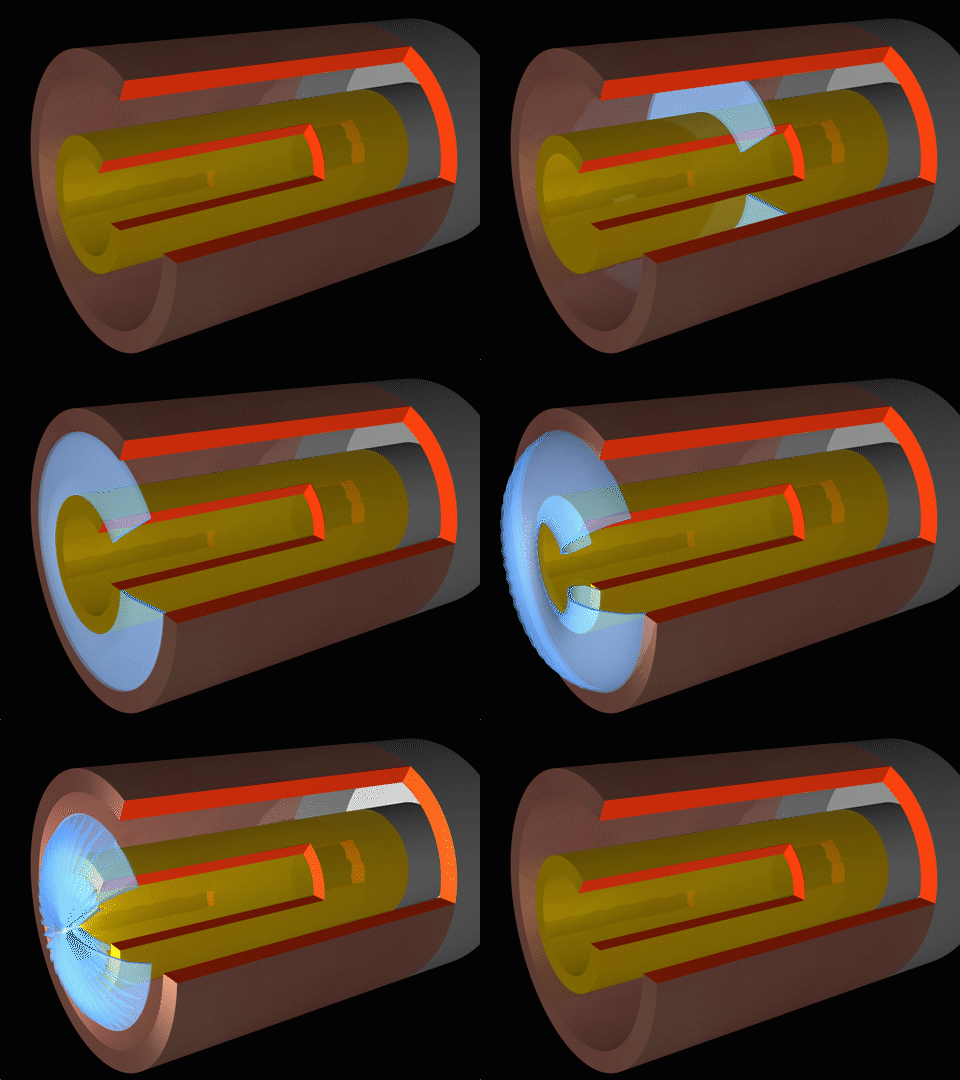
This is the best thing I've seen in a while for a potential usable fusion reactor.
2012 baby! If they actually bring this thing to market and it is as efficient and as safe as they say, then our next big thing in energy may already be in the final stages of development.
Next Big Future: Focus fusion has agreement with CMEF of Sweden
Lawrenceville Plasma Physics, Inc. (LPP) has announced the signing of its first licensing agreement for the manufacture, distribution and marketing of focus fusion reactors. The reactors, which could produce energy safely and for far less than current costs, are under development by LPP, which expects them to be ready by 2012.
OK, so I see that I'm getting a significant bump in traffic from Dadman's UFO posting. I'm hoping some of those folks actually look at the site instead of just reading that one post. In case they do, I thought I'd post my opinion of UFO sightings.
First of all let me start off by saying that I think the chance that the human race is the only group of self-aware, intelligent beings in the universe is so ridiculously low that it stretches all bounds of credulity to believe that we are "alone" in the universe. As I have said in other posts, the main thought that pops into my head when I consider such a possibility is "man, what a waste of space."
So my position on UFOs starts with the basic powerful belief, which I would call as much a certainty as I am certain of anything, that we are NOT alone in this universe, and in fact if I had to bet on it I would say that there are likely billions of other planets with intelligent beings on them. I am very pro-alien life and always have been.
But does that mean that the earth is "likely" to have been visited by any of those alien races at all? Well, that's when things get a little more difficult to work out. And here's why.
The universe is big. I sometimes think that there are very, very few people on this planet who have any real conception at all about how big this universe is, how big the galaxy we live in is, and how intimidating the distances are between even the closest stars we can see.
Factor in the fact that I am pretty much a skeptic when it comes to supernatural capabilities, and I think that we may not know everything about physics, but we know quite a bit about it, and you might start to see how unlikely I think it is that there are spaceships zipping around the galaxy like an L.A. freeway at rush hour.
And then add to that the complete lack of credible evidence of alien encounters and the flood of hoaxes and fakes we have seen over the years, and I have to admit that my skepticism of alien encounters is at least as high as my skepticism of the neighborhood "psychic" being able to tell me who my soul-mate is. Much less simply predicting the next lottery drawing.
To put it as succinctly as I can, the space between stars is so daunting that it defies easy description to people who may not have any real concept of what "the nearest star to earth is 4.5 light-years away" means.
What it means is that unless there is some magical way to get around the most fundamental things we know about physics, things like the laws of thermodynamics, the laws of conservation of mass and energy, the amount of energy it takes to accelerate physical objects to anything like the speed of light, etc... and the realization eventually sets in that making a trip to another star is a BIG DEAL. And I don't just mean for our current level of technology. I mean a BIG DEAL period. And that's not even taking into account such minor details as what happens in space when a gamma ray burst irradiates everything with life-snuffing radiation.
It is highly likely, in my view, that there are some star-spanning civilizations in the universe. It is somewhat likely that there are some in our galaxy. But unless we discover some way to overcome the most basic physical limitations our physics tells us exist, then it is unlikely that there are any galaxy-wide spanning civilizations or even any civilizations that occupy major star clouds. Much less civilizations that are roaming around the galaxy looking for random places to stop and have a picnic.
The energy cost is simply too high to waste it on random chance of encountering a suitable planet or system for colonization or trade partners. It is far more likely that star-spanning civilizations grow in carefully planned steps from one system to another after using extreme technology such as mile-wide telescopes and million-mile long antennae to search the sky for the most likely candidates for the next step. And even then the effort to build and launch a colonization attempt, or even a scouting effort is such a staggering investment of economic resources that it cannot be something that is done on a whim.
I would not be surprised to learn that there are civilizations who have sent long-distance probes on low-energy flights to nearby stars, but such flights would take centuries and would likely have a fairly high rate of failure. But there could be millions of such probes roaming the galaxy as I type this, and still the odds of a single one of those stumbling into our solar system wuold likely be in the range of one in a million or more.
Then there's the whole issue of what I expect would happen if one of those probes did enter our system. What would the likely result be? At best it would send a signal back to the home planet or the nearest outpost. Such a signal would likely take decades or centuries to reach home. And it would take much, much longer for that civilization to react to the signal with anything like a scout ship or fleet of ships.
But if they did, again the massive investment of time and energy into the effort makes it inconceivable to me that once they reached here, they would simply play hide and seek with us for decades. I just can't see any benefit to them to do so. Most likely they would simply announce their presence and seek to contact us, or else they would simply watch us from a safe distance (say the orbit of Neptune, perhaps) and call for the troops to come and clear off this nice juicy planet from the current infestation of potential competitors.
The LEAST likely of all scenarios is the one that most UFO devotees usually claim to be happening. The idea that some civilization has been secretly watching us, experimenting on us, and sending ships down into our atmosphere to be seen by lucky humans and blow their cover is patently absurd.
Basically I find the arguments that our skies are full of alien ships, and our world is infested with alien visitors hiding among us to be essentially the same level of wishful thinking as those who believe in ghosts, the Loch Ness monster or inter-dimensional gateways that pop into and out of existence. Basically I think the whole thing is fundamentally an atavistic need for people to believe in some sort of magical, supernatural connection that humans have with the universe. It used to be the Gods of Olympus, satyrs and fairies. Now it's galactic overlords, robots and "grey aliens."
So expect me to view all reports of UFOs with complete skepticism. Such claims require extraordinary evidence, and any photo that could have easily been photoshopped by a high school freshman is certainly not going to get me to say anything but "sheesh, here we go again."
When they arrive, there will be no doubt. I just hope they don't come guns a-blazin'.
If you had to switch places with any movie character in the history of the movies, who would you switch with?
Superman?
Robin Hood?
Ripley from Alien?
Rhett Butler?
Peter Pan?
Mr. Darcy?
McClintock?
The Man With No Name?
Rambo?
Wilbur the pig from Charlotte's Web?
I have come to the unfortunate conclusion that I am truly humor-deprived.
It's not that I don't have a sense of humor, I do. It's just that it takes something with a 9.0 or better magnitude on the humo-richtor scale to get me to laugh out loud.
Which partially explains why I am such a downer at parties.
The overwhelmingly vast majority of humor just elicits a wry chuckle or tiny smile from me. And much of what most people find funny (like the Three Stooges, or most "political" humor) just strikes me as mean-spirited or spiteful.
In fact it is the dry, wry sort of humor (ironic humor in particular) that I seem to appreciate most. I wonder if that's because a wry, cynical smile is precisely what is expected from that sort of humor, and that's what I'm best at providing.
How do you get your "funny" back? Is there any way to get a funny bone transplant? Any ideas?
How does a ship sail upwind? At first blush this would seem to be impossible, but it is not impossible. In fact well-designed and well-crewed sailboats can sail upwind at surprisingly respectable speeds. How do they do it?
Basically the answer has to do with the fact that a ship experiences two forces while in a steady wind. The wind itself provides a force, and the water provides another force. The wind force is called aerodynamic force and the water force is called hydrodynamic force.
But the main reason a ship can sail into the wind is that sails act as true airfoils. In other words, they act like airplane wings. They exploit Bernoulli's principle which says that the force on an object in a fluid is dependent on the speed at which the fluid flows over the surface of the object. For a sail (or an airplane wing) that force is different on the leading and traling edge of the sail. The net force is what provides the thrust the ship feels.
But, in the absence of hydrodynamic forces, a ship could not maintain a particular heading to exploit the properties of an airfoil. Drag forces would quickly orient the sail such that it no longer had a different air pressure on one side than the other, and the wind would simply blow the sail along.
What allows the sail to maintain an orientation to exploit the differential aerodynamic forces is the ship's hull, keel or other object which takes advantage of the hydrodynamic forces in the water to offset the forces of the wind which want to reorient the sail so that it only blows downwind.
Because these two forces can be set to oppose each other, the resulting total force on the boat is an additive vector derived from adding the aerodynamic force to the hydrodynamic force, and that resulting vector can point in virtually any direction except directly upwind.
Since a ship cannot sail directly upwind, they have to zig-zag along an optimal angle into the wind. This zig-zagging is called "tacking into the wind" and a really well designed sailboat can tack about 35 degrees from straight into the wind.
Now, if there is a strong current in the water, that can also be exploited to improve the angle of movement into the wind.
It is the real-time evaluation of all of these forces, and the ability to plot an optimal course into and downwind that separates average sailors from great ones. The zig-zagging of the ship requires a complex set of adjustments to the ship's rudder, angle of attack in the water and sail settings that has to be redone every time the ship zigs or zags. This has to be choreographed like a fine ballet in order for the optimal results to be achieved.
The realization that a ship could be made to sail upwind in this manner is one of the defining moments in all ancient seafaring cultures. The fact that such cultures were able to understand and exploit this is a testament to how clever human beings really are. Ancient Phoenicians, for example, had no idea of how Bernoulli's theorum explained fluid dynamics, but they intuitively understood how to exploit them anyway. It's almost a zen thing, they were able to figure this out by pure feel.
And people think that ancient humans were dumb. This stuff is not easy folks, and humans have been doing it for tens of thousands of years...
Telescopes will one day be virtually useless if based on earth. The combination of light pollution, atmospheric interference, and political turmoil over their placement and use will eventually turn earth telescopes into museums. There will also be a limit placed on how large you can build one, and with telescopes, size is everything, so that alone will eventually make earth-based telescopes obsolete.
Astronomy, even optical astronomy will move into space. The Hubble Space telescope is a relatively small telescope by modern astronomical standards, roughly one-third the diameter of the Keck telescopes. Its amazing photos are more a result of the lack of atmosphere and the ability to keep the telescope pointed at the same spot in the sky for hours, even days.
There is already talk of trying to put a larger telescope into space, but what we need to be doing is not thinking about how we get telescopes designed on earth into space, but instead we need to start thinking about how we design a space telescope to be MADE in space.
I've had some really bizarre notions about how to build telescopes in space. One idea I've had is to blow a really, really big bubble in space. Now I'm not sure how you do that, but for the sake of argument, let's say that you can build a giant beach ball in space, say something on the order of ten kilometers in diameter. Then you spray the entire outside of the ball with a hard-setting resin that makes it a solid shell. Once it cures, you cut out circular pieces of the shell and paint the inside with reflective aluminum or something else. Do it right and you end up with several huge spherical mirrors. Spherical mirrors are not perfect telescopes, but if you build a much smaller (say something the size of the Hubble telescope) hyperbolid mirror as a secondary mirror, you can correct the spherical aberrations of the main mirror. One big beach ball in space could give you six or more giant reflecting telescopes in orbit. Arrange them properly and use interferometry, and bingo you have telescopes with resolution capable of spotting a planet like earth orbiting millions of stars in our galaxy.
But say you want something truly gargantuan. A telescope the size the earth. Let's shoot for a 15,000 kilometer mirror. How would you build something like that? It's pretty clear you can't use the beach ball approach (or could you.... hmmm...) still, it seems unlikely. So what can you do? Well, you could build a lot of little mirrors and have them laser-ranged and self-adjusting in relation to a central platform. So, as with many of my far-future space-based schemes, let's say you start with an asteroid, one with a high silicon content. Then you build a self-replicating robot that builds two copies of itself, and then builds a small (say 1m diameter) mirror. For the sake of argument let's copy the Keck idea and have them make hexagonal mirrors. For the sake of simplicity, make the mirrors spherical with a focal radius of say, 15,000 kilometers. Then the mirror-robots launch themselves from the asteroid, and arrange themselves in the shape of a telescope. It would start small, but would grow rapidly. As each new mirror was completed and put in place, the final telescope would be just a bit bigger and better. Perhaps it would take a hundred years to complete the mirror, but I'm betting on the exponential nature of the robots making two copies of themselves getting the full mirror built pretty fast.
Now, what if you wanted to build a telescope the size of earth's orbit?