Cosmic Conservative

Rational Conservatism from the heart of America

Science & Technology

Idea for a high-end pellet gun

By CosmicConservative
So... high end pellet guns sell for up to $5,000. I have an idea that I think would produce a pellet gun of such superior accuracy and consistency that it should be eagerly sought after by pellet gun enthusiasts and could easily sell for $3,000 or more. I don't think it's a difficult engineering challenge either. It's just something that nobody seems to have put together all the elements of. If I had a machine shop, I could build a prototype in a week or so. What's the best way to see if this could be a money making idea? Yeah, I know the answer is "PATENT IT!" I am looking into that now. Assuming I do pursue a patent, what's the best way to build a prototype?

The ultimate pellet gun?

By CosmicConservative
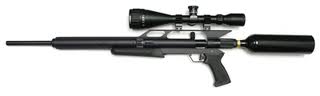
So... I think I have finally found the pellet gun I really want. This is the Maserati of pellet guns. It's called the "Condor" and it's made in America by an American manufacturer called "Air Force." (Clever, eh?) Why is this such an awesome pellet gun? Lots of reasons. It's a dual power source design. You can either use compressed natural air at up to 3,000 psi, or you can use CO2 "cartridges." The "cartridges" is in quotes because we're not talking about the sort of cartridges you put in a typical pellet gun, the CO2 cartridges are huge, and are used normally to recharge paint ball guns. Obviously there is a huge power difference between CO2 cartridges and the compressed natural air, but CO2 is a nice power source for plinking. Compressed natural air is more for serious shooting. I love this basic design. The air tank doubles as a shoulder stock, which reduces the weight of the gun by a pound or more. The air flows directly into the breech in the direction of the barrel, doing away with any recoil or airflow turbulence problems. It's got weaver scope mounts and a loooong barrel, which is ideal for accuracy. But there's more. The "gun" here is really more of a "gun platform" than a "gun." You can swap out the barrel, use alternate power sources and add all sorts of tactical accessories (laser sights, flashlights, scope levels, etc.) easily. You can purchase all of the common pellet caliber barrels, from .177 to .25. And at 3,000 psi it will send a .25 caliber pellet at over 800fps, delivering over 30 foot pounds of energy at the target as much as 50 yards downfield. The huge air reservoir allows you to get up to 100 shots in the "sweet zone" of the power curve. Most PCP airguns get 20 or so shots before you have to top it off again. Plus you can "dial down" the power which still provides more power than most airguns but can then last up to 200 shots before falling off the bottom edge of the power curve. The gun itself costs about $650. Additional barrels and accessories would push that up to $1,000 or so. But man, oh man, what a pellet gun you would end up with... Yeah, the Maserati of pellet guns. I really want one. :)
Oh... hey! Solar Eclipse viewing from the western USA this Sunday

By CosmicConservative
If you live in an arc from West Texas through parts of Arizona, New Mexico, Nevada and California (as well as up into Washington I believe) you will have a good chance to view an annular solar eclipse Sunday evening. Annular eclipses are those where the moon's apparent size is smaller than the sun's apparent size and so the edges of the sun will shine like a golden ring in the sky. However, by sunset pretty much anywhere west of Kansas you should have a view of a partial solar eclipse, and those are rare enough. So enjoy!

We need a new post-galactic universal model measuring unit

By CosmicConservative
I'm tired of reading that such and so astronomical object is "only 34 million light years" away, or "300 million light years.." or whatever. Astronomers don't actually use light-years as the "official" astronomical measuring unit. They use the "parsec" which is a derived measurement based on the parallax of earth's orbital diameter. A parsec is about 3.25 light years. For longer distances they use "mega-parsec" which is a million parsecs or some other such variation. But you never see those used because "parsec" is such a weird word that most people don't recognize it as a distance measure anyway. That's why the original Star Wars movie used "parsec" as a unit of time in Han Solo's famous defense of the Millenium Falcon. Anytime you have to throw "kilo-" and "mega" and "tera" onto something to measure it, you've pretty much proven that the base measure is sort of meaningless. So, I propose that we define a new unit of measurement based on the size of our local group of galaxies. The average diameter of the volume of space containing the local group could be called one "cluster unit" or shortened to one "clunit". Therefore the distance to any astronomical object would be defined in terms that relate to the size of our local group. The nearest galactic cluster might then be 12 clunits away. The Andromeda galaxy might be .01 clunits. That would immediately show that the Andromeda galaxy is pretty friggin close in galactic terms. The farthest items in the universe would then be a few thousand clunits distant. I think anyway. I'm too lazy to do the actual math, but I think it would work out that way. This sort of things puts the units in an astronomical context, instantly giving the reader a sense of scale of the distance being discussed. Anything 1 clunit or less is clearly pretty close. Anything 100 clunits or farther is pretty far out there. 1,000 clunits and you're getting to the edge of the universe... Makes perfect sense to me...

Planet in Goldilocks zone

By CosmicConservative

The planet lies in what they describe as a 'habitable zone', neither too near its sun to dry out or too far away which freezes it.

And the discovery could help answer the question of whether we are alone in the universe, which has been plagued astronomers and alien fanatics for years.

Scientists found the planet, Gliese 667Cc, orbiting around a red dwarf star, 22 light years away from the earth.

via Astronomers find new planet capable of supporting life - Telegraph.

Sensational stories like this always crack me up. This isn't news. It isn't even new. All this story is really saying is that the planet orbiting Gliese that was previously suspected strongly of orbiting in the "Goldilocks zone" around the red dwarf star is now confirmed to be smack in the middle of the zone. I wish these mouth-breathing, hyperventilating "reporters" would just report the facts. The facts here are that we've got strong evidence for the existence of a rocky planet orbiting around a red dwarf star at a distance where it would receive a comparable amount of heat and light from its star as the earth does from the sun. That's all we really know. Everything else is speculation. It may have a super-dense atmosphere like Venus and a runaway greenhouse effect, or it may have no atmosphere. It may have perfect temperatures but no water. Nobody knows. It is reasonable to suppose that there could be water there though, since water is pretty common in our own solar system and current solar system formation theories would suggest that water is pretty common in most third or fourth generation star systems. The fact that there is a rocky planet there is a good indication though that the star was formed from a similar dust cloud as the earth. Heck, it may have formed from the very same dust cloud as earth. It's pretty dang close. 22 light years is kissing cousin distance.

Al Gore in Internet Hall of Fame

By CosmicConservative
One of the favorite memes of righty bloggers is to mock Al Gore for having claimed to invent the internet. Today Al Gore is one of the first inductees into the "Internet Hall of Fame".

The group’s description of Gore states: “Al Gore, the 45th Vice President of the United States, was a key proponent of sponsoring legislation that funded the expansion of and greater public access to the Internet. Instrumental in helping to create the ‘Information Superhighway,’ Gore was one of the first government officials to recognize that the Internet’s impact could reach beyond academia to fuel educational and economic growth as well.”

via No invention: Al Gore’s Internet honor - Patrick Gavin - POLITICO.com.

This is well deserved. As I have said here on this blog before, no matter how much scorn and derision I heap upon Al Gore as a Climate Change Zealot and general political sleaze-bag, they guy actually was one of the key supporters of the government support for creating what is now the world wide web. The "I created the internet" meme is as fair to Gore as is the "I can see Russia from my house" meme is to Sarah Palin. So good for Gore.

Bio-ethics and terraforming

By CosmicConservative
So... Let's say that we approach the Singularity and as part of that transformative exponential explosion of technology we discover a way to quickly and efficiently terraform the planet Venus, reducing it's atmosphere to earth-like densities and changing the composition to be nearly identical to earth's nitrogen/oxygen/CO2/Water vapor mix. As part of that a system of orbiting satellites provide a constant shade to reduce the sun's intensity to be comparable to the energy the earth receives from the sun. (The 'extra' sunlight would be converted to energy for all the happy, busy Venusians to use.) Let's say that this can all be done in a decade. Then, just as the engineering is about to begin, someone discovers that Venus's atmosphere is populated with a family of "extremophile" bacteria which require the conditions of Venus's current atmosphere to survive. Would it be ethical to drive those extremophiles to extinction in order to have an entire new planet which could be populated with the entire rich diversity of earth? Or are we ethically compelled to allow the Venusian bacteria to stop our efforts to terraform Venus?

Googling asteroids

By CosmicConservative
Well, someone with some actual cash is actually going to pursue exactly the space exploitation approach I've been championing for literally all of my adult life. This is good news.

James Cameron, Google Founder Back Space-Mining Venture - WSJ.com.

A new company backed by two Google Inc. GOOG -0.54% billionaires, film director James Cameron and other space exploration proponents is aiming high in the hunt for natural resources—with mining asteroids the possible target. The venture, called Planetary Resources Inc., revealed little in a press release this week except to say that it would "overlay two critical sectors—space exploration and natural resources—to add trillions of dollars to the global GDP" and "help ensure humanity's prosperity." The company is formally unveiling its plans at an event Tuesday in Seattle.

The "new" flying car

By CosmicConservative
Here's a cool video. I want one. Such a brilliant, state-of-the-art invention, right? Wrong: The "auto-gyro" has been around for a long, long time. This "Pal-V" is just the latest in a long line of similar car/planes that have been "on the verge" of becoming "the next big thing" since before WWII. There is a famous video of an auto-gyro landing on Pennsylvania Avenue and then folding its rotors and driving off like a car, but I couldn't find it. The auto-gyro works by allowing the overhead rotor to spin freely. The aerodynamics of the rotor cause it to spin when you pick up speed. Eventually they spin fast enough to provide enough lift to get you airborne, so long as you still have enough thrust to keep moving forward. Early auto-gyros had standard front-mounted propellers. But there have been many with rear mounted thrust propellers as well. They are extremely safe too, because the overhead rotor will auto-rotate as you fall from the sky, slowing you like a parachute, and so long as you have even a bit of forward momentum, you can flare the auto-gyro without thrust on landing and make a nice, soft, safe landing even if your whole engine falls out of the thing. It's sort of amazing that these have never caught on. Maybe this one will. There's really nothing new about this at all, except maybe it's a bit sleeker due to using new super-light/super-strong materials like carbon fiber. I'd love one.

Is sugar toxic? - CBS News

By CosmicConservative
Sound familiar?

(CBS News) Dr. Robert Lustig, a pediatric endocrinologist at the University of California, believes the high amount of sugar in the American diet, much of it in processed foods, is killing us. And as Dr. Sanjay Gupta reports, new scientific research seems to support his theory that sugar is toxic, including some linking the excess ingestion of sugars to heart disease. Gupta's report will be broadcast on 60 Minutes Sunday, April 1 at 7 p.m. ET/PT.

via Is sugar toxic? - CBS News.