Neil Armstrong, the first man to walk on the moon, died Saturday, weeks after heart surgery and days after his 82nd birthday.
Armstrong commanded the Apollo 11 spacecraft that landed on the moon on July 20, 1969, and he radioed back to Earth the historic news of "one giant leap for mankind." He spent nearly three hours walking on the moon with fellow astronaut Edwin "Buzz" Aldrin.
via Astronaut Neil Armstrong, first man to walk on moon, dies at age 82 - Cosmic Log.
Sad indeed. Neil Armstrong is the closest thing I probably have to a personal "hero" from popular culture, sports or science. People who know me know that I don't go much for hero-worship and I don't idolize people just because they were successful at one very visible thing.
But Neil Armstrong was special. Neil Armstrong was like the George Washington of the astronauts and test pilots. Most people had or have a general awareness of Neil Armstrong but the respect Armstrong had from his peers is legendary. It is no simple coincidence that Neil Armstrong was the man that NASA pinned their hopes for the success of the most ambitious government program in the history of the world.
People think of Neil Armstrong as an astronaut. But he was first, and in his mind, foremost, a pilot, and a test pilot at that. After serving his country with honor and distinction as a Naval aviator in the Korean War, Armstrong became one of the nation's elite test pilots and flew, among many others, the X-1, X-15 and the aborted but forward-looking "Dyna-soar" space vehicle. Armstrong was one of the first civilians to join the NASA astronaut program. And he did so in spite of the jeers of other test pilots such as Chuck Yeager who ridiculed astronauts as "monkeys", a reference to the practice of early test flights having primates strapped into the capsule to test survivability.
Armstrong was the mission leader of "Gemini 8" and he and David Scott became the first men to successfully dock two spacecraft in orbit.
The Apollo 11 mission has been documented and scrutinized for years, and yet still I am surprised by how few people realize what Armstrong did on that mission. One of the reasons for the ridicule of pilots like Yeager was that the program called for the entire moon landing sequence to be done by computer, with no human control. Of course Armstrong and the other Lunar Lander pilots were taught how to "fly" the Lunar Lander, but the hopes of the NASA engineers and administrators was that human intervention would not be needed.
But that was not the case. If you listen to the tapes of the landing sequence, you will hear a very calm voice announce a code (I can't remember the exact code) but the code was supposed to mean a landing abort. Armstrong did not recognize the code (there were hundreds of codes possible that the pilots had to memorize, but this one either had not been on the list, or was one Armstrong failed to remember). Since it was not in his mental list of critical errors, Armstrong instead decided to continue the landing and within a few seconds a frantic mission control search of codes and their causes resulted in mission control agreeing with Neil's split-second decision.
Continuing on, Neil recognized that the lunar scenery was "wrong". The landing site was chosen for it's smoothness, but Neil was seeing huge boulders and craters outside the window and saw nothing but more boulders and craters in the direction the lander was moving. Again Armstrong made the split-second decision to assume manual control of the Lander.
Now. This is important.
Flying a Lunar Lander is not like flying an aircraft. It's more like balancing a beach ball on four water jets. To "fly" the lander meant simultaneously controlling multiple rocket nozzles which adjusted the Lander's altitude, yaw and pitch. And it meant doing it in lunar gravity, something that was impossible to accurately simulate on earth. Neil was on his own, flying a brand-new rocket type in lunar gravity over a boulder-strewn landing area with nothing but a tiny window to look out of and with the entire world watching.
His heart rate and blood pressure skyrocketed. But his voice does not falter for an instant. Because their descent had overshot their planned landing area by several miles, there was no way to get back to that location and Neil had to locate a flat area to land amidst all the boulders and craters visually through a window about the size of a dinner plate.
Think about that.
And at first he saw no safe place to land. He flew on, making his best guess from the limited view he had of where he might find a flat place to land. Every second spent precious fuel he could never get back. His blood pressure and heart rate remained at alarming levels, but he simply keeps looking.
Finally, with no more than a few seconds of fuel left, he finds a spot and settles the Eagle down.
It was because Armstrong believed that human reaction and adaptability would likely be required when the moment of truth came that he was able to shrug off the taunts of Chuck Yeager and the other non-astronaut test pilots. And in the end he flew the Eagle to a safe landing, something no "monkey" could have accomplished.
And for all the years afterward Neil avoided the spotlight and fame that could have been his for the taking. He did his job, ignored those who tried to bring him down and delivered one of the most uplifting human achievements in human history and called it "just doing his job."
Rare, rare man. He will be missed.

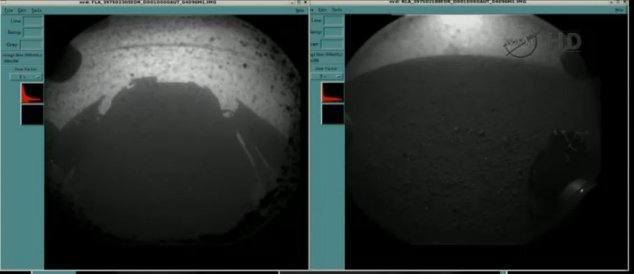
 Seriously, I am sometimes amazed by how clever humans are.