Sometime in the next couple of years, you will probably
buy a 3D TV.
Just bought a new flat-panel HDTV for Christmas? Enjoying that new Blu-ray disc player? Guess what? They're already obsolete. Everything may be going 3D.
Later this week at the annual Consumer Electronics Show in Las Vegas, a slew of companies will be pushing what they hope will be the next big thing in TV: 3D movies and games — even new 3D HDTV broadcasts.
The technology used to deliver that 3D is still not completely determined, but there is at least one technology that has been demonstrated in working 3D TV models. The first 3D TVs will likely be out in time for Christmas shopping in 2010.
3D vision is a simple thing in theory. All you have to do is deliver an appropriately oriented image taken from an appropriately positioned camera to each eye so that the brain perceives the depth of field necessary for a 3D image.
Fifty years ago this was originally done by using red and blue filters so that images could be projected from two sources simultaneously on the same screen. The blue image would go through the red filter (because red filters reflect red light) and the red image would go through the blue filter. Each eye would therefore see a slightly different image, which the brain would perceive as a stereo image.
The problem with red/blue filters is that they aren't perfect, and they skew the colors anyway. So the viewing experience was somewhat unpleasant with fuzzy images and color bleeding.
About 20 years ago 3D movies started coming out using polarized light filters. The concept is exactly the same as with red/blue except that the polarized version uses two light sources polarized at right angles to each other. So one image is projected on the screen with vertical polarization, and one is projected with horizontal polarization. The screen is specifically designed to reflect the same polarization as the incoming light. Using glasses with polarizing filters (just like many sunglasses have) the vertical polarized image will be blocked by the horizontal polarizing filter and the horizontal polarized image will be blocked by the vertical polarizing filter, thus delivering two separate images to the eyes. I first saw this sort of 3D movie back in 1999 at DisneyWorld. The movie "Avatar" uses this technique. Compared to red/blue 3D technology the polarized version is sharper and has none of the color bleeding problems. So images are sharp and clear and the experience is extremely realistic.
To do this sort of 3D in a TV though is not so simple. TVs don't generate polarized light, and even if they did, the resolution of the LCD or plasma screen would have to quadruple so that half of the pixels would be polarized one way, and the other half would be polarized the other way, but the resolution would stay at 1080p.
So for TV images the technical wizards came up with a completely different approach. Using unpolarized LCD or Plasma TVs, they deliver two images to the same pixels, but alternate them so that two different images are flickering back and forth. For this to work you have to have glasses which have shutters which close and open in synchronization with the TV image. That means they need a power source to work. The glasses being used in today's demonstrators are similar in appearance to the polarized glasses, but when in use they have LCD shutters turning the glasses opaque and then clear 240 times per second. The TV is switching between images 240 times per second. This approach relies on the retina's tendency to blur fast images together (which is the same thing that allows animation to work) so that you don't perceive the flickering, it just looks like one steady image.
Such glasses will probably cost about $50 each, so for a family of four to watch a 3D movie would mean $200 in glasses. And if you break them, you're out of luck.
Now, for a movie like Avatar which was filmed in 3D and can be delivered in two separate video feeds, this technique can easily be adapted to show the movie on a suitable TV/goggle combination. But for live TV there are tons of details to work out, and cable companies are already struggling to deliver HDTV channels. So it's gonna be a while before you can watch your favorite football team in 3D.
But I bet within 5 years, you'll be able to do so.
 Think you're ready for that in 3D in your living room?
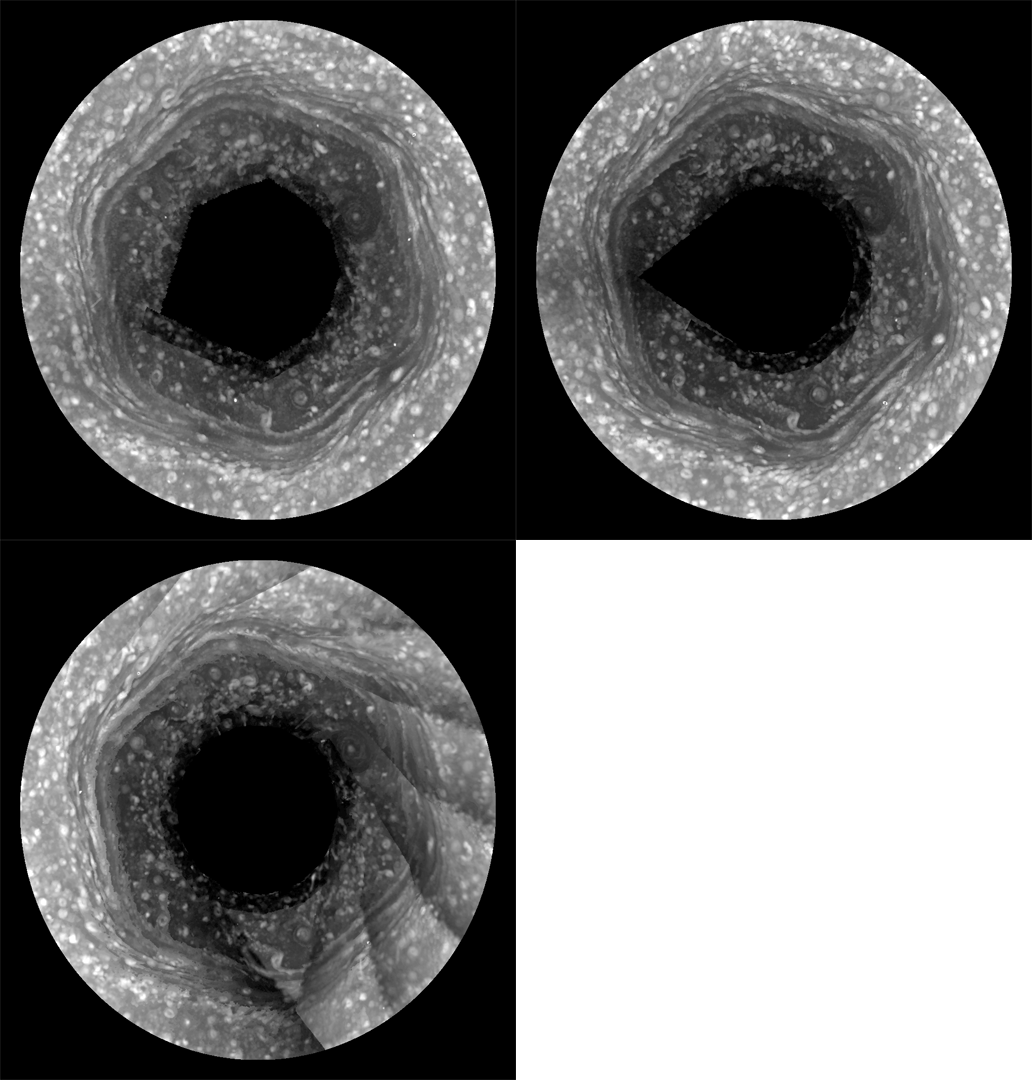 This is what I love about space exploration. I cannot imagine what is causing this, and I can assure you, NOBODY would have predicted this.
That hexagon is near perfect. And it's been that way since we first glimpsed Saturn's north pole...