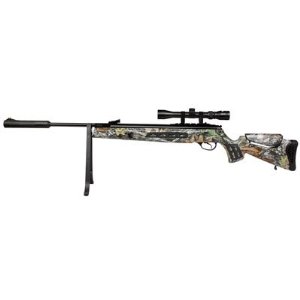
Just can't stop myself... Even though I'm not ready to weigh in on the accuracy of the gun... I'm stuck on an endless conference call and need to stay awake...
Here are the things I like so far:
1. The gun is solid as a tank. It weighs as much as a tank, but it's built like one too. All the parts seem to be meshing together well, there don't seem to be any problems with any seals, the stock fits the metal breech and barrel cleanly, it all feels solid and secure when you pick it up.
2. The barrel sights are much better than I expected. I've been seeing lots of ads for guns with "fiber optic sights" for a while. Pretty much every pellet gun over $125 comes with them. I thought they were pretty gimmicky sounding until I actually saw how they work. During daylight anyway, they work very nicely. The rear sight has two green fibers making up the framing, and the front sight is orange. Lining it up on the target gives a sort of LED look and feel. It's quite nice actually. I'm looking forward to sighting them in tomorrow. The back sight has a nice adjustment screw for both windage and elevation too.
3. The trigger. Very nice trigger. Very very nice. And adjustable as well. I may play with the trigger pull weight at some point, but right now it seems to be set just about how I like it, so I haven't messed with it. You can adjust both the weight of the trigger and the length of the draw on the trigger.
4. The noise level. It's not "quiet" but it's not nearly as loud as other similar guns. If I'm shooting it off the deck in my back yard, you can't hear it if you are sitting in the living room with the TV on. I doubt if any of my neighbors can even hear it unless they are out in the yard. Considering the violence of the actual firing, it's very surprising how quiet it is. There is no "ringing" sound that most break-barrel pellet guns are infamous for. The damping mechanisms inside the gun to reduce vibration and reduce sound seem to work.
5. The power. I'm not kidding about this thing being comparable to a .22. I suppose it's not really near the actual power, but compared to the pump style pellet guns I'm used to, this thing is a monster. The pellets I'm pulling out of the bullet trap are literally just flattened. There's no "pellet" left, just a thin smear of lead about the size of the tip of my thumb. I have no doubt this thing could take down a deer. Seriously.
6. The safety. It automatically sets the safety when you cock it, and you can't turn the safety off until it is fully cocked, so it is supposedly impossible to misfire while cocking. The safety "switch" is a simple thumb-operated lever on the very back of the barrel behind the breech. It's handy and easily manipulated with your thumb. I typically leave the safety engaged until I sight in the target, and then turn it off just before firing the gun.
7. The stock. OK, it's plastic, not wood. But I am more about function than form, and the camo stock with the adjustable cheek rest and the rubber shoulder pad with rubberized grip enhancers feels very comfortable, with the nitpicky detail of having to deal with the split front end of the stock so that the barrel can lever downwards through the stock to cock the gun. Unlike most "plastic" stocks, this one does not feel slippery, doesn't feel fragile, doesn't feel hollow or ring when tapped... it is quite sturdy, functional and is easy to grip.
8. The look and feel. The gun does not look or feel like a pellet gun. It looks and feels like a "real" gun. And it looks like a pretty cool gun.
Things I am sorta "meh" about:
1. The sling. It is nice that it comes with a sling and the sling connectors are already installed on the gun. I've had to install slings on guns without sling connectors before and it's pretty touchy to figure out the best place to put the connectors so that they carry the gun comfortably but don't put so much stress on the stock that you end up splintering the stock. But the sling itself is lame and is only adjustable on one side of the shoulder pad. It seems to work OK, but it's nothing great.
2. The loading. To load the gun you have to break the barrel and insert the pellet directly into the front barrel, then fully cock the gun so that it is ready to fire. It feels sort of clunky and puts dirty, perhaps wet, fingers way too close to the compression tube for my taste. I put this in the "meh" category instead of "don't like" because I don't really have a good alternative to suggest. It's sort of built into the fundamental break-barrel design. But it's funky and awkward and you need to be mindful of the proximity of the compression tube, which can be damaged if you manage to get dirt into it.
3. The scope rail. It's better than lots of pellet gun rails. At least it has one, my pellet pistol doesn't and I had to buy special mount gizmos to even mount a scope on it. And it also has a screw in "adjustable" stop so that the scope won't just slide off. Plus it is the new design (I forget the name, maybe "Weaver") which allows scopes with built-in stops to latch firmly onto the rails (of course the scope that came with it doesn't have that feature...). I suppose one day I might put this feature on my "things I like" list if I buy a better scope, but for now it just seems odd that the gun has such a well thought out scope rail system, and such a crappy scope. It almost seems like a deliberate design to encourage the buyer to buy a better scope.
Things I don't like:
1. The scope.
2. Did I mention that the scope sucks?
3. The recoil/backlash. It's more than I expected, and I expected a lot.
4. The weight. It's actually pretty heavy.
5. The cocking. Cocking this thing is like doing chest buildup exercises. It's a serious effort. Probably 35 pounds worth of effort every time you cock it. And there's no perfect orientation that I've been able to find that makes it simple, easy and fast. I suppose over time I'll figure the best compromise between those things, but right now it's just work.
I will do a separate post on the gun's accuracy when I believe I have finally convinced myself of whether it shoots straight or not.
This isn't going to be a "review" because I don't think I'm ready to provide an opinion on my new pellet gun, but I thought I'd report status.
The Hatsan Mod 125 Sniper in .25 caliber arrived with 800 .25 caliber pellets on Friday. I got home early Friday (but was still working from home) but that meant when I finally did finish work, I was able to go outside and shoot the gun.
So I did. I shot it once at a stump I use as a target for my pellet pistol and my slingshot.
The pellet blasted through the stump like it was nothing but sawdust. Luckily the stump is on a hill and the pellet just buried itself in the ground behind it.
"Cripes!" I thought. "What the hell!?"
So I decided to find another target. I figured a sturdier, live tree would be a fine target, and would let me see how powerful the pellet was.
Well, more about accuracy in a minute. I hadn't yet even tried to sight the gun in, and I actually missed the tree. It wasn't a big tree and it was about 20 yards away, and I should have known better than to shoot an unsighted gun at something that far away, but everyone does stupid things sometimes I suppose.
So instead of hitting the thigh-thick tree I was shooting it, it instead hit a wrist-thick tree behind it, but not dead on. Instead it ricocheted.
And you could HEAR it ricochet. It "zinged" off into my neighbors yard, caroming off one of his trees.
"Shit!" I said. Yeah, I did. I was stunned. That was like a frickin' BULLET. So I decided it was unsafe to shoot in my backyard until I built a shooting backstop that could actually stop one of the pellets.
So no more shooting Friday night. Instead I researched bullet stops. Finally I realized that trying to make one would just end up with another pellet eventually tearing through the plywood or whatever and I turned to the web to locate commercial bullet traps for .22 rifles.
Turns out that you can buy one for about $80. They are essentially boxes made of high-strength steel angled in such a way that the bullets you shoot (yes, bullets, I decided I needed something that would stop a .22 long rifle) would collect down in a trap at the bottom. The idea is that frequent target shooters can collect the bullets and recycle the lead. I doubt I'll do that, but who knows... Those pellets ain't that cheap. They cost me roughly $.04 each.
So... the bullet trap I purchased is 10"x11". Which you would think is big enough that you would never miss it from shots up to 25 yards away, but just in case I backed it up with some dense particle board and some 2x6s for an area roughly 4'x4' that definitely will stop any pellet. But since the vast majority of pellets should be hitting the steel, there shouldn't be any problem with my backstop getting splintered by repeated hits...
Between building the backstop and driving into town (fifty miles remember) to buy the bullet stop, I used up most of Saturday, so it was late Saturday afternoon before I got to do any real shooting. And then today it snowed like heck and I had a game session in town, so not much time today either.
But still, I've put about 100 pellets through the gun now.
Which should be plenty to sight it in, you would think.
But I'm not doing well with sighting it in.
First of all, the scope like totally sucks. The scope of virtually every pellet gun sold as part of a combo is roundly derided by the reviewers (and this one was too) who all say to buy one of the $60-100 scopes that actually work. This is a 3-9x scope with a 32mm objective lens. That would be perfectly fine, except the scope has no means to adjust focus distance, and it appears to be set to focus at infinity. That means the closer you try to focus, the blurrier the image gets. Even at 25 yards the image is too blurry to use the 9x setting, and it is annoying (to say the least) to use even the 5x power. You more or less have to leave it on 3x power at that distance, and even then it's not sharp enough to engender much confidence in what you are seeing. The red bullseye on the targets I am shooting at is a round blur and to shoot you just sort of aim at the center of the blur.
To say I am disappointed in the scope is a vast understatement. However, I knew going in that the scope was junk, every review said it was. I wasn't buying the gun for the scope. Although I have to admit I did think that the "this scope is a blurry, worthless piece of crap!" comments in the reviews must surely have been hyperbole. They weren't.
Still I was determined to make it work. So I tried to sight it in.
My first couple of groups were not terrible at ten yards... but they weren't very good either. Certainly not up to my own expectations. But what made me feel even worse was that the more I shot, the worse I was getting.
I was totally amazed by this until I took one shot and the scope's back mount popped off the rail.
This gun KICKS! I mean it is like holding a pipe with a firecracker going off in it. Apparently I had not tightened the scope fasteners well enough and by my second grouping it was working itself loose, getting more and more out of alignment with each shot, until if just flat fell off.
So... OK, at least that explained why my first couple dozen shots kept getting worse. So I reattached the scope and this time really bore down on the screws to hold it as tight as I could. Then I set about re-sighting in the scope at ten yards.
This time I got a reasonably decent grouping. Not as good as I hoped, but seven of ten shots in the red bullseye and the other three I blamed myself for missing. I was free-standing with the rifle, not feeling like I needed to brace myself for such a close shot, and I could feel the barrel wiggle a couple of times when I pulled the trigger. I put that down to unfamiliarity with the gun, but figured I was ready to sight in at 25 yards, which is what I intend to have it set for since that's about the distance I expect to get a shot at my pesky yard skunk.
But it was late by now and I figured I could finish the 25 yard sighting in on Sunday morning.
So this morning I set it all up and shot probably 60 shots at the target.
I may have hit the bullseye (about the size of a nickel) five times out of sixty shots. So now I'm over 100 shots total and still am not consistently shooting groups. The last twenty or so shots I finally broke down and set up a bench to rest the gun on and shoot. That was definitely better, but still I was missing by four inches on some shots, and in random directions.
So now I'm worried that the gun isn't what the reviews claimed. But to be fair, I'm not using the pellets the reviewer said to use either, like an idiot I listened to the guy on the phone when I bought the gun and he recommended the pellets I'm using now. They are super-heavy, over 30 grain when an average .25 caliber pellet is about 25 grain or less. So they are heavy.
I may have to just purchase the ones that were listed as the most accurate to finish sighting the gun in, but I dunno... I find it hard to believe that the pellet itself can make that much difference.
So, what's the deal?
Have I forgotten how to shoot?
Well, I took my pellet pistol out there and was nailing things like I always do with it (and it has no scope) so I don't think that's the problem.
Here's where my head is right now.
1. This is an incredibly heavy gun. It is easily twice as heavy as my .22 rifle. It is also fairly top heavy and the balance point is a bit forward on on the stock, where the stock splits to allow the barrel to cock. So it's taking some adjustment to find a comfortable way to hold the gun.
2. Cocking this thing is a BEAST. It's a literal workout to cock this thing a dozen times. It makes your arms tired.
3. The scope. I'm still not sure that it isn't getting knocked around even though I've got it screwed tight.
4. The recoil/kick is really amazing. It kicks harder than my .22. It's a fairly violent process. I am concerned that it is so violent that it keeps knocking the cheap scope's innards out of alignment. I know just enough about gun scopes to know that the fine windage and elevation adjustments are made with an internal barrel that fits inside the main barrel and if that isn't locked down tightly, it can get out of alignment even on guns that don't kick like a mutant mule.
5. I'm old now. My eyes aren't what they once were. I have to wear glasses and the glasses I have are graduated bifocals. I'm not convinced that I am consistently using the same part of the glasses to look through.
6. Maybe the pellets really are that inaccurate. They are massive. I bought them because they were the highest rated energy delivering pellets, which is what you want if you are hunting. But you have to hit something before you can kill it.
So, what to do?
First, next chance I get (when the snow melts, we got about a foot in the past 24 hours), I think I'm just going to remove the scope entirely and see if I can sight it in with the normal barrel sights. Those shouldn't be getting jacked around by the recoil anyway. If I can, at least I'll believe the gun is worth keeping.
Second, I'm going to have to really work on that "artillery hold" technique I guess. The worse my results are, the more I tend to clamp down on the gun to keep it still, and that's exactly what they say causes poor results with these break-barrel guns. I honestly did not realize how hard it would be to do that. All of the experts said it was very difficult for shooters accustomed to the standard hunting/target shooting styles taught for "real" guns to adjust to the artillery hold for these pellet rifles, but of course I thought that couldn't possibly apply to ME. Perhaps I was wrong. I will keep working on it.
Third, there are quite a few comments about these guns needing a couple hundred pellets fired through them to "settle down" before they attain their true accuracy. The gun comes from the manufacturer with oil in the compression chamber, and that oil does something called "dieseling" which means the oil in the chamber will actually ignite from the adiabatic heat generated by the gas compression, resulting in a small explosion that affects accuracy (while boosting pellet speed). But dieseling is supposed to stop after about twenty shots and I've fired over 100. Still, I see smoke drifting up from the gun barrel after some shots, so I suspect there is still some dieseling going on.
Fourth, I need to get a more stable "bench" to do my shooting from. I just stacked two plastic storage bins on top of each other and they were pretty shaky, and I was hunched over pretty far so it was pretty uncomfortable. And if you are uncomfortable when shooting, you will not shoot well.
I am disappointed and concerned though. I definitely expected to be happier than I am right now. In fact, I am concerned enough that right now I would not use the gun to shoot the skunk, I don't feel confident enough that I can get a one-shot kill, and that was the whole point of buying the gun in the first place.
Dadman here. I know it's been a long while since I posted anything on this blog but I have a serious question to ask. Honestly, I really don't like asking for advice or guidance preferring to work things out on my own, but the decision I will soon have to make is a real doozy and I really could use a dispassionate perspective or two.
Here's my situation: I may soon have to choose between accepting a new role in a company I've worked at for 19 years or taking a generous severance package and walking away. The company I presently work for is a great company, but nearly two decades of working in the high stress corporate cubicle farm has grown boring and monotonous, and just a little bit unhealthy for a variety of reasons. The new role will be more of the same. My heart, mind, and soul really desire to take a risk and try something new and different. The severence would provide a financial buffer of at least 6 months perhaps longer.
If I were to just 'follow my heart' I would take the severance and run. But there's so much more to consider. I have a son in college and one in high school. If I walk I might lose my healthcare or will at the very least have to pay a lot more to keep it current through COBRA. My current income will be difficult to replace. It might take a lot longer than I realize to find a new job at any salary level. On the other hand it's not often a company offers to pay you big bucks to leave your job. This could be just the opporunity I've been praying for the make a break from my current routine. If I find a new job relatively quickly the severence would become an enormous financial windfall that could help my family realize some of our dreams.
I recently saw the movie 'We Bought a Zoo' (an excellent movie by the way) and a line in the film really resonated with me. Matt Damon's character tells his son, "All you need is 20 seconds of insane courage and I promise you something great will come out of it'" I feel like it may be time for me to exercise some courage. It's been awhile. I've let fear rule the roost for far too long. The choice I may soon be forced to make is an insanely difficult one. The stakes are high. The path is not clear.
What would you do?
The researchers – Professor Ping Koy Lam, Dr Thomas Symul and Dr Syed Assad from the ANU ARC Centre of Excellence for Quantum Computation and Communication Technology – have tuned their very sensitive light detectors to listen to vacuum – a region of space that is empty.
Professor Lam said vacuum was once thought to be completely empty, dark, and silent until the discovery of the modern quantum theory. Since then scientists have discovered that vacuum is an extent of space that has virtual sub-atomic particles spontaneously appearing and disappearing.
It is the presence of these virtual particles that give rise to random noise. This ‘vacuum noise’ is omnipresent and may affect and ultimately pose a limit to the performances of fibre optic communication, radio broadcasts and computer operation.
“While it has always been thought to be an annoyance that engineers and scientists would like to circumvent, we instead exploited this vacuum noise and used it to generate random numbers,” Professor Lam said.
“Random number generation has many uses in information technology. Global climate prediction, air traffic control, electronic gaming, encryption, and various types of computer modelling all rely on the availability of unbiased, truly random numbers.
Now, the analysis...
There is something profound going on here that I believe most scientists are totally missing.
There has always been this presumption in science that "randomness" is the same thing as "noise." But there are seriously powerful distinctions between the two. As this story reveals, if you think about it.
If you read this story, you should be struck by how casually the scientist quoted in the story treats the epistemological acceptance of quantum mechanics. There is a real sense of "faith" being expressed here that the scientific discipline of quantum mechanics is unchallenged and accepted. The appeal to quantum mechanics itself as "proof" of the randomness of the "zero-energy field" is quite striking, even if it is simultaneously completely ignored.
There is an even deeper alethiological issue here too.
Hmm... it occurs to me that I'm using some of my favorite sesquipedalian verbosity again. So I'll explain.
"Epistemology" is the study of "knowledge." It attempts to address the idea not only of what we know but as much as we can, how we know it.
Alethiology is a more obscure branch of science, and one that is frequently mistaken for epistemology. Alethiology is the study of "truth."
What is the difference between "knowledge" and "truth?"
Heh... yeah, that's an awesome question. Perhaps the best answer to that is a simple question:
"Can you know something that isn't true?"
This article is the best example I've seen in a long time of at least attempting to demonstrate the reliance on "knowledge" when "truth" is beyond our ken.
At its core this boils down the a fundamental question of how can we possibly extract truly random numbers out of "nothing".
This question becomes more important the deeper theoretical physicists dig into the concept of "information theory" which more and more attempts to describe the universe in terms of abstract concepts which have associated attributes of information, and that information is what determines the "nature" of the physical manifestation of the concept in question.
Sigh... I really have a problem attempting to communicate some things... Let me try again...
There is a growing branch of physics theory that attempts to explain the nature of the universe by breaking the universe itself down into information components. The usual analogy is to a computer generated "universe" where the actual universe itself is a sort of illusion that is based on a collection of information which is operated on by certain rules. So gravity isn't a "force" at all, its a "rule" that derives from how the particular bits of information in the "computer memory" are manipulated by "algorithms" which result in transforming that information into a new state.
This entire line of thought comes from some of the most fundamental "problems" we have in understanding the universe. For example, how does a photon "know" that it's a photon? How does a proton "know" how to interact with an electron?
The current "standard model" theory says that fundamental particles interact through the exchange of "virtual particles" which carry information from one to another which results in what we see as a "force."
But how do the particles KNOW that they need to exchange these virtual particles? Suppose one particle sends a virtual particle, but the other does not respond? Well, the standard model says that can't happen. But how can they "know" not only what to exchange but more importantly when to exchange them?
There is something deeply mysterious and perhaps even mystical going on here. One of the most famous arguments in the history of physics was between the proponents of "force at a distance" and the proponents of "force projection." Einstein HATED force at a distance. In fact it was his deep belief that there was no such thing as force at a distance that led to his creation of the general theory of relativity. In Einstein's mind, the "information" that each particle needs to "know" to react as expected is contained in the warp and weave of space-time itself.
But that simply introduces a NEW problem that Einstein simply ignored. What is space-time made of?
It is interesting to me how much we "know" about the universe (epistemology) while simultaneously having no "proof" that what we know is actually true (alethiology).
Which brings me back to extracting random numbers from the "zero-energy noise".
People mistakenly think that "random" means "no information." That is totally not true. I mean just look at the story. Random numbers are incredibly useful things to have. If you can use them then they have value. What value do they have? They are unpredictable. How valuable is that unpredictability? Well, you can see from the story above that random numbers are extremely valuable.
Why are random numbers so valuable?
This is where I get all mystical.
Randomness is required for the universe to have free will.
Where do we find true randomness in the universe, as far as we know?
Most scientists will tell you that you can find randomness in one of two places. EITHER you get it from the quantum foam (meaning quantum mechanical random fluctuations exactly like the ones this story is about) OR you get it from chaotic phenomena.
But the usual explanation for how chaotic behavior happens eventually boils down to quantum mechanical effects anyway.
So, in essence, all randomness comes from the quantum foam from which these random numbers are being extracted.
Or are they really random?
How do we know that they are?
Another classic example of my compulsive behavior has just been demonstrated.
I blame the reality show "Top Shot." (FWIW, so does the Cosmic Wife)
Two weeks ago I didn't even know I "needed" a new pellet gun. Now I have one. Because... well.... I need one.
Really. I do.
To be fair, I've been contemplating getting a pellet rifle for some time. Ever since I bought my pellet pistol last year. The reason is pest control.
I bought the pistol to harass birds enough to deter them from pecking on our house. I also had a notion that it would work for varmints too. We have regular problems with skunks and ground squirrels on our property. For a while we had a fox in the yard which deterred other vermin and I sort of liked the fox, but it either left or died, and so now a skunk (or skunks) has moved back in. In contemplating killing the skunk I decided to look up the effectiveness of pellet guns against skunks, and that's when I learned that my nifty little Crosman 1377 pellet pistol is an awesome pellet pistol, but it would not humanely dispose of a skunk. In fact it might just piss a skunk off. And one thing you really want to avoid is a pissed-off skunk.
So for a long time I sort of just forgot about it. But with the coming of Spring has come the return of the skunk problems.
So while sort of randomly surfing the web on the subject of pellet pistols, after a short detour down the path of exploding pellets and other fascinating subjects, my mind drifted back to the skunk.
That led to a desire to find the most reasonable purchase of a pellet gun that I could find which would be suitable for skunk-busting. Throw into the mix that I received a small cash award from work and I not only had a "need" for a pellet rifle, but I had the opportunity to purchase one more or less guilt-free. That's never a good thing.
So for most of a week I spent an hour or two each night researching pellet guns.
This is what I do. I can't help it. I can't just call up Bass Pro Shops and say "Hey, I've got a skunk problem and need a pellet gun for about $200, what do you recommend for skunk-killing?"
Well, OK, I actually did do that. But I didn't like their answer. Because it didn't match my own research. In fact the answer I got sounded a whole lot like "We have pellet guns we like to sell. We recommend that you buy one of them. Come on in and I'll set you up!" Their "expert" couldn't even answer some of my basic questions (like which pellets were the best for which gun, what their accuracy ratings were at 10, 20 and 50 yards, and how many foot-pounds of force they delivered at impact).
In the end I learned more about pellet guns than I ever really needed to know. But as is usual with me, the initial need to find a suitable pellet gun became a complete fascination with pellet gun history, technology and performance.
And, in the end, I purchased the one I mentioned in a previous post.
Was it the "right" one?
Well, even now I am second-guessing that question.
It was undeniably the best performing pellet rifle in the range that I could afford for the purpose I needed (killing skunks) according to multiple reviews and personal endorsements of acknowledged pellet gun "experts" on the web.
But there's still a few things that sort of poke at my "buyer's remorse" button.
See, the gun I bought is an example of what I call "mature technology". What that means is that the gun has a classic, well-proven design and is supposedly the gun with the highest quality control, the tightest tolerances and, not coincidentally, the best consistency of performance, including accuracy.
But there are two things that nag at me.
First, the gun is a .25 caliber pellet rifle. .25 caliber pellets are more expensive than .177 or .22 caliber pellets. They are roughly $9 for a box of 200. however, if you buy three boxes, you can get one free, so it's roughly $27 for 800 pellets if you buy them that way. (At least that's how "Pyramyd Air" sells them). That's 3.375 cents per pellet. That's more than twice what I can buy .177 pellets for. So my per-shot cost is 2-3 times what a .177 pellet would cost, and is significantly more than a .22 pellet.
Since I have learned that shooting steel BBs through your pellet gun is a classic n00b mistake (which ruins the rifling on your gun) that means there will be no cheap pellet shooting.
But then again, shooting 200 pellets is a pretty significant investment of time and energy into something I enjoy, so it's probably a much cheaper form of entertainment than, for example, golf.
The other thing that nags at me is a technology and design thing.
See... break barrel pellet rifles work by using the barrel as a lever to compress a steel spring. The spring holds all the energy and when you pull the trigger it causes a piston to compress a huge amount of air into the firing chamber, resulting in the pellet being blown down the barrel of the gun.
So, back to the "mature technology" thing. This sort of mechanical engineering is ancient. There are no mysteries involved in the engineering of a device which compresses a spring, and uses the spring to drive a piston down a cylinder. This sort of technology has been around for two hundred years. Steel used in such springs has a lifetime measured in decades if treated properly. They are as reliable as, well, steel springs. In fact there isn't much that is as reliable as steel springs. The physical forces involved are known to the fifteenth decimal place. The same is true for pistons and cylinders. It's all about the tolerances of construction and the seals. Compressing air in spring-loaded cylinders has entire text books written about the subject.
The end result is that the theory involved is as well understood as it is possible to be. So making a functioning mechanical device using the technology becomes an exercise in choosing materials, creating parts with extremely high tolerances and constructing them reliably and well.
And that's what Hatsan is known for. Hatsan is like the Mercedes Benz of air guns. They are a Chinese company, but they use German steel parts in their guns. Their quality control practices are Demming-inspired. They make excellent air guns.
But Crosman has recently developed a new technology to replace the steel spring in air rifles. They call it "Nitro piston" technology. Their new top of the line air gun models use a nitrogen gas filled piston instead of a spring.
There are many inherent design advantages to using a nitrogen gas piston instead of a spring. The most obvious is that springs create shock waves when they uncoil, producing violent physical effects that are not restricted to the single dimension of the spring's travel. You get secondary and tertiary vibrations in all dimensions. This compromises accuracy when used in an air gun. Current technology guns attempt to control this by using dampeners and having high tolerances for the parts, but there is only so much you can do.
But a nitrogen gas piston has virtually no secondary or tertiary decompression effects. Plus the nitrogen gas suffers no stress fatigue. You can keep a nitro-piston gun cocked for hours or days, something that would more or less ruin a steel-spring based gun. Gas pistons are also more predictable and smoother in their decompression than a steel spring.
With all of that going for them, you'd think that nitro-piston guns would seriously out-perform steel spring guns. But that's not true because there are many other factors involved in gun accuracy. Plus the nitro-piston technology itself is still improving.
So for now a well-built steel spring gun still outperforms a nitro-piston gun.
But I predict that within five years steel springs will be relegated to the bargain bin pellet guns of the future.
So, the NEXT gun I buy....
As I mentioned in the below couple of posts on pellet guns, I've been looking at dozens of Youtube video reviews of pellet guns. Pellet rifles mostly, but on occasion I've checked reviews of some interesting pellet pistols as well.
In general the reviews will do target shooting as part of the review. It is quite interesting to me how consistent the target shooting "standards" seem to be. In other words, regardless of the source of the review, the standard shooting distances seem to be the same.
The bulk of the reviews I have been watching are done by one of two air gun providers, or are done by independent reviewers on their behalf. Those are "Pyramyd Air" (where I bought my gun) or "Airgun something-or-other" (I forget their name). Besides those there are a couple of guys who do reviews just because they seem to be airgun devotees.
All of the reviewers I've been watching use almost exactly the same equipment. There's this thing called a "Chrony" which measures the speed of a projectile, and all of them have one. The Chrony is a small box with two sets of "antennae" that look like nothing more than old portable TV "rabbit ear" antennae. You shoot through them and it calculates the speed by how fast it passes each set of antennae. Or that's what it seems anyway.
They also have ammunition scales that measure things in 'grains'. Pellets for pellet guns seem to range from about 4 grains to well over 20 grains for the largest pellets.
They also use a webcam set up to align their sights so that you are looking through the gun's scope as it is shooting. Although sometimes the reviewer will instead set the webcam up to record the target as the pellets hit instead.
What surprised me was not that they all had the same equipment, nor that they all recorded results from the same distances. No, what surprised me were the ACTUAL DISTANCES that they all used.
Generally speaking these rifles were tested at 10 and 20 yards. Every now and then, if the reviewer was interested enough, they might do a 50 yard test. Once, and only once, I saw a review that covered 100 yards.
TEN YARDS!? Really? Using a scope on a bench-mounted RIFLE? Thirty FEET? I guess I can see testing a PISTOL at ten yards, but what's the point of doing a rifle test at 10 yards? Jeeze, if you are 10 yards from your target, using a rifle scope starts to introduce parallax effects. I sure as heck wouldn't sight my scope in at ten yards.
Twenty yards is at least somewhat reasonable. Sixty feet. Still seems like a crazy close distance for a scope. I would think a scope would become useful more at about fifty yards. And required at more like a hundred yards. But the testing is all done at 10 and 20 yards.
At that range these pellet rifles were generally putting groups together that were no more than a few inches, and the best rifles were putting groups the size of a dime. Considering that you can't just keep a pellet gun clamped in place on the bench (because of the cocking or pumping needed to fire another shot), that's still probably more impressive in terms of the reviewer being able to repeatedly sight the gun than how the gun itself might actually perform.
Virtually all of the pellet rifles I have been looking at are of a design called "break barrel." The term is derived from the pumping design which uses the barrel itself as the pumping/cocking mechanism. The barrel "breaks" just in front of the breech and is levered downwards to compress a powerful spring in the body of the gun.
This is a totally different mechanism than the old standard multi-pump mechanism, such as my Crosman 1377 pistol uses. Multi-pump designs use a compression valve to drive compressed air into a receptacle which holds the air until you fire the gun. Multiple pumps drive more and more air into the receptacle, up to a point where a release valve bleeds off any excess air you pump in. When you pull the trigger on a multi-pump, all that really happens is that the air is released from the receptacle and expands into the barrel behind the BB or pellet, pushing it out the barrel. So there is virtually no recoil. But multi-pump designs are self-limited by the amount of air you can force into the receptacle, as well as how much pressure those compression valves can withstand. The result is that most multi-pump pellet guns top out at about 750 feet per second for a standard .177 caliber pellet. Which is respectable, and more than adequate for target shooting, plinking and very small game (birds, rats, small snakes..) but they don't really work well for larger small game (rabbits, squirrels, large birds, possums, etc.)
A "break barrel" design is totally different. Instead of pumping air into a compression valve, break barrel designs work much more like the old Daisy Red Ryder BB gun. They compress a spring. When you pull the trigger, the spring releases and drives a piston forward at high speed and great force so that a single massive blast of compressed air is forced into the barrel, expelling the projectile.
This sort of design can drive much more powerful bursts of air into the barrel, and can do so with only one cock of the gun (although it's a pretty good pull, usually around thirty pounds to do the cocking).
But there are drawbacks to the break barrel design. The most immediate drawback is that the release of the spring is a violent physical act, which jars the entire gun. Some of these break barrel designs kick more than a .22 rifle. But because the projectile is moving much slower than a .22 bullet, the violent motion imparted from the spring is acting on the gun while the pellet is still in the barrel. That means the barrel is moving slightly as the pellet leaves the gun.
So, how can such a gun be accurate at all? You might ask.
Well, some of them aren't. If you get sloppy with your spring alignment and the tolerances of your internal moving parts aren't tight, you get all sorts of three dimensional chaotic movement, and the result is that it's quite literally impossible to produce a decent grouping since each pellet leaves the gun with random lateral or vertical momentum. So the best guns are the ones which have the tightest tolerances and the best damping of the internal forces.
But even then, there is still some movement of the barrel. So how can you shoot straight?
The answer is that the spring's impact on the gun may be violent and may be impossible to stop just by holding the gun tightly, but it is repeatable. in other words, the spring reacts the same way every time.
So if you hold the gun lightly and let it do its little dance as the pellet is traveling through the barrel, then the final result on the pellet itself is very close to identical. But you have to let the forces flow through the gun, you can't fight it.
Most rifle hunters have been taught to hold their rifle tightly to their shoulder and to prepare for and overcome the gun's recoil. Trying that with a break barrel pellet gun will do nothing but guarantee poor accuracy. To shoot one right requires what they call the "artillery hold." They call it that because the problem that the internal spring introduces for weapon stability during fire is very similar to the same problem that artillery pieces have always had (and still have today). In fact if you watch a slow-motion video of a 4" battleship gun firing, you'll see exactly what I'm talking about. Those guns actually move a few FEET when they fire. But they can be fired accurately because that movement of the barrel is understood and planned for in the firing of the gun. It's predictable, so it is just factored into the aiming of the gun.
So, the bottom line is that shooting a break barrel pellet gun means having to learn an entirely new means of shooting the weapon. The technique is usually taught as using one hand to balance the gun, usually right past the breech, letting it rest freely on your flat palm, then using the other hand to pull the trigger, without gripping the stock any more than you have to, and just letting the gun jerk when you pull the trigger.
It's going to be interesting to see if I can master the technique, since my whole life shooting rifles I've been taught to do it almost exactly the opposite.
I have a problem at my house. We have skunks. We've had to clean our dog from skunk spray once, and our new dog is sure to get sprayed soon the way things are going. We've tried a number of things to get the skunk(s) to leave our property, including mothballs, human urine, harassment...
None of it has worked. It has gotten to the point that we have skunk smell on our property pretty much every day.
Which isn't going to help sell the house. As if it's going to sell anyway.
But I'm sick of the skunk.
I could legally use my .22 to shoot the skunk, but I don't want to for a variety of reasons. Mostly I don't want to have the noise of a gun going off in my backyard because I don't want to alarm the neighbors.
So I've been researching skunk-killing air rifles. I went through about two dozen reviews of different guns and I finally settled on this one:
It's the "Hatsan Sniper 125". It shoots .25 caliber pellets at up to 750 fps, theoretically delivering about 25 foot-pounds of impact force. Killing something like a skunk supposedly takes at least 15 foot-pounds of force, meaning a typical air rifle or pistol simply doesn't have the power needed. This thing is powerful enough to compare with a .22 small rifle shell. It is also supposed to be the most accurate pellet rifle on the market. I've seen reviews of people putting five shots within a quarter-sized circle at 20 yards.
Not sure I can duplicate that sort of performance, but I think I can get close.
I should be getting it Friday or Saturday. I will probably be up all night Saturday since the stupid things are nocturnal.
Wish me luck.
Wow. I have been exploring an entirely new and unknown culture. Unknown to me anyway.
So, I was at Walmart a few months ago and saw a cheap Crosman BB gun scope. Well, BB gun or .22 it said. It's only 4x and has no coatings, it's cheap, light and probably doesn't even work well.
But it was only eight bucks.
I mean how can you go wrong with eight bucks for a pellet gun scope?
So, we were in Walmart last night and I just couldn't stop myself. I bought the last one they had. I figured I'd come home, put it on my pellet gun and see if I could improve my accuracy on longer shots.
But it turns out that it won't fit on my pellet gun.
What I have is the Crosman 1377 pump-action .177 caliber pellet gun. I think mine is the 1377C model. Which is sort of a bummer now that I am looking into this stuff because the "B" model apparently had a magnetized bolt which would hold a steel BB so that you could shoot down. The model I have has a brass bolt and if you put a standard BB in it and point downward, it just rolls out the barrel. Which is very annoying. Of course it's actually designed for pellets anyway, and pellets don't roll out the barrel, so it's hard to call that a design flaw or anything. It's just that BBs are a whole lot cheaper than pellets and I'd prefer to do my plinking with the cheaper ammo if I could.
Anyway, I'm getting off track.
So, I get the scope home, pull out the pellet pistol, and ... uh oh. No way to mount the scope. I mean I can't imagine how I could have thought that a Crosman pellet gun scope might fit on a Crosman pellet gun... But it doesn't.
So last night, after my fourth night on a midnight deployment call in the past two weeks, I went to bed trying to figure out ways to mount the scope to the pistol. But I couldn't come up with anything that I thought would be worth trying, at least with the materials I have at home.
So this morning I decided to do a google search on "mount scope on Crosman 1377 pellet gun."
Oh. My. God.
It turns out there are two "standard" ways to do that. Both involve buying a product from Crosman. Huh. What a shock that is. You can either buy some mounting brackets that fit on the upper barrel of the pistol, or you can buy an entirely new breech which comes with scope mounts. The brackets were a bout $10 while the new breech was about $30, so you can guess which one I bought. (Luckily I had a $25 Amazon gift certificate sitting on my desk since Christmas, so I actually didn't even have to spend anything out of my pocket.)
In anticipation of the mounting brackets arriving next week, I decided to check out one of the google links that came up from my search showing how to attach the scope to the pistol.
That's when I discovered the wild and wacky world of pellet gun enthusiasts...
Some things I have learned.
My pellet pistol turns out to have quite a cult following. It is regarded as one of the most accurate and reliable pellet pistols ever made. In fact it is so highly regarded, and has such a wide following, that you can buy an amazing variety of after-market accessories for the gun. Besides the steel breech replacement made and sold by Crosman, you can buy all of the following, and much, much more:
Custom wood grips and pump handles (to replace the cheap plastic ones)
Grip extensions (which make it more like a short rifle than a pistol)
Replacement piston and valve (which supposedly pump more air into the chamber)
Silencer
Trigger replacement
Replacement springs (to reduce trigger pull)
A wide variety of different sights
Some of the modified pellet pistols look like anything from a carbine to Han Solo's blaster from Star Wars.
But that was only the half of it.
One of the Youtube referred videos was on making "explosive pellets."
Yes. You read that right. "Explosive pellets."
Made in your own kitchen.
It turns out that there are several ways to make explosive pellets. The easiest and most common is to pick up some of those red circles of plastic "caps" for the typical cap gun which are sold right there at the same store as the pellets. Then you can just scrape the gunpowder (or whatever it is) out of the caps and pack it tightly into a hollow point pellet and there you go. Instant exploding pellet.
If that's not impressive enough for you, you can make tracer pellets which burn through the air on their way to the target. Or poison pellets. Or you can snip the head off a thumbtack and stick the pointed pin part through a pellet to make a nasty pellet-arrow.
There are dozens and dozens of videos showing how to make your pellet gun more lethal. I'm tempted to send some of the videos to "Mythbusters" to see if the will do an episode on them.
Also, as if all that wasn't enough, I also discovered that Crosman has a .22 caliber version of my existing pellet pistol, and that one is much more lethal and even more accurate than mine.... So now I'm wondering if I should get that one...
Arg...
I am insanely careful about my email and other online accounts.
But apparently not careful enough. Someone in Yugoslavia somehow got into my email and started sending out emails. I have changed the password and security question, but they got in once....
So... I had long ago, years ago, put a corner shelf up in my home office. I had intended to put corner shelves in all four corners and run shelves around the whole room about 18 inches below the ceiling. But I didn't really like how they turned out.
But I didn't take the first shelf down either. Because I am LAZY. Well, LAZY is probably too kind a word for the total lack of follow-through I demonstrate sometimes.
For example, the shelf I put up, I didn't even bother to screw or glue the shelf to the supports. I figured the weight of the stuff I put on it would keep it in place.
And it did.
For years.
Until tonight. All I did was close my office door and there was a sudden crash from behind me as if a rhinoceros had crashed in through the wall.
"What the..?" I turned around and it took me a moment to even figure out what had happened.
Because somehow my desk had become littered with broken airplanes.
Yeah... that's right. I remember now. I had put my miniscule WWII model airplane collection on the shelf. Two P-51 Mustangs, two Spitfires, and a P-47 Thunderbolt. Also I had a large crystal ball and an aluminum block to hold the crystal ball.
All of it came crashing down on my desk, narrowly missing my computer monitor, and smashing into my two "Gelatinous Cube" miniatures I had, for some reason, left on my desk.
It looked like a war zone.
Now I have to see if I can even find all the broken parts. So far I know I'm missing one Mustang propeller blade and one back wing for one of the Spitfires.
Can they be glued back together without looking like crap?
I dunno....
But at least they got to fly...