Sigh....
This whole episode should be some sort of life lesson.... I suppose it is, but much like Calvin from the "Calvin and Hobbes" strip, my mantra in life sometimes seems to be "Live and don't learn."
So, I sent the Hatsan back.
Remember, I originally purchased the Hatsan because it was the most powerful (and supposedly most accurate) break barrel pellet gun on the market. Although I never saw the accuracy, I can attest to the power. That gun was a monster. It would punch a .25 caliber round-headed pellet through 1/2 inch plywood with ease, and about one out of four shots into 3/4" plywood also penetrated. I have no doubt the gun could kill a deer, much less a skunk. In .25 caliber it supposedly delivered up to 40+ foot pounds of energy on impact, which is about half 1/4 of a typical .22 long rifle bullet. It is technically not considered "lethal" according to the standard measure of "lethal" firearm, but I wouldn't want to take a pellet from the gun.
But my experience with the gun has been totally negative. So much so, in fact, that it has put me off break-barrel designs entirely.
The unfortunate aspect of this is that the pellet rifle world is divided into four basic categories:
1. Pump pneumatic guns. These are guns you pump up with repeated pumping actions building up air pressure in a reservoir which is released when you pull the trigger. The advantage of pump pneumatic guns is that when you shoot the gun, there is negligible recoil. The disadvantages are that you can't really design a gun that you can pump up easily to deliver any sort of real power. They have a practical limit based on how much you can pump into the reservoir each pump, and how many pumps you can make. Typically ten pumps is considered to be the max that a shooter will tolerate to get full power. Also the power of these guns tends to be highly variable and therefore the muzzle velocity of the pellets tend to be unpredictable. This is because it is hard to get every pump to be the same. So for the most part pump pneumatic pellet rifles are restricted to backyard plinking duty. They aren't considered suitable for "ethical hunting" and they typically aren't consistent enough to be used for serious target shooting. Pump pneumatic guns can be quite cheap. Some quality guns sell for less than $100.
2. Break barrel guns. These now come in two flavors. Steel spring and gas piston. The Hatsan was a steel spring. The advantage of the break barrel gun is that you can generate some serious energy storage from a single pump of the barrel because the energy is stored in a spring or a gas piston instead of increasing the air pressure of an air reservoir. Upon pulling the trigger the spring or gas piston decompresses violently, driving a large piston down an airtight tube to generate a sudden burst of air pressure which propels the pellet. The disadvantage of these guns is that the violent energy release tends to cause the guns to be difficult to shoot with accuracy, requiring a high degree of skill in holding the gun in exactly the same manner for every single shot. The violent energy release tends to travel throughout the gun loosening bolts, changing the scope alignment and just generally wreaking havoc with the gun to the point that maintaining the guns can be a pain. This is why I eventually soured on the design. However, these guns do provide enough energy that if you CAN shoot them accurately, you can reliably take down prey of up to raccoon or even coyote size. Which is why I thought it would be perfect for a skunk. Break barrel guns vary in price according to quality. You can get some .177 caliber basic models for $100, but decent quality guns with any real power tend to be in the $300 - $600 range.
3. CO2 cartridge guns. These guns are similar to the pump pneumatic guns. The limitations of CO2 as a power source are quite severe. CO2 cartridges work by exploiting the volatility of liquid CO2. Basically as long as you have enough CO2 in the cartridge that the pressure keeps some of it in liquid state, the CO2 pressure in the cartridge remains constant. When you fill up a CO2 cartridge the pressure inside the cartridge increases until it reaches the point that the gas liquifies, then adding more CO2 essentially doesn't change the pressure, it just makes more liquid CO2. In reverse this means that the cartridge will deliver more or less exactly the same amount of gas pressure per shot until the liquid is gone, at which point you might get one more shot before it becomes exhausted. The problem with CO2 guns is that the pressure inside the cartridge at which the liquid becomes gas and vice versa is highly dependent on the temperature. At 100 degrees you might get 2,000 psi pressure inside the cartridge, which will send a pellet on its way at a respectable velocity (but still somewhat less than a break barrel or PCP gun can achieve). But when you get down to, say, 50 degrees, you might be getting only half that pressure, and at really cold temperatures the gun becomes unusable. So since most hunting occurs in the fall or winter, CO2 guns tend to be reserved for backyard plinking and general tomfoolery. CO2 guns are probably the cheapest pellet rifles in general since they have few moving parts and don't have to be made to high levels of quality or use high quality materials. So $50 might get you a decent CO2 rifle.
4. Pre-charged pneumatic guns. These are the the real deal. They have all the power (and more) of the break barrel guns with all of the advantages of the CO2 or pump pneumatic guns. They have negligible recoil. They have fixed barrels. They have relatively few moving parts. The disadvantage of the PCP guns are primarily in two areas. First they tend to operate at around 3,000 psi, which is scuba tank territory and requires very high quality construction and high quality materials to avoid catastrophic tank or barrel failure. This really drives up the price. But besides that, they require some means of charging the gun before you can shoot it. Those of you who have filled up a bicycle tire with a hand pump understand what a pain it is to hand-pump an air reservoir. But bicycle tires tend to be fully inflated at about 45 psi. These guns require 3,000+ psi. Air pumps that can handle that much pressure are specialty items. You can't find one at your local Walmart. And they ain't cheap. A decent quality 3,000 psi air pump that can charge a PCP air rifle costs $200 - $350, depending on the quality. The good ones have moisture filters because if you pump moist air into the reservoir, when you shoot the gun, the moisture will condense immediately due to the drop in pressure. That means your gun innards will get wet, but it also means that your air pressure will drop slightly due to the condensation of the water, which means you'll lose a bit of power. So you want DRY air. As it happens, that's also what scuba tanks require, so it is common practice to charge these guns using scuba gear. But that's not cheap either. First you need an adapter so that the scuba tank filler can fill the gun, second you need a scuba dealer who will fill your gun and third you need to pay the scuba dealer for the service of filling your gun. Or you can just buy a fully charged scuba tank and fill your gun from that, but each time you fill your gun you'll bleed off some pressure from the tank and eventually you'll have to top off the scuba tank again to keep the pressure in the gun at the required level. PCP guns tend to run from about $400 to well over $2,000.
So you can guess what I am now wanting...
The best deal I can find so far in terms of power, accuracy and overall cost is the AirForce Condor pellet gun platform. The basic .25 caliber model costs roughly $650 for the gun and the PCP tank. But that tank has to be charged before you can use the gun. A hand pump costs a minimum of $200. The scuba tank adapter costs roughly $100. Since there aren't many scuba dealers in my neck of the woods, I would have to go with the hand pump. So the "bare bones" model is essentially $850. Plus tax. Free shipping though.
Now, I do have a trade in of $300 from the Hatsan I am sending back, so that means it's really about $550 out of pocket.
But that's freaking CRAZY! I can buy a pretty dang nice 30.06 rifle for that much money.
Oh, and I need a scope too. So another $50 - $75 on top of that....
Sheesh..
The hell of it is that I have probably already decided to buy the thing. Now it's just figuring out how to justify it internally.
Yeah, I've sort of deliberately not posted anything on my Hatsan pellet gun situation.
As you probably know, I returned two of these guns for problems and finally received a third that I thought was working properly. I was working on sighting it in and was making progress.
Here's the deal. I have shot and retrieved several pellets and it is clear that the pellets are rifling properly and are tracking properly once they are in the air. That means they should be accurate once they leave the barrel.
The problem is "leaving the barrel." The recoil on this gun is so violent that it blows my mind. It literally broke a cast iron retaining bolt that was holding the scope in place. It shook loose the bracket that holds the sling on, and I lost the pin that holds the bracket to the stock (it fell between the boards on my deck when it came apart).
The worst thing though is that I screwed up. Just as I was feeling like I was figuring out how to hold the gun for repeatably accurate shooting, I went to cock it and the barrel slipped out of my hand, whipping back up so violently that it appears to have bent either the barrel or the joint holding the barrel slightly.
You can't see it visually, or maybe you can just barely see that it is angled a bit up, but it is enough that I can no longer get the scope to sight in on the new trajectory of the pellet. So I've been trying a variety of ways to shim up the front of the scope so that it can sight in the new pellet location.
I don't feel comfortable returning the gun now since I was the one who messed it up.
Also, the reason the gun has such problems with recoil is because of its power. It is still the most powerful break barrel gun out there, and if I can ever get the sighting thing worked out, I think it still will be an awesome gun.
Just to give you an idea, the best results I've had with repeatable shooting so far has been to hold the gun so lightly that it is almost floating in my hands. I lay it at its balance point in front of the trigger on my left palm, and I very lightly rest it against my shoulder, just enough to keep it from shaking, and then I put the ball of my thumb directly behind the trigger. Then I pull the trigger as straight back as I possibly can.
When I feel I have accomplished this successfully, I get pretty nice groups. But it is very, very hard to do this. I find that even when I try very hard to hold it this way, I still have a tendency to pull the gun slightly to the right and up when I pull the trigger. Because the gun is essentially floating, the slightest pull off-line will move the barrel, messing up the shot.
The experts seem to feel this sort of hold requires thousands of shots to truly master. It's that hard. But the results should be to have a very accurate gun with awesome power.
Anyway, that's where I am. This weekend I hope to get some time to figure out how to shim up the scope so that it sights in again and I will practice again with the "artillery hold". I think the gun is accurate, it just has to be held right.
So... I think I have finally found the pellet gun I really want. This is the Maserati of pellet guns.
It's called the "Condor" and it's made in America by an American manufacturer called "Air Force." (Clever, eh?)
Why is this such an awesome pellet gun? Lots of reasons.
It's a dual power source design. You can either use compressed natural air at up to 3,000 psi, or you can use CO2 "cartridges." The "cartridges" is in quotes because we're not talking about the sort of cartridges you put in a typical pellet gun, the CO2 cartridges are huge, and are used normally to recharge paint ball guns. Obviously there is a huge power difference between CO2 cartridges and the compressed natural air, but CO2 is a nice power source for plinking. Compressed natural air is more for serious shooting.
I love this basic design. The air tank doubles as a shoulder stock, which reduces the weight of the gun by a pound or more. The air flows directly into the breech in the direction of the barrel, doing away with any recoil or airflow turbulence problems. It's got weaver scope mounts and a loooong barrel, which is ideal for accuracy.
But there's more. The "gun" here is really more of a "gun platform" than a "gun." You can swap out the barrel, use alternate power sources and add all sorts of tactical accessories (laser sights, flashlights, scope levels, etc.) easily.
You can purchase all of the common pellet caliber barrels, from .177 to .25. And at 3,000 psi it will send a .25 caliber pellet at over 800fps, delivering over 30 foot pounds of energy at the target as much as 50 yards downfield.
The huge air reservoir allows you to get up to 100 shots in the "sweet zone" of the power curve. Most PCP airguns get 20 or so shots before you have to top it off again. Plus you can "dial down" the power which still provides more power than most airguns but can then last up to 200 shots before falling off the bottom edge of the power curve.
The gun itself costs about $650. Additional barrels and accessories would push that up to $1,000 or so. But man, oh man, what a pellet gun you would end up with...
Yeah, the Maserati of pellet guns. I really want one. :)
The U.S. Anti-Doping Agency brought formal doping charges against former cyclist Lance Armstrong in an action that could cost him his seven Tour de France titles, according to a letter sent to Armstrong and several others Tuesday.
As a result of the charges, Armstrong has been immediately banned from competition in triathlons, a sport he took up after his retirement from cycling in 2011.
In the 15-page charging letter obtained by The Post, USADA made previously unpublicized allegations against Armstrong, alleging it collected blood samples from Armstrong in 2009 and 2010 that were “fully consistent with blood manipulation including EPO use and/or blood transfusions.” Armstrong has never tested positive.
At some point I think there should be a statute of limitations on doping charges. If they can't prove you were doping for a race wtihin, say, six months... then move on. If six months isn't reasonable, then say two years... going back 20 years to rewrite history just strikes me as crazy.
So, I went to a Rockies game last night. It was the last night of my supposed "vacation", and we had some very good news on the family front, so we were in a mood to celebrate.
So I went to the Colorado Rockies website to order tickets. Their prices ranged from the mid-$20 range up, with most tickets I was interested in ranging from $35 to $45.
So I almost bought four tickets, but then I remembered someone telling me that you can get cheaper tickets online if you go to a ticket reseller. I've never done that due to fears that I would get to the ballpark and discover my tickets were fraudulent.
But this time I looked up a couple resellers and found one that would leave tickets purchased that same day at the "call" window for pickup. So I checked their prices.
OMG! Are you kidding me?
Now, it is true that the Rockies suck big time this year. I wrote them off as losers over a month ago and I stand by that call. If anything they are only looking worse week after week.
But $8 for tickets in the outfield?
I'm not talking about "Rock Pile" tickets, which are the el cheapo nose bleed tickets. I'm talking about tickets where you have an actual chance of catching a foul ball or home run, and where you have reasonably good view of the action.
$8 a ticket for tickets I was about to pay $34 each for.
Well, I took a chance. With the "handling fees" and taxes I ended up spending just about $50 for four tickets in the Left field bleachers just on the fair side of the foul pole. We had two balls hit very close to us, one a home run, the other a just barely foul ball.
It was a good night. Of course the Rockies lost.
Of course they did.
So... it's been a week now, or close to it, since "Prometheus" opened. I made some comments in my previous post about my problems with the movie's "plot". At that time I didn't want to spoil it for anyone who might want to go see the movie, but after a week I feel like I can post my thoughts more specifically. Especially since I really think this movie is one of the worst written "sci-fi" movies I've ever seen. So, WARNING! SPOILERS!!
I have been particularly hard on the plot of the movie. Here are my specific reasons for feeling this movie was so poorly written.
The entire concept of the movie is based on the fundamental premise that the "giants" or "engineers" who created humans on earth had spent time interacting with humans and helping them develop civilization all over the Earth, and in each case they had left a deliberate and highly specific "map" that would allow humans to one day locate their planet. The heroine of the movie and her boy toy interpreted this as a specific "invitation" from the engineers to visit their home world, presumably to get answers about the most profound and important questions in human history. "Why are we here?", "What is our purpose?", "What else can you teach us?"
But later we learn that the planet the engineers "invited" us to, was actually some sort of military base that was specifically built as a means of creating and delivering weapons of mass destruction (in the form of alien creatures) to EARTH! Yes, the "engineers" apparently deliberately communicated to EARTHLINGS where they were building the genocidal weapons which they would use to destroy Earth itself.
Why? What possible rationale would the engineers have for giving earthlings a map to the planet where they were building the weapons they would use to destroy Earth? The answer is that there is no such rationale. It beggars belief. It makes, quite literally, no sense whatsoever. It's like the Aemricans in WW2 provided the Nazis with a map of where they were developing the atomic bomb. It's not merely silly, it's incomprehensible. And that's the FUNDAMENTAL PLOT DEVICE of the movie.
Now... throwing that aside...
So a starship is built with ion engines that can cross 35 light years of space. (I think it was 35 light years, although this is unclear because the diagrams they show and other comments in the movie imply that the planet is halfway across the galaxy, or something on the order of 100,000 light years. Not that it matters. The engines the ship has could not possibly cover even 35 light years in anything less than generations. Clearly the writers simply have no clue what they are talking about in terms of space travel, propulsion or anything else.
But... much more important than the complete ignorance of distance and time considerations is this.
They flew the damn ship directly into the planet's atmosphere!
This is more than bizarre. This violates pretty much every single precept of mission management, physics, logic and common sense. You don't fly your interstellar spaceship onto the planet! You have smaller shuttles that you send down to the planet for investigation! Even if you might EVENTUALLY land the main ship, you sure as hell don't fly across half the galaxy and then just nose down into the atmosphere and start flying around searching for things VISUALLY!
I can't even begin to describe how totally and completely freaking insane this is. They literally were flying their whole spaceship MANUALLY through mountain ranges and canyons such that they DIDN'T EVEN SEE THE ENGINEER'S STRUCTURES until they were right on top of them.
Look. You have a spaceship. You are coming into a stellar system where you suppose an exponentially superior technological race has their HOME PLANET. You don't even go into orbit around that planet at first. You park your ship somewhere and send probes in. Then, if you decide that it is safe to proceed, you might go into orbit around the planet, but you would dispatch some tiny mapping satellites which would not only map the entire planet in a few hours, locating any structures, for example, but would provide all of the navigational aids you might need when you actually send a scouting party down in a shuttle.
But no. They just fly straight in, drop into the atmosphere and start FRIGGIN LOOKING AROUND WITH THEIR OWN DAMN EYEBALLS to see what they can see.
Such complete and utter incompetence deserves to be eaten alive by aliens.
I could go on.
"Hey, let's take our helmets off!" No worries man. Just do it.
"Joe and I are bored, we're heading back to the ship." Sure. Split the party. Nobody's really in charge anyway. This is a "scientific expedition" there's no need for discipline, logic or regard for physical safety while exploring the ruins of an advanced alien technology that appears to have been destroyed by mysterious attackers who might still be around.
Joe and his buddy get lost. I mean really? They can map an entire underground structure to the sub-millimeter level and beam the holographic image back to the main ship, but two guys in spacesuits can't follow a breadcrumb trail back to their ship without getting lost?
"Hey, look, I'm an engineer who has just been revived from hibernation, and I can see that all of my comrades are dead, our entire military infrastructure has been compromised by the very genocidal creatures we were creating, who now appear to be loose on the planet, but who cares about that? There's a friggin EARTHLING! KILL KILL KILLKILLLKILLKILLK!!!!!!"
I was on the verge of outright hysterical laughter at that point.
Just the high points.
Oh, so why did they land their entire interstellar spaceship on the planet's surface anyway?
Because the directer apparently thought a violent ship to ship ramming scene would be just the perfect visual climax for his movie. That's why.
In fact pretty much every stupid, idiotic thing that happened in the movie (and there were truckloads of stupid, idiotic things) were clearly put in the movie to force the plot to happen the way the director wanted it to go. Not because it made any sense at all. It just had to provide the right impact to the viewer. That's all.
Well, I had low expectations going into this movie. I'm not a big fan of the "Alien" series of movies. I did like "Bladerunner", but I think that had better material to work with than Alien or Aliens.
Still, I wanted to see the show, figuring this would be a special effects extravaganza.
It was.
That's all it was though.
The plot was so utterly incomprehensible that I have to believe they started filming this movie before the story was written. There are plot holes so gaping they could swallow a galaxy-sized black hole.
Heck... that's not fair. You can't put holes in what doesn't exist. This movie is more like a tattered collection of plot fragments scattered over a skeleton of gore, horror and cheesy background music.
We saw it at the IMax in 3D. Please don't subject yourself to that expense.
This would be a good movie to watch on your 52" home theater system on a rainy Saturday evening.
Well... except the CGI is pretty good.
How the heck they made Charlize Theron unsexy is a major mystery to me. That may be the most impressive achievement of the entire film.
So, I think I may have posted here in the past how ambivalent I am about my job situation. I'm doing work that is not challenging, is highly stressful and does little to provide opportunities to excel.
But it pays well and I get more recognition than I probably deserve.
Anyway, I just got one of my mid-year reviews completed. I had expected to be given a mediocre review, and was worried I might get a bad one. For this review you had to provide co-workers that were higher ranked (in my case meaning VPs), equal rank and one level down.
Since I want good feedback I listed some people I knew would probably have some negative things to say about me since I lock horns with them quite frequently. So I expected a lot of comments about my communication style, my tendency to escalate, etc.
Surprisingly I didn't get any of that. In fact the only "area of improvement" I got was to be more strategic and market focused. Because that's what they expect of potential VPs.
So, apparently I'm still on the list of potential promotion candidates in spite of probably two years of what I consider lackadaisical production.
What was really interesting was that the area that my boss wants me to work more on is pretty nicely aligned with my own interests. I love looking at technology and figuring out the market impact of technology.
So after two years of humdrum, maybe things are looking up?
I'll keep my fingers crossed. At least I have the potential to enjoy my job more, even if it goes nowhere.
When I was in high school D-Day already seemed like ancient history. It is hard to realize that my graduation day was closer to D-Day (33 years) then today is to my graduation day (35 years). I guess that should give me an idea of how modern high school kids view the 70s.
Whenever I think about D-Day though, my mind actually goes back two years, to June 4 - 7 of 1942, when the Battle of Midway was fought. Midway is one of the most amazing military stories of all human history. I wonder how many kids today even know what happened those three days, how many men died, how desperate the situation was for the USA in the Pacific until that battle, and how the outcome of that battle altered the entire course of the war, and therefore, probably, human history.
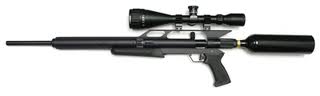 It's called the "Condor" and it's made in America by an American manufacturer called "Air Force." (Clever, eh?)
Why is this such an awesome pellet gun? Lots of reasons.
It's a dual power source design. You can either use compressed natural air at up to 3,000 psi, or you can use CO2 "cartridges." The "cartridges" is in quotes because we're not talking about the sort of cartridges you put in a typical pellet gun, the CO2 cartridges are huge, and are used normally to recharge paint ball guns. Obviously there is a huge power difference between CO2 cartridges and the compressed natural air, but CO2 is a nice power source for plinking. Compressed natural air is more for serious shooting.
I love this basic design. The air tank doubles as a shoulder stock, which reduces the weight of the gun by a pound or more. The air flows directly into the breech in the direction of the barrel, doing away with any recoil or airflow turbulence problems. It's got weaver scope mounts and a loooong barrel, which is ideal for accuracy.
But there's more. The "gun" here is really more of a "gun platform" than a "gun." You can swap out the barrel, use alternate power sources and add all sorts of tactical accessories (laser sights, flashlights, scope levels, etc.) easily.
You can purchase all of the common pellet caliber barrels, from .177 to .25. And at 3,000 psi it will send a .25 caliber pellet at over 800fps, delivering over 30 foot pounds of energy at the target as much as 50 yards downfield.
The huge air reservoir allows you to get up to 100 shots in the "sweet zone" of the power curve. Most PCP airguns get 20 or so shots before you have to top it off again. Plus you can "dial down" the power which still provides more power than most airguns but can then last up to 200 shots before falling off the bottom edge of the power curve.
The gun itself costs about $650. Additional barrels and accessories would push that up to $1,000 or so. But man, oh man, what a pellet gun you would end up with...
Yeah, the Maserati of pellet guns. I really want one. :)
 I should do this.