For the third time since I moved to Colorado our state is in the national news due to a lunatic (or lunatics) with guns and captive targets. First was the Columbine shooting, then the Platte Canyon shooting (which my son was in school just a short distance from the shooting) and now this.
There will be political grandstanding, exploitation of the event for campaign purposes and renewed screeching for gun control.
I don't remember if I've ever been in that theater, but since we used to live in Aurora and it's just right next to the Aurora Mall where we shopped regularly, I would bet I have been in that theater before, unless it was built after we moved. Anyway I've spent a good bit of time in that area and lived just a few miles south of the mall and theater for about five years before moving into the mountains.
In this case the shooter surrendered and is in custody. Maybe that will allow us to shed some light on what was going on in his twisted mind.
But I doubt it. In the end I can't help but think that crazy is just crazy.
I had posted a month or so ago that I had an idea for a superior pellet gun design.
Well, I've refined that design and I now believe that if the design could be turned into an actual working pellet gun, it would be the most accurate, most flexible and most powerful pellet gun on the market. Basically my design focuses on removing as many variables from the pellet firing process as possible. In fact I believe it has essentially removed every possible variable, allowing a series of shots of virtually identical power, meaning virtually identical muzzle velocity.
Every pellet gun on the market today has serious issues with variable factors in the pellet firing process. The current design which virtually every gun follows uses a heavy hammer which smashes down on a spring-loaded valve, which quite literally bangs open the valve for a split second allowing gas to escape while the valve is open before the spring and air pressure inside the tank close the valve again.
Even pump action pellet guns use a similar hammer striking a valve approach.
There are multiple problems with this approach.
1. The hammer itself suffers from a variety of mechanical effects which cause its striking force to be variable. Those include friction, position of the gun, spring exhaustion and alignment. Thus while the hammer generally hits with a fairly predictable force, the actual force has been measured to vary by as much as 10% even in high quality guns.
2. The valve has two forces which oppose the hammer, the spring and the air pressure inside the tank. This creates a quite complex curve when you look at how long the valve is open, how much air is expelled from the tank, and how quickly and smoothly the air is expelled. The result is typically a "bell curve" distribution of actual pellet-expelling force. This is because as you reach the maximum capacity of the tank, the air pressure inside the tank can actually overcome the ability of the hammer to open the valve. This is called "valve locking", and it's a real problem with PCP guns, especially as the hammer suffers spring fatigue or friction issues which reduce it's force. A valve-locked gun simply doesn't fire. However, it's not a binary situation. The valve itself if usually a modified "poppet valve" which has a "T" shaped hole in the valve so that when the valve is pushed below a seal, the upper branch of the "T" is exposed to the air in the container which rushes out, powering the pellet. When "valve lock" occurs the hammer simply doesn't push the "T" down far enough to allow any air to escape. But if the valve is pushed down far enough for a portion of the valve hole to be exposed, then SOME air escapes, but it is a constrained flow, which increases turbulence and decreases air efficiency. The end result is that even with higher pressure in the tank, there is less force on the actual pellet. As the air is expelled, the top of the "T" is forced further and further down into the tank, allowing more efficient air exhaust which increases the power until you hit maximum efficiency for the tank, at which point the pellet's muzzle velocity will be at its highest.
3. From that point on each shot reduces air pressure, reducing efficiency and pellet velocity declines. The reason current PCP designs work reliably at all is because you can exploit this bell curve and get up to a couple dozen shots within a reasonable variation of muzzle velocity such that the point of impact does not move much up to reasonable shooting distances. But it does move.
4. As the air pressure in the tank declines, the hammer knocks the valve down further into the tank, leaving the top of the "T" exposed to allow more air to flow for a longer period of time simply because it travels farther. This is true until the valve reaches the limit that the spring will allow, by which time the gun is usually no longer shooting accurately anyway. Fortunately this effect actually increases the right side of the bell curve described above. There is less air pressure in the tank, but the valve is open longer, providing a larger volume of air which provides more thrust to the pellet, resulting in more shots in the usable zone of the bell curve.
Anyway, my design pretty much does away with all of that. The design essentially provides exactly the same air pressure and air volume for every shot until the air reservoir no longer has enough air to power the gun. There is no "bell curve" of performance, it's a theoretical straight line from the first to the last shot.
If I could build this gun and it would perform as I expect it to, I could easily sell them for $6,000 each.
Man... I must be getting old. I don't remember getting our last house ready to sell being anything like this nightmare.
So we've spent the majority of our last week's worth of free time just trying to clear out the house so that it looks halfway like a house someone would want to move into. The advice on house selling seems to be "empty every possible thing out of the house until you barely have a chair to squat in or a pot to pee in."
So, in that vein I've been trying to clear out my office/workroom. It's not going so well. So far I have packed up seven medium boxes (medium basically being boxes about 15"x15"x15" or so). I've packed up most of my tools, supplies, terrain, miscellaneous stuff and anything else that will fit in a box that size without falling out the bottom when you move it.
And the room is still full of stuff. It's like stuff is breeding in the room while I try to clean it out. I still have all of my miniatures in their foam trays, hundreds, probably thousands of blocks cast from hydrostone, two bookshelves full of books, a bunch of airplane models, plus too much else to describe. I have decided that what I need is a dump truck.
And that's just ONE ROOM. The Cosmic Wife is working on the kitchen and has emptied out every crevice, nook and cranny and put back only what is deemed "necessary" so there are more boxes full of kitchen stuff that we desperately needed at one time, but now can "live without" as we try to sell the house.
Now I need to rent a storage unit to hold all this stuff while we try to fix the house up enough to sell it. We've got to fix the walls up, probably paint most rooms, clean carpets, etc.
And we are doing all of this so that we have the rare privilege of selling the house for 3/4 of what we paid for it. Or maybe even closer to 2/3 of what we paid for it.
It is almost certain that for us to sell the house we will have to actually bring cash to the table, essentially PAYING someone to take the house off our hands.
Man... And then we will have to move into our new house, a house that will likely have far less room to store stuff. In the end I'd guess that 3/4 of the stuff we put into storage will eventually get donated to Goodwill or thrown in a landfill.
That is all assuming that even if we bring several thousand dollars of our own money to the table we actually CAN sell it. There is no guarantee.
If it wouldn't wreck our credit for years and potentially open me up for being sued, I would probably just empty the whole house, toss the keys in the driveway and drive away...
Well, not quite yet.
But, I am dropping my model 41p Remington Targetmaster rifle off at a gunsmith today to tap the barrel for bolt holes to allow me to attach a scope.
I took it out shooting a couple of times and at 40 yards using the iron sights my old eyes just can't do what they used to do. I was able to put 17 of 18 shots within 3 inches of the center, but that's really not very good. You couldn't reliably kill squirrels with that sort of accuracy.
It's really sort of sad. I remember shooting 40 yards or more at squirrels and nailing them just about every time with this gun. It's not the gun. It's my eyes. I just can't focus with the iron sights like I used to. Even with my glasses I can't hold the sight on target.
I think I know why too. And it is definitely age related.
I used to be able to focus my eyes very precisely. Using iron sights on a rifle you have to be able to keep the front sight and the target in focus at the same time, or at least quickly adjust your focus from one to the other. I can't do that anymore. Now if I'm focused on the target, even with my glasses the front sight is a little blurry. If I focus on the front sight, the target is blurry. And if I try to focus on the front sight and then quickly focus on the target, by the time I refocus, the gun has shifted slightly.
I did some online research into shooting and age and this appears to be a relatively common thing that happens when shooters get into their forties and fifties. I see a whole lot of posts about shooters getting scopes for this reason.
That's because scopes focus both the target and the reticle in the same optical plane by design. That way you can keep a crisp view of the crosshairs superimposed on a crisp view of the target. Which I just can't do anymore with the iron sights.
So, off to the gunsmith. I dunno how long it will be before I get it back. I'm not going to buy an expensive scope, just about any scope will do I think. I'll probably end up spending less on the .22 scope, including the tapping of the barrel, than I spent on my Condor scope (which was $150 or so).
Man, this getting old sucks.
So, with all my concentration on high pressure air compression, specifically to get to 3,000 psi in the quickest way possible, I suppose it was only a matter of time before I casually wondered at what ocean depth 3,000 psi would be felt.
So on my way in to work this morning, while sitting at a traffic light, I tried to guesstimate the depth.
It's pretty straightforward, but doing so while driving reduces your resources to pretty much just your own brain.
So I started with the basics. Water is fairly difficult to compress. For all practical purposes you can consider water to be incompressible, meaning that density of water at depth is the same as the density at sea level. Also, the pressure of water at depth, just like air pressure on the surface of the earth, is essentially just the weight of all the water or air stacked up to the surface of the water or edge of space. That means if you took a column of air one square inch but extending upwards 400 miles or so, you'd have 14.7 pounds of air.
So what I had to figure out is how high a column of water one square inch in cross-section would need to be to weigh 3,000 pounds. That simple.
So, how high does a 1 sq inch column have to be? Well, I knew that one cubic centimeter of water weighs one gram, but I don't have any English weights and measures memorized, not reliably. I thought a gallon of water weighed about eight pounds, but I wasn't sure of that. So I had to convert cubic centimeters into cubic inches, then convert kilograms into pounds...
I came up with a depth of around 6,200 feet. The actual value is about 6,700 feet. So my traffic light guesstimate was well within 10% of the actual value. Not too bad for a two minute in the head calculation. (Actual error was almost exactly 7.5% error...)
... always amazes me.
I've been continuing my descent into the minutia of the engineering and technical details of pellet guns and the assorted peripherals and paraphernalia associated with the hobby.
One of the things I have been digging into is the whole concept of air pressure regulators. If you have extreme high pressure air in a bottle, you might think that it would require a highly complex system to deliver air at, say, ambient air pressure.
But that's not the case. In fact it's pretty simple. The first air regulators were created back in the eighteenth century, right after the first industrial air compressors were created. Originally created to deliver air to miners underground, they were quickly adapted to underwater breathing. In fact the initial design of air pressure regulators was so simple and so effective that they remained essentially unchanged until Jacques Cousteau revolutionized underwater exploration with his "self-contained underwater breathing apparatus" which we now know as "scuba gear." Even then Cousteau's modifications were relatively trivial and may even have been accomplished before Cousteau by a contemporary of Cousteau's who was, unfortunately, killed in WWII.
So how does a regulator work? The simplest design is called a "one-stage regulator" and it essentially is nothing more than a small air reservoir attached directly to the high pressure air tank with a diaphragm on one side. The diaphragm is spring-loaded and is attached to a "poppet valve" which opens when the diaphragm is pushed TOWARD the high pressure tank, and closes when the diaphragm moves AWAY from the high pressure tank. A screw on the spring allows you to increase or decrease the load on the diaphragm so that more or less air enters the reservoir from the high pressure tank. A pressure gauge in the small reservoir tells you how much pressure it holds. Once you set the pressure using the screw, if you pull air out of the reservoir, the poppet valve will open, allowing more air from the high pressure tank, which will close the poppet valve.
It's sheer brilliance really. And dirt simple. And highly reliable to boot.
If you need even more precision in your air pressure you can use a "two-stage regulator" which essentially creates two separate reservoirs so that the air pressure in the second reservoir does not jump up and down so much as the high pressure air enters the first reservoir. You can design this such that the "screw" is actually replaced with an ambient pressure device so that as you increase or decrease the external pressure, the regulated pressure automatically matches the outside pressure. This is the innovation that Cousteau added, and is why you can breathe at any depth using scuba tanks. The tanks deliver air at the ambient pressure, meaning that the deeper you dive, the higher pressure the air you breathe is. This is great until you reach the point that the pressure causes nitrogen to dissolve in your blood, but that's a whole different discussion.
So, something so simple should be cheap right? Well, I suppose technically they are "cheap". A regulator to control air pressure output on a high pressure tank costs about $120 or so, which isn't that much. But after seeing how they are made, I can't help but think that's a lot of money for a valve, a diaphram, a spring and a screw....
Here's a picture of a single stage regulator:
Seriously, I am sometimes amazed by how clever humans are.
The latest installment of the Scrat-based franchise. Each movie the little prehistoric squirrel-rat takes on a more prominent role in his slapstick one-offs which have no actual tie in to the alleged story. The fact that Scrat keeps getting more movie play is probably due to the inability of the writers to come up with more material to flesh out the supposed story behind the movie.
I suppose the movie is supposed to be about a father-daughter relationship as the daughter grows up and the father has to let go. But if so, it's just about as evolved in concept as Scrat himself.
This is no "Father of the Bride". The movie attempts to become some sort of action-adventure farce with oblique and bizarre Odyssey references as Manny, the father mammoth portrayed by Ray Romano, along with his saber-toothed and tree-sloth friends Diago and Sid, attempt to re-unite with Manny's wife and daughter who have been left behind after some sort of inexplicable earth-shattering (literally) catastrophe causes the continents to break apart and sail around like flotsam in a whirlpool.
The scatalogical humor flies (again, literally) as farts, regurgitation, body odor and mucus provide most of what passes for humor.
I suppose I should say that the animation is pretty good, but the 3D effects are laughably overdone, with slimy noses shoved into the audience, along with smelly butts and anything with a sharp point. It's as if a bunch of middle school boys discovered 3D technology and made a movie with it.
There's really nothing good to say about the movie. The story is lame, and even what story there is makes no sense, and even if it did make sense, it is constantly interrupted by the nonsensical adventures of the apparently invulnerable and immortal Scrat.
Every joke was telegraphed light-years ahead of the exaggerated and predictable delivery. Every emotional moment was trotted out on schedule and with exactly the end result you would expect in a cartoon episode. Every stereotype and trope is played to the hilt.
I can't even recommend this movie as a DVD rental. I suppose it might show up for free one day and if you have pre-teen kids who still think farting is the most hilarious thing they ever heard of, you might plop them down in front of the TV while you find something better to do.
Cosmic says, don't waste your time or money.
No, this isn't a political post. This is another pellet gun post. :)
Now that I have joined the ranks of PCP ("Pre-Charged Pneumatic") pellet gun enthusiasts (and I am enthusiastic), I am learning that there are three main costs to this hobby. The first is, obviously, the gun. The second is the pellets. The third is the air itself.
There's no such thing as free high-pressure air. I know that's hard to believe, but while we may be figuratively swimming in free air 24 hours a day, unfortunately all of that air is at around 14-15 pounds per square inch, which will send a pellet at exactly zero feet per second. The air that you need to use a PCP pellet gun is air at 2,000 - 3,000 pounds per square inch. You can't find air at that pressure just laying around.
In fact, prior to the rise of the paint ball gun industry the only real place to find air compressed to up to 3,000 psi was in SCUBA tanks. While there were a few high pressure air pellet guns (and in fact, high pressure air guns have been in existence for several hundred years), there was no real consumer market for them. The creation of the paint ball (or "airsoft") industry changed all that. Paint ball guns became so popular that stores started popping up all over the place. It wasn't long before some players realized that they could use SCUBA tanks to extend their game play. It wasn't long after that before someone realized they could store air in tanks up to 4,500 psi and regulate the output for consistent shots for hours before having to refill their guns.
So now there are two places you can get high pressure air, SCUBA shops and paint ball gun shops. (Actually there are three, many fire departments have high pressure air compressors to fill their "scba" tanks, which are air breathing tanks that are not designed for underwater use but are designed to allow firefighters to breathe in the midst of a smoke-filled building. But it is considered poor form to go to a firehouse and beg for free air. However, if you ARE a firefighter, you might have a leg up on this hobby.)
Or, of course, you can buy a hand pump and pump your own high pressure air up to 3,600 psi (there may be hand pumps that will pump higher, but I haven't seen one). And just in the past few months a product has come available that is specifically designed to pump high pressure air for paint ball or PCP airgun purposes.
All of these have costs though. And all of them have their advantages and disadvantages. One way to compare the different options is to measure it in terms of cost per gun tank refill.
My hand pump cost $200. Until it wears out (and it will, according to the online folks who would know) then every time I use it, my cost per refill will go down. So far I've refilled my tank three times. So right now my cost per refill is $66. That's a lot. But let's say that I really get into the sport and I shoot enough that I need to refill a tank about twice per week, or 100 times per year. That means in a year refilling the tank will cost $2 per refill. That's pretty cheap.
A SCUBA tank costs about $250 (including regulator and valves). A refill of a SCUBA tank costs about $15. According to what I've seen online, a typical SCUBA tank will fill about 20 airgun tanks before the SCUBA tank needs a refill itself. Sticking with the same 100 refills per year, that means refilling the SCUBA tank itself 5 times, so a total cost of $325. That means a tank refill cost of $3.25.
Finally there is the "Shoebox Air Compressor" which is a product that you can use to fill tanks yourself. Ignoring the cost of the electricity involved, the product costs $550, but there's a catch. The compressor requires compressed air to work, so you need 80 PSI air input before you can reach 3,000 psi output. So you have to have some means of providing the incoming 80 PSI. The cheapest way to do that is to have a SCUBA tank which you use to deliver 80 PSI regulated air. So taht's another $250. So total of $800. Or $8 per tank refill.
Compare that to the $3-$5 cost of a tank refill if you go to a paintball store and have them use their compressed air to do it.
Now, those are all a one-year cost. The costs change considerably if you participate in the hobby for multiple years. For a five year comparison the prices of each option approach a steady state of about $1 per refill. That's because you'll have to replace or rebuild your hand pump since they wear out, you'll have to recertify or replace SCUBA tanks and you'll have to do maintenance on your shoebox air compressor. The hand pump will always be the cheapest, but eventually it becomes a matter of maybe $.25 difference per refill.
At that point the question becomes "what is more convenient?" Well, it's pretty obvious that the least convenient way to do it is to use the hand pump. Even just topping off the tank after shooting 20 or 30 times is a chore. It took me 50 pumps to restore the tank to full status after shooting fifteen pellets. So on average it's about three pumps per shot. If you are shooting A LOT, then you'll be doing a lot of pumping.
It's not exactly clear which of the remaining approaches are more convenient. The SCUBA tank approach allows you to take the SCUBA tank to a shooting location and refill from the back of your car or truck. The "shoebox air compressor" needs electricity, so it's very convenient at home, but not very convenient on the range. Plus the air compressor takes up to an hour to refill a tank while you can refill a gun tank from a full SCUBA tank in about fifteen seconds.
So... most serious shooters are moving to a combination of the SCUBA tank AND the shoebox air compressor. Meaning they buy TWO SCUBA tanks, one to use as a regulated 80 psi input for the compressor, and one to fill up and carry to the shooting location for refills. So that's basically a $1,000 initial investment.
So... The question is whether there might be a market for some device which is cheaper than any of the existing options PLUS is portable and battery operated. If you could design and produce such a device at a $500 price point, PCP and Paintball gun owners would be beating a path to your door.
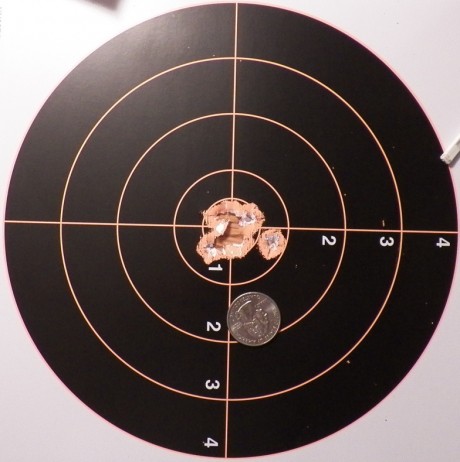
OK, so I have "group" in quotes because I was actually still playing with the scope elevation and windage settings while shooting this.
This is eight pellets. On one pellet I twitched as I pulled the trigger. Well, I probably twitched on all of them, but I twitched enough that I noticed it. That is the "outlier" pellet in the group.
Group size is measured center-to-center so the size of a group is defined as the largest distance between any two pellets' centers. In this case, measuring with the outlier pellet, it's a 1 1/8" group. Measuring without the outlier it's a 7/8" group.
In general a 1" group is considered "lethal". Not great or awesome or anything to really brag about, but "lethal" is good enough for me.
Now, I do think that my next group will be tighter since my last couple of shots in this group were right in the same spot, and right on the center crosshairs. So While I 'sighted it in" roughly on Thursday night, now I've "dialed it in" and feel that at least at 25 yards, I can hit pretty much anything I need to.
Of course now I have to pump up the tank again.... sigh.
A tiny amendment buried in the federal transportation bill to be signed today by President Barack Obama will put operators of roll-your-own cigarette operations in Las Vegas and nationwide out of business at midnight.
Robert Weissen, with his brothers and other partners, own nine Sin City Cigarette Factory locations in Southern Nevada, including six in Las Vegas, and one in Hawaii. He said when the bill is signed their only choice is to turn off their 20 RYO Filling Station machines and lay off more than 40 employees.
There is a morality tale here. This is classic power politics. Track this back through the process and you'll find the fingers of cigarette manufactures all over this.
Now, it is a little known fact that I, Cosmic, used to be a smoker. And at first I used to smoke "Marlboro's". But anyone who knows me knows how I deal with hobbies. Soon, after falling in love with books written by Louis L'Amour, I found myself intrigued by a scene in one of L'Amour's books where the protagonist rolled his own cigarette with one hand, while holding a gun on the villain as I recall...
That seemed to be a very practical skill to me for some reason. So I began buying chopped tobacco and "Zig-Zag" cigarette papers. Back then you could buy "Zig-Zag" papers anywhere. Even if you were 15 or 16 years old, which I was at the time.
So I learned how to roll my own cigarettes. And, yes, eventually I did master the "one-handed rolling" technique. It's not really that hard. At the highwater mark of my cigarette rolling career, my cigarettes were as round and firm and regular as any commercially purchased cigarette.
One trick was to use a piece of paper (usually a dollar bill) to tighten up the roll for a near-perfect cigarette.
I didn't smoke long. Maybe not even a year. And I haven't rolled a cigarette since. I suspect I could still do it, it's not hard.
Something about me always regrets not using a skill I once mastered... So even though I don't smoke now, I still find myself wanting to roll up a cigarette from time to time just to see if I can still do it.
 Seriously, I am sometimes amazed by how clever humans are.